He Was Bullied, Shy, And Had No Confidence — He Became One Of The Toughest Action Legends The World Has Ever Seen

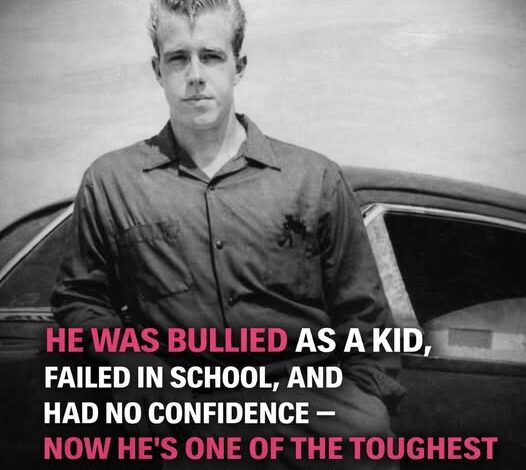
Chuck Norris entered the world with almost none of the qualities people later projected onto him. Long before the legend, the martial arts champion, the action star, or the cultural myth built around impossible toughness, he was simply a quiet, insecure boy growing up inside instability — the kind of child who learned early how to stay unnoticed because attention often brought pain.
He was born Carlos Ray Norris in 1940 during a period when survival itself consumed most working-class families. Money was scarce. Security was fragile. Home rarely felt peaceful for long. His father struggled with alcoholism, drifting in and out of reliability until eventually becoming more absence than stability. For a young boy, that kind of environment leaves invisible marks. Children raised around addiction often become experts at emotional caution before they fully understand what fear even is. They learn to read moods quickly. Stay quiet. Avoid conflict. Shrink themselves emotionally to keep chaos manageable.
Norris later spoke openly about how painfully shy he was growing up.
Not reserved in the charming sense.
Invisible.
The kind of child bullies instinctively target because insecurity radiates outward even when no words are spoken. He drifted through school uncertain of himself physically, socially, emotionally. He didn’t possess the confidence people now associate with his image. In fact, much of his early life was defined by the absence of confidence altogether.
And perhaps that is what makes his later transformation so compelling.
Because Chuck Norris was not born fearless.
He became disciplined.
There’s a difference.
When his parents separated, the family relocated to California searching for some version of stability. But changing geography does not automatically heal emotional emptiness. Norris carried his insecurity with him. He graduated high school still directionless, uncertain who he was or what he was capable of becoming.
That feeling — drifting through early adulthood without identity — is more common than most people admit.
Some people inherit purpose naturally through supportive families, financial opportunity, or strong self-belief. Others spend years simply trying to survive emotional confusion quietly enough that nobody notices they feel lost.
Norris belonged to the second category.
Joining the Air Force initially was less about patriotic destiny than practical necessity. He needed structure because life had offered very little of it so far. The military gave him movement, routine, and escape from stagnation. But it was his deployment to South Korea that truly altered the trajectory of his existence.
Because South Korea gave him something America never had:
a mirror showing him who he might become instead of who he had been taught to believe he already was.
There he encountered Tang Soo Do.
At first glance, martial arts can appear entirely physical:
kicks,
punches,
combat,
competition.
But for many practitioners, especially those carrying insecurity or emotional instability, martial arts become something deeper:
structure.
Identity.
Self-respect.
For Norris, Tang Soo Do represented order entering internal chaos for the first time.
Inside training halls, discipline mattered more than charisma. Consistency mattered more than popularity. Progress came through repetition, humility, patience, and self-control rather than natural social confidence. Martial arts offered him something revolutionary:
earned belief in himself.
That transformation did not happen overnight.
He trained relentlessly, absorbing not only physical technique but the philosophy underneath it — respect, focus, restraint, perseverance. Slowly, the shy boy who once avoided confrontation began standing differently. Speaking differently. Carrying himself differently.
Confidence built through discipline tends to root itself more deeply than confidence built through praise alone.
And once Norris discovered that inner foundation, everything else began changing around it.
After returning to the United States, he opened martial arts schools and quickly established himself within competitive fighting circles. Tournament victories followed. Championships accumulated. He developed a reputation not only for physical skill but for intensity and precision. In another life, perhaps that would have remained enough — respected martial artist, successful instructor, disciplined competitor.
But Hollywood eventually found him.
And once again, transformation followed opportunity.
His friendship and later onscreen rivalry with Bruce Lee introduced him to cinema at precisely the right cultural moment. Lee recognized something useful in Norris immediately:
authenticity.
Unlike many actors pretending to understand martial arts, Norris carried real-world discipline audiences could feel instinctively even before he spoke. Their legendary fight scene in Return of the Dragon became iconic partly because it represented two genuine martial artists bringing physical credibility onto screen simultaneously.
That role changed everything.
Suddenly, the insecure boy who once felt invisible stood opposite one of the most electrifying performers in film history — and held his own.
Hollywood noticed.
Throughout the 1970s and 1980s, Norris evolved into one of action cinema’s defining figures. Yet what separated him from many contemporaries was his emotional stillness. Other action stars relied heavily on swagger, humor, or spectacle. Norris projected something quieter:
control.
His characters rarely felt chaotic or reckless. They felt disciplined. Measured. Capable of violence without being consumed by it. That persona connected deeply with audiences because it reflected the actual philosophy shaping him beneath the performance.
Then came Walker, Texas Ranger.
For an entire generation, the role cemented Chuck Norris not merely as an action hero but as a cultural archetype: the stoic protector, morally grounded, physically formidable, emotionally restrained. The show amplified his image into near-mythic territory over time. Eventually internet culture transformed him into something even stranger — a walking symbol of exaggerated invincibility through jokes, memes, and absurd “Chuck Norris facts.”
But behind all that mythology remained the real story:
a deeply insecure child who once struggled simply to believe he mattered.
That contrast matters.
Because society often misunderstands toughness entirely.
People imagine strength as something natural — an inherited trait possessed effortlessly by certain individuals from birth. But many truly resilient people emerge from vulnerability, humiliation, fear, and emotional instability. They become strong not because life was easy, but because weakness once hurt them badly enough to demand transformation.
Chuck Norris understood that intimately.
Martial arts did not merely teach him how to fight.
They taught him how to exist inside himself differently.
And perhaps that explains why his story continues resonating far beyond action movies or celebrity nostalgia. Underneath the fame sits something universally human:
the possibility that identity is not fixed permanently by painful beginnings.
A shy boy can become confident.
A directionless teenager can discover purpose.
Someone raised inside instability can still build discipline strong enough to reshape an entire life.
Norris carried that lesson with him through tournaments, film sets, television fame, and eventually into cultural legend. Yet despite the larger-than-life image built around him, the emotional core of his journey remained surprisingly quiet:
a man spending decades transforming childhood fear into self-mastery.
Not through magic.
Not through instant success.
Through discipline repeated daily until insecurity slowly lost its grip.
That is why his story endures.
Not because he played tough men onscreen.
But because beneath the mythology, Chuck Norris represents something people desperately want to believe is true:
that even the softest beginnings can forge extraordinary strength if someone refuses to stay broken by where they started.