I Adopted a 3-Year-Old Girl After a Tragic Crash—13 Years Later, My Girlfriend Tried to Turn Me Against Her


Thirteen years ago, during what should have been just another exhausting overnight shift in the emergency room, I met a little girl whose entire life had collapsed in a single instant.
She was only three years old.
One moment she had parents, a home, a future that still made sense. The next, she had fluorescent hospital lights, strangers speaking softly around her, and the hollow silence that follows tragedy when no one knows what to say anymore. The accident that took her parents happened suddenly, violently, without giving anyone time to prepare for the aftermath.
What struck me first was not how loudly she cried.
It was that she barely cried at all.
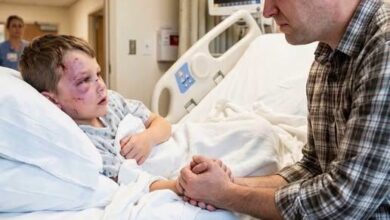
She sat motionless on the hospital bed, staring at nothing in particular while machines beeped steadily around her as though the world itself had not noticed hers had ended. Most children her age reacted to fear with noise or panic. She reacted with stillness. The kind of stillness that feels unnatural in someone so small.
When I first walked into the room, I expected confusion. Fear. Maybe screaming.
Instead, she reached for my wrist with both hands and held on so tightly it startled me.
She didn’t ask questions.
She didn’t speak.
She simply held on like letting go might cause everything else around her to disappear too.
And somehow, in that tiny silent moment, something inside me shifted permanently.
Not dramatically.
Not like a lightning strike or revelation.
More like a quiet door closing behind me before I realized I had already walked through it.
At first, I told myself I was simply being thorough.
I checked on her more often than necessary.
Adjusted blankets that didn’t need adjusting.
Stayed in her room longer than hospital protocol required.
I kept inventing reasons to return:
checking vitals,
reviewing charts,
monitoring emotional stability.
But the truth was simpler.
I couldn’t stop thinking about her.
Social workers arrived.
Paperwork began.
Temporary placement discussions happened in careful voices just outside her room.
And every time someone mentioned “relocation” or “placement,” something inside me tightened painfully.
She started recognizing me before she spoke much again.
Then one afternoon, while I sat beside her drawing absentminded circles on a coloring page she wasn’t using, she quietly said my name.
That was the moment everything became irreversible.
After that, I stopped pretending emotional distance still existed between us.
Days turned into weeks.
Weeks became months.
The foster evaluation process started formally, though nothing about it felt formal emotionally anymore. She wasn’t a patient to me. She wasn’t paperwork. She wasn’t even a responsibility in the ordinary sense.
She was a frightened little girl who woke up crying from nightmares she couldn’t explain. A child who flinched at sudden noises. Someone who looked relieved every time she confirmed I had returned to the room instead of disappearing like everyone else already had.
The idea of sending her into another unfamiliar home with strangers felt unbearable in a way I could no longer rationalize away professionally.
So eventually, I stopped trying.
People asked me constantly if I understood what I was doing.
Some asked kindly.
Others didn’t.
“You’re a doctor. You work impossible hours.”
“You’re single.”
“Do you really think this is realistic?”
I never had a perfect answer.
I still don’t.
All I knew was that every instinct inside me resisted letting her disappear into another temporary place where she would once again have to learn entirely new faces, new rules, new fears.
So I applied to adopt her.
The process consumed my life.
Home inspections.
Interviews.
Financial evaluations.
Psychological assessments.
Everything about it felt surreal because during the day I still worked emergency medicine while at night I learned how to become someone’s father.
The adoption became official on a gray Tuesday morning inside a quiet courtroom.
I remember sitting there barely breathing while the judge reviewed documents and asked procedural questions in a voice that sounded almost casual considering my entire future depended on them.
Then finally:
“She is legally your daughter.”
I looked over at the tiny girl sitting beside me swinging her feet nervously beneath the chair.
And suddenly nothing about my life belonged solely to me anymore.
I named her Avery.
Not because the name carried some grand meaning, but because it felt open. Unfinished in the best possible way. A name that gave her room to become whoever she needed to become without forever defining her through loss.
The early years were harder than people like to admit.
Trauma does not disappear because someone receives love.
Healing is not linear.
Safety does not arrive instantly.
There were nights Avery woke up screaming without understanding why. Mornings where she refused to speak entirely. Certain sounds—sirens, slammed doors, footsteps approaching too quickly—could still pull her backward emotionally into panic she couldn’t fully explain.
And there were moments I failed her too.
Times I misunderstood silence for stubbornness.
Times exhaustion made me impatient.
Times I forgot that children surviving trauma often react to fear long before they understand it consciously.
But alongside those difficult moments came smaller ones that mattered even more.
The first time she laughed fully without checking the room first.
The first time she fell asleep on the couch without worrying I might leave while she slept.
The first time she called me “Dad” accidentally, froze in horror, then whispered it again carefully like testing whether the word belonged to her now.
It did.
Over the years, Avery grew into herself quietly.
Not loudly confident.
Not dramatic.
Just steady.
Her kindness became the thing everyone noticed first. She paid attention to people in ways most adults don’t. She could detect sadness behind fake smiles almost instantly because she learned early what hidden pain looks like.
And slowly, life stopped revolving entirely around survival.
We built routines.
Shared dinners.
Movie nights.
School projects spread across kitchen tables.
For years, it was just us.
And honestly, I thought that would always be enough.
Then I met Marisa.
At first, everything seemed healthy. She was intelligent, warm, thoughtful in subtle ways. She asked about Avery without sounding performative. She remembered details. She laughed easily.
For a long time, I convinced myself this was simply life expanding naturally.
Not replacing anything.
Not threatening anything.
Just growing.
But relationships rarely fracture dramatically at first.
They shift quietly.
Small comments started appearing regularly.
“You’re very devoted to her.”
“She’s extremely attached to you.”
“You really organize your whole life around her, don’t you?”
Individually, none sounded cruel.
But repeated often enough, they started feeling less like observation and more like criticism disguised as concern.
Still, I ignored it.
Because I wanted peace.
Because I loved Marisa.
Because I believed people could learn each other if given enough patience.
Then came the night everything collapsed.
Marisa arrived unexpectedly carrying her phone in her hand.
Her calmness unsettled me immediately. Not emotional calm—controlled calm. The kind people rehearse beforehand.
“I need you to see something,” she said quietly.
Then she played the video.
Security footage.
A hallway outside my office.
A figure moving carefully near the doorway.
Avery.
Or someone intended to resemble her.
Marisa let the silence do most of the work.
She claimed Avery had entered my office repeatedly. Suggested items were missing. Implied boundaries were being violated.
But while watching, something bothered me instantly.
Not emotionally.
Visually.
The hoodie looked wrong.
Avery owned one nearly identical, but the proportions were off. The shoulders sat differently. The sleeves folded incorrectly near the wrists. Tiny details most people would never notice unless they spent years learning someone’s movements instinctively.
So I asked for the file.
Then I reviewed it frame by frame.
And slowly the truth became obvious.
The timestamps were inconsistent.
The hallway camera angle didn’t match the actual building layout.
Motion continuity had been subtly manipulated.
It wasn’t evidence.
It was construction.
A performance carefully assembled to create implication without proof.
When I finally looked up, Marisa already knew I understood.
At first she tried reframing it.
“I was trying to protect you.”
“You’re too emotionally involved to see clearly.”
“She depends on you too much.”
But the longer she spoke, the more visible the real emotion underneath became.
Resentment.
Not just toward Avery—
toward what Avery represented.
A love she couldn’t compete with.
A bond existing beyond approval or control.
A relationship formed through survival and choice rather than convenience.
And instead of trying to understand that bond, she tried to fracture it.
That was the moment clarity arrived completely.
Not anger.
Not confusion.
Certainty.
I told her to leave.
Quietly.
Firmly.
No yelling.
No dramatic scene.
Just finality.
After she walked out, the house became silent again.
But not empty.
Relieved.
Avery stood near the hallway the entire time watching everything unfold without interrupting once. She looked frozen, like she was waiting to learn whether this situation would somehow determine her place in my life all over again.
I sat beside her carefully.
Not across from her.
Not standing above her.
Beside her.
And I told her exactly what she needed to hear.
That she did not need to compete for space in my life.
That trust was already hers.
That nothing she could do would make her less my daughter.
And that no one—not anyone—would ever get to rewrite her place in this family through lies or manipulation.
She didn’t cry immediately.
She just nodded slowly like someone testing whether reality still held together properly.
Later that night, she came quietly into the living room and sat beside me without speaking.
After a while, she rested her head against my shoulder exactly the way she used to when she was little and still afraid to fall asleep alone.
And for the first time all evening, I let myself breathe again.
Because some truths become clearer with time:
real love does not weaken under honesty.
Real family does not collapse because someone outside it grows resentful.
And real belonging is not built through biology alone.
It is built through staying.
Through choosing each other repeatedly.
Through protecting each other when it matters.
Through refusing to let fear or manipulation rewrite bonds forged through years of trust.
Avery and I were never temporary.
We were never accidental.
We were built on the quiet promise made years earlier in a hospital room when a frightened little girl grabbed my wrist and refused to let go.
And all these years later, neither of us ever really did.