Did You Know That If Hair Grows On Your Ears It Is Not A Sign Of Illness Or Mystery But A Natural Result Of Aging Hormones Genetics And Time Working Quietly Inside The Human Body Over Many Decades

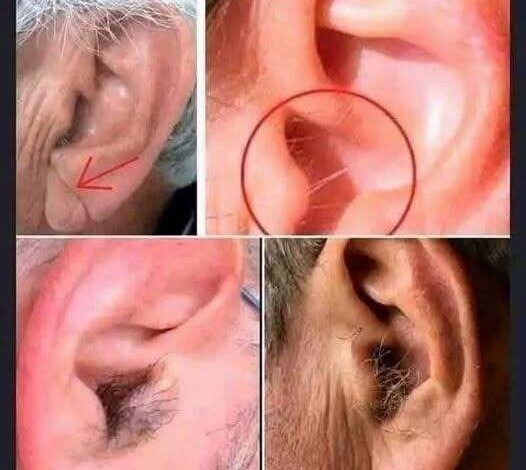
The first time you notice ear hair, it can feel almost personal.
Not because it hurts. Not because it changes your life in any dramatic way. But because it appears quietly, in a place you never thought to check, at a time when your body may already be asking you to accept more than you expected.
Maybe your hairline has started to retreat.
Maybe the hair on your head feels thinner beneath your fingers.
Maybe your face holds more lines than it used to, and certain angles in the mirror catch you by surprise.
Maybe your energy is not the same, your joints complain sooner, your skin feels different, and some mornings you look at your reflection and think, I still feel younger than that.
Then one day, aging adds its strange little punchline.
A hair in your ear.
Then maybe another.
Then maybe one in your nose, bold as if it belongs there, as if it has been waiting years for its chance.
It can feel ridiculous. Annoying. Even embarrassing. You may find yourself wondering how the body can be so unfair—taking hair from the places you want it and sending it to the places you never asked for it. The hair you hoped would stay seems to disappear quietly, while these new, unwanted hairs arrive with complete confidence.
But ear hair is not a failure.
It is not a sign that you have let yourself go.
It is not proof that you are unattractive, unclean, weak, old, or somehow becoming less worthy of being noticed, loved, respected, or desired.
It is simply part of being human.
As we age, the body changes in ways both visible and hidden. Hormones shift. Hair follicles respond differently than they once did. Genetics, which may have been waiting patiently in the background, begin to make themselves known. Some areas grow less hair. Others grow more. Patterns that once felt predictable suddenly change without warning, explanation, or permission.
That does not mean it feels easy.
A small change can carry a much bigger emotional weight than people admit. One stray hair can feel like a symbol. It can seem to whisper that time is moving, that youth is changing shape, that your body is no longer completely under your control. You may notice it while brushing your teeth or washing your face, and suddenly the mirror feels less like glass and more like an announcement.
Here is another sign. Here is another thing you did not choose.
That reaction is understandable.
Aging is not only a physical process. It is emotional. It asks you, again and again, to make peace with a body that has carried you through your entire life, even as that body changes in ways you might not welcome. It asks you to separate confidence from youth, identity from appearance, and self-worth from the tiny details that shift over time.
Ear hair is one of those details people often joke about but rarely speak about gently.
Because of that, it can feel more shameful than it needs to.
But there is no shame in it.
There is no shame in trimming it.
There is no shame in asking a barber, stylist, or someone you trust to help.
There is no shame in making it part of your regular grooming routine.
There is also no shame in leaving it alone.
You are allowed to decide what makes you feel comfortable in your own body. You can use a trimmer. You can check it once a week. You can laugh about it. You can ignore it. You can treat it as a minor inconvenience instead of a personal crisis.
The important thing is that your choice comes from care, not disgust.
You do not have to punish yourself for having a body that ages.
You do not have to stand in front of the mirror and turn every new detail into evidence of decline. You do not have to let one hair become a story about losing yourself. You do not have to look at a normal human change and speak to yourself with cruelty.
Your body is not betraying you.
It is changing.
It is adapting.
It is continuing to do what bodies have always done: protect, adjust, endure, and carry you forward.
Ear hair may even have a practical purpose. Hair around the ears can help catch dust, debris, and tiny particles before they reach more sensitive areas. That does not mean you have to admire it or welcome it with gratitude, but it may help to remember this: your body is not trying to embarrass you. It is not mocking you. It is following an old biological pattern, one written long before you ever stood in front of a mirror worrying about how you looked.
Still, the feelings matter.
Because for many people, ear hair is not really about ear hair. It is about time. It is about watching your body change in small, undeniable ways. It is about realizing that the version of yourself you carry inside may not always match the version other people see from the outside.
That can be painful.
But it can also become an invitation to be kinder to yourself.
You are still you.
You are still the person who has loved, worked, failed, tried again, grieved, laughed, worried, hoped, and carried responsibilities no one else fully saw. You are still the person shaped by countless ordinary days, private battles, quiet victories, and moments of strength you may not even give yourself credit for.
A few hairs do not erase that.
They do not erase your attractiveness.
They do not erase your humor.
They do not erase your wisdom, your tenderness, your dignity, your experience, or the life you have built.
If anything, these small signs of aging are reminders that you have made it this far. You have survived years that were easy and years that nearly broke you. You have adapted before, even when change felt impossible. And now, in this small and oddly specific way, you are adapting again.
So yes, ear hair can be irritating.
It can be awkward.
It can catch you off guard.
It can feel like one more thing to manage.
But it is not a verdict on who you are.
It is not the end of confidence.
It is not a reason to feel ashamed of your reflection.
It is just one small part of living in a body that continues to change.
Trim it if you want. Leave it if you want. Laugh about it if that helps. Keep it private if that feels better. But do not let it convince you that you are lesser than you were.
Aging does not make you less human.
It makes your humanity more visible.
And this, too, is proof that you are still here—still living, still changing, still becoming, and still deserving of kindness from the person looking back at you in the mirror.