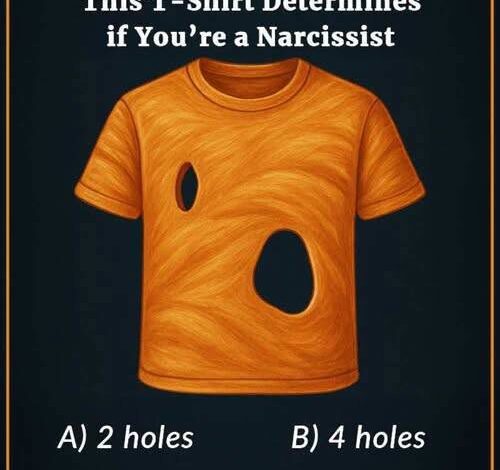
At first glance, it looks like the kind of puzzle a child could solve in seconds.
A picture of a T-shirt.
A simple question:
How many holes are there?
Most people answer almost immediately.
“Two.”
After all, the shirt has two obvious tears in the middle.
But that quick response is exactly what makes the riddle so effective.
It is not testing your eyesight.
It is testing your assumptions.
The moment you slow down and examine the image more carefully, the question begins to change. A T-shirt already has several openings before it is ever damaged. There is the neck opening, two sleeve openings, and the opening at the bottom.
That is four holes before you even consider the tears.
Then come the two visible rips.
If those tears go completely through both the front and back of the shirt—as they often do in this type of puzzle—they count as two additional holes.
Suddenly, the answer becomes six.
The fascinating part is not which answer you choose.
It is why you chose it.
Many people instinctively focus only on the damage because the tears stand out visually. The familiar openings disappear into the background because our brains no longer think of them as “holes.” We see them as normal parts of a shirt rather than openings in the fabric.
That mental shortcut is something we use every day.
Our brains constantly filter information to help us make quick decisions. Without those shortcuts, even simple tasks would become exhausting. But those same habits can also cause us to overlook details hiding in plain sight.
This is why puzzles like this remain so popular.
They remind us that seeing is not always the same as observing.
Two people can look at the exact same image and arrive at completely different answers, each convinced they are correct. Neither person is necessarily careless. They are simply approaching the question from different perspectives.
One person interprets “holes” as accidental damage.
Another interprets “holes” as every opening in the garment.
The puzzle quietly rewards the second interpretation because it asks us to examine the object itself rather than our expectations about it.
In many ways, this tiny riddle reflects something much larger about everyday life.
We often move through the world assuming we already know what we are looking at. We rely on habit, familiarity, and first impressions. Most of the time, those instincts serve us well.
But occasionally, they prevent us from noticing something important.
A conversation.
A relationship.
A problem.
An opportunity.
A detail everyone else missed.
The lesson extends far beyond a torn T-shirt.
Critical thinking often begins by asking one more question than everyone else.
What am I overlooking?
What assumptions am I making?
Is there another way to interpret what I see?
Those simple questions help us become more thoughtful decision-makers, better problem-solvers, and more careful observers.
That is why brainteasers remain surprisingly valuable.
They are not really about finding the correct answer.
They are about training the mind to slow down, look again, and challenge its own automatic conclusions.
Whether you answered two, four, or six, the puzzle has already done its job.
It interrupted your assumptions.
It encouraged you to examine the details.
And it demonstrated that sometimes the greatest obstacle to seeing clearly is not what is in front of us—
It is what we believe we have already seen.
A torn T-shirt may seem like an ordinary object.
Yet for a brief moment, it becomes something far more interesting.
A reminder that careful observation often begins where certainty ends.