It looked like an ordinary tattoo.
Then the internet got involved.
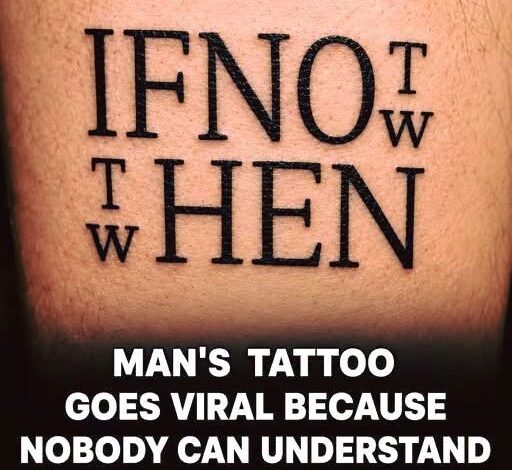
Within hours, a single blurry photograph of a man’s forearm had spread across social media, leaving thousands of people staring at their screens, zooming in, squinting, and debating one simple question:
What does it actually say?
At first glance, the tattoo appeared to contain a short inspirational quote. But the lettering seemed compressed, the spacing uneven, and several words blended together so tightly that even careful inspection offered few clear answers.
The longer people looked, the less certain they became.
What started as a simple image quickly transformed into an online mystery.
Across Facebook, Reddit, X, Instagram, and countless discussion forums, users began dissecting every inch of the tattoo. Some enlarged the image repeatedly. Others adjusted brightness, sharpened the contrast, or isolated individual sections in hopes of revealing hidden letters.
Instead of finding clarity, they found even more confusion.
Every viewer seemed to see something different.
One person believed the first word was obvious.
Another insisted it was completely different.
Some thought they could recognize fragments of familiar phrases, while others concluded the tattoo was nothing more than unreadable script.
The disagreement became part of the entertainment.
With every new interpretation came another theory.
Another debate.
Another attempt to solve what had unexpectedly become one of the internet’s latest visual puzzles.
Ironically, the tattoo had never been intended to confuse anyone.
According to the widely accepted explanation, it was meant to display a motivational quote—a personal reminder encouraging action, courage, and forward movement through life.
Like many inspirational tattoos, its purpose was deeply personal.
It was supposed to inspire the person wearing it every single day.
Unfortunately, the final design didn’t translate as clearly as intended.
The lettering was tightly packed.
Several characters overlapped visually.
The chosen font emphasized style over readability.
Individually, these design choices may have seemed minor.
Together, they transformed a straightforward sentence into something that looked almost impossible to decipher.
Eventually, after countless discussions and comparisons, one interpretation began appearing more consistently than the others.
Most people agreed the tattoo was intended to read:
“If not now, then when.”
It’s a phrase recognized around the world as a reminder to stop postponing important decisions and take action instead of waiting for the “perfect” moment.
The irony wasn’t lost on anyone.
Even after learning the intended message, many viewers still struggled to actually see those words within the tattoo itself.
Knowing the answer didn’t necessarily make the image easier to read.
That contrast became the real story.
The tattoo was no longer simply body art.
It became a fascinating example of how communication can break down when presentation overshadows clarity.
A powerful message had been hidden behind an unfortunate design.
As the image continued circulating online, the conversation gradually shifted beyond the tattoo itself.
People began discussing something much broader.
How often do our intentions fail to match the way others receive them?
Almost everyone has experienced saying one thing and being understood another way.
Writing an email that sounds harsher than intended.
Sending a message that gets misunderstood.
Explaining an idea that seems perfectly clear in your own mind but leaves everyone else confused.
In that sense, the tattoo became surprisingly relatable.
It wasn’t just about ink.
It became a visual metaphor for communication itself.
The internet amplified that lesson even further.
Online, meaning rarely belongs entirely to the person who creates something.
Once an image, photograph, or statement enters public view, thousands of people begin interpreting it through their own experiences, assumptions, humor, and perspectives.
Content evolves.
Conversations branch in unexpected directions.
Sometimes the audience creates an entirely different story than the creator ever intended.
That’s exactly what happened here.
The man who chose the tattoo almost certainly understood its meaning every time he looked at his arm.
But once the photograph reached millions of strangers, the message no longer belonged only to him.
It became a collective puzzle.
A shared joke.
A design lesson.
A conversation about perception.
As the weeks passed, the online frenzy gradually faded.
New topics replaced it.
New viral images appeared.
Yet the tattoo continued resurfacing whenever discussions turned toward typography, design mistakes, or optical illusions.
It had become memorable for reasons completely different from those originally intended.
Graphic designers pointed to it as an example of why readability matters.
Tattoo artists discussed the importance of spacing, font selection, and long-term legibility.
Others simply appreciated it as another reminder that even small design decisions can dramatically change how a message is understood.
Beyond the humor lies a surprisingly meaningful lesson.
Clear intentions do not always produce clear communication.
Whether we’re speaking, writing, designing, or creating art, the message we hope to share isn’t always the one people receive.
Perspective changes everything.
Presentation matters.
Sometimes the smallest details determine whether an idea connects—or becomes confusing.
In the end, the tattoo itself never changed.
The ink remained exactly as it had always been.
What changed was the conversation surrounding it.
What began as a personal reminder evolved into an international discussion about interpretation, design, and the fascinating ways people search for meaning.
Perhaps that’s the greatest irony of all.
The quote was meant to encourage immediate action.
Instead, it inspired thousands of people to stop, stare, debate, and question what they were seeing.
And in doing so, it became far more memorable than anyone could have predicted.
Sometimes the most interesting stories aren’t found in the message itself.
They’re found in the countless different ways people try to understand it.