Strong Earthquake in Venezuela Captured in Dramatic Video, footage as death toll could exceed 10,000

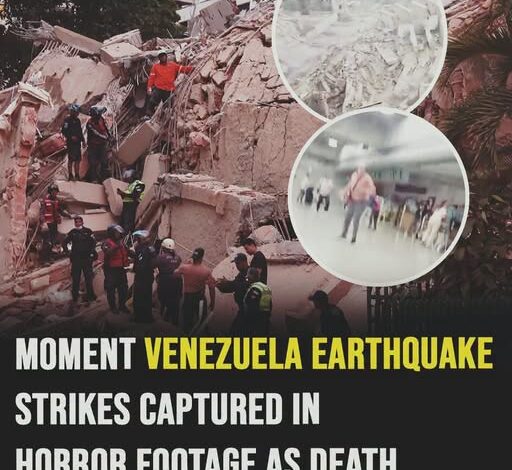
Venezuela’s northern coastline has been thrust into crisis after reports of two powerful earthquakes struck within seconds of one another, sending shockwaves across the country and triggering a large-scale emergency response. According to early geological reports, the tremors measured 7.2 and 7.5 in magnitude and were felt far beyond the epicenter, shaking Caracas as well as numerous coastal communities. The rapid succession of the quakes left residents with virtually no time to react, turning an ordinary day into a desperate race for safety.
Preliminary assessments suggest the earthquakes rank among the most significant seismic events to affect the region in decades. The reported epicenter was located offshore in the Caribbean Sea, near La Guaira and west of the coastal community of Morón. This densely populated area lies close to key transportation routes, residential neighborhoods, and major infrastructure, increasing concern about the scale of the damage.
Because the earthquakes originated just offshore, their effects were felt across both coastal towns and inland cities. Authorities also reported a series of aftershocks following the initial tremors, raising fears that weakened buildings and damaged infrastructure could face additional strain.
Emergency services were mobilized immediately as reports of structural damage began arriving from multiple locations. Buildings, roads, bridges, and public infrastructure sustained varying levels of damage, with older residential and commercial structures appearing especially vulnerable. Rescue teams worked under difficult conditions as debris blocked streets and heavy equipment struggled to reach some of the hardest-hit neighborhoods, forcing many crews to begin searching by hand.
Among the facilities reportedly affected was Simón Bolívar International Airport in La Guaira. Airport operations were temporarily suspended after damage was reported to parts of the terminal and surrounding infrastructure. Officials ordered precautionary evacuations while engineers carried out safety inspections. The airport closure also complicated efforts to coordinate incoming humanitarian assistance, prompting authorities to evaluate alternative routes for emergency aid.
In response to the disaster, Venezuelan officials declared emergency conditions across the most severely affected areas. Rescue operations focused on locating survivors trapped beneath collapsed buildings while emergency shelters were opened in schools, sports complexes, and public buildings to house families forced from unsafe homes. Many residents fled with only essential belongings, uncertain whether their houses would remain standing.
Hospitals and clinics quickly came under intense pressure as medical personnel treated a growing number of injured residents. Doctors, nurses, and emergency responders worked continuously despite power interruptions, damaged facilities, and limited medical supplies. Authorities stressed that casualty figures remained preliminary and would likely change as rescue teams gained access to additional locations.
International assistance also began taking shape as several countries signaled their willingness to support relief efforts. Search-and-rescue specialists, medical teams, and humanitarian organizations prepared to deploy personnel and supplies to assist Venezuelan authorities. Coordinated rescue operations in densely populated urban areas were identified as the immediate priority.
At the same time, restoring essential public services became a major focus. Damage to electrical systems, water networks, and communication infrastructure left thousands of residents without reliable access to basic necessities. Engineers and technical crews began assessing the extent of the destruction while working to restore critical services wherever possible, though officials cautioned that full recovery would require significant time.
Eyewitnesses described scenes of confusion and fear as the earthquakes struck without warning. Residents rushed into streets while buildings swayed violently around them. Emergency alarms sounded across residential complexes and business districts as evacuation procedures were activated. Images shared online showed damaged buildings, cracked roads, clouds of dust, and crowds gathering in open spaces while awaiting official updates.
Authorities have continued warning residents about the possibility of additional aftershocks and urged people to stay away from visibly damaged buildings until structural inspections are complete. Engineers are evaluating bridges, hospitals, schools, transportation corridors, and other critical facilities to determine whether repairs are possible or whether demolition will be necessary.
Although early reports point to extensive destruction, officials continue to emphasize that comprehensive damage assessments are still underway. Final casualty figures, economic losses, and the full extent of the structural damage cannot yet be confirmed. Emergency management agencies say information is being updated continuously as communications improve and previously isolated communities become accessible.
Government leaders have appealed for national unity while requesting continued international cooperation during the response. Their immediate priorities remain rescuing survivors, caring for the injured, providing shelter for displaced families, and delivering food, clean water, medicine, and other essential supplies to the hardest-hit communities.
As rescue efforts continue, attention remains fixed on the affected regions and on the resilience of the people facing this crisis. The coming days are expected to be crucial as emergency crews continue searching damaged buildings, engineers assess infrastructure, and authorities work to build a clearer picture of the disaster’s full impact.
While the earthquakes lasted only moments, the recovery is expected to unfold over months—or longer. For thousands of families, rebuilding homes, restoring communities, and recovering from the emotional and physical toll of the disaster will be a long journey. As more verified information becomes available, the full scope of the event will continue to emerge, guiding both national recovery efforts and international humanitarian support.