The teenager probably thought no one would ever remember what happened in the park.
He had no idea the quiet man sitting beside the pond would be the federal judge deciding his father’s future less than twenty-four hours later.
It was one of those peaceful Sunday mornings that seemed untouched by the rush of everyday life.
Families pushed strollers along winding paths.
Joggers passed beneath towering oak trees.
Children tossed bread to ducks gathered around the edge of the pond.
Arthur Caldwell sat alone on a weathered wooden bench, sipping coffee while enjoying one of the few quiet mornings his schedule allowed.
To everyone around him, he looked like an ordinary retiree.
No one recognized the decorated military veteran.
No one recognized the federal judge whose courtroom handled some of the nation’s most complex criminal cases.
Beside him rested Buster.
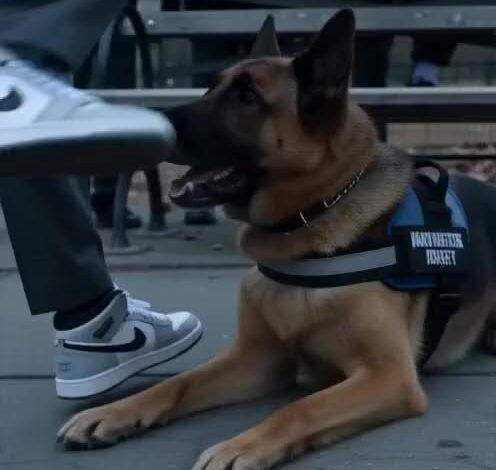
The large German Shepherd lay calmly at Arthur’s feet, wearing a blue service vest that identified him as a trained assistance animal.
For Arthur, Buster was far more than a pet.
After years of military service and combat deployments, returning to civilian life had not been easy.
Long after the uniforms were folded away, invisible wounds remained.
Buster had helped him rebuild routines, manage anxiety, and navigate difficult days that few people ever saw.
They had become inseparable.
Arthur gently scratched behind the dog’s ears while watching ducks glide across the water.
For a while, everything felt peaceful.
Then a group of teenagers wandered through the park.
They laughed loudly, tossed a football between themselves, and paid little attention to anyone around them.
At first.
As they approached Arthur’s bench, one boy slowed.
He looked about sixteen.
Expensive sneakers.
Designer sunglasses.
An air of confidence that bordered on arrogance.
He glanced at Buster.
“What kind of dog is that?”
Arthur smiled politely.
“German Shepherd.”
The teenager smirked.
“Looks lazy.”
Arthur chose not to respond.
The group continued walking.
Then, without warning, the boy turned back.
Before anyone could react, he swung his foot toward the resting dog.
The kick landed against Buster’s side.
The German Shepherd yelped and instinctively backed toward Arthur.
Several nearby families gasped.
Arthur stood immediately.
His military instincts screamed at him to react.
Years of discipline stopped him.
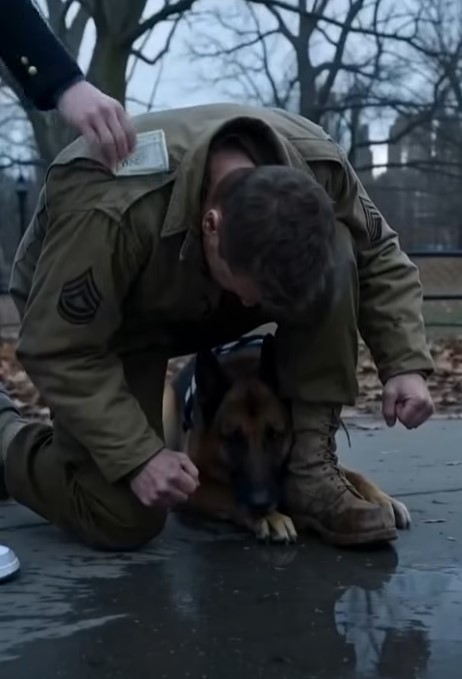
Instead, he knelt beside Buster.
“You okay, buddy?”
The dog leaned against him, trembling slightly.
Arthur looked up just long enough to clearly see the teenager’s face.
The boy laughed.
His friends laughed with him.
Then they disappeared down the walking trail.
Arthur remained where he was, gently examining Buster.
Although the dog appeared shaken, there were no obvious signs of severe injury.
Still, Arthur wasn’t taking chances.
He drove directly to the veterinary clinic.
The examination revealed bruising along Buster’s ribs.
Fortunately, nothing had been broken.
“He’ll recover,” the veterinarian assured him.
“But he’ll be sore for several days.”
Arthur thanked the staff before driving home.
That evening he sat in his office preparing for Monday morning’s federal sentencing hearing.
The case had dominated headlines for months.
Business executive Marcus Vance had been convicted of multiple counts of fraud, bribery, and financial corruption involving millions of dollars.
Arthur opened the sentencing file one final time.
He reviewed victim impact statements.
Financial reports.
Character letters.
Then he reached a section discussing family circumstances.
Several photographs accompanied the defense’s request for leniency.
Arthur stopped turning pages.
He looked closer.
One family photograph included Marcus Vance standing beside his wife…
…and his teenage son.
Arthur stared silently.
It was him.
The boy from the park.
The one who had kicked Buster.
The file identified him as Tyler Vance.
Arthur leaned back in his chair.
The coincidence seemed almost unbelievable.
He continued reading.
The defense described Tyler as respectful.
Compassionate.
Responsible.
A model student.
Community volunteer.
The words contrasted sharply with what Arthur had personally witnessed less than twelve hours earlier.
The following morning, the federal courthouse overflowed with reporters.
The sentencing hearing drew national attention.
Victims filled one side of the courtroom.
Marcus Vance’s supporters occupied the other.
After reviewing financial evidence and victim testimony, the defense began presenting arguments for a reduced sentence.
Attorney Rebecca Sloan addressed the court.
“Your Honor, Mr. Vance remains an extraordinary father.”
She gestured toward Tyler.
“His son represents everything Mr. Vance has worked to build.”
She continued describing Tyler’s excellent character, strong values, and positive future.
Arthur listened carefully.
When she finished, he folded his hands.
“Counsel…”
“There is one matter I believe the Court should address.”
The courtroom fell silent.
Arthur looked toward Tyler.
“Yesterday morning I encountered your son in a public park.”
Marcus turned sharply toward his attorney.
Tyler’s expression changed instantly.
Arthur continued calmly.
“During that encounter, I personally witnessed your son deliberately kick my federally registered service dog while the animal was lying peacefully beside me.”
Silence.
Complete silence.
Several reporters immediately lowered their pens before furiously beginning to write.
Arthur wasn’t finished.
“The Court understands this incident is separate from today’s sentencing.”
“However, because the defense has introduced character evidence regarding Mr. Vance’s family, the Court must evaluate that evidence using all relevant information available.”
Defense counsel attempted to respond.
“Your Honor, with respect—”
Arthur raised a hand gently.
“I have no personal interest in punishing a teenager.”
“My responsibility is simply to evaluate whether the character evidence presented accurately reflects reality.”
The prosecution quietly submitted additional juvenile records already contained within pre-sentencing reports.
Those records documented multiple behavioral incidents involving Tyler over several years.
While many had been handled informally, together they painted a pattern inconsistent with the image presented moments earlier.
Arthur reviewed the documents one final time.
Then he addressed the courtroom.
“Character is not measured by carefully selected photographs or favorable descriptions.”
“It is revealed by the choices people make when they believe no one important is watching.”
He paused briefly.
“In this instance, someone was.”
Turning toward Marcus Vance, Arthur delivered the sentence.
“For the crimes of fraud, corruption, conspiracy, and related financial offenses…”
“I sentence you to twenty years in federal custody.”
The courtroom remained silent.
Several victims quietly embraced one another.
Marcus lowered his head.
Court officers escorted him away.
Before adjourning, Arthur addressed one final matter.
He directed federal authorities to forward documentation regarding the attack on Buster to the appropriate agencies responsible for investigating interference with federally protected service animals.
The matter would proceed separately under applicable law.
Weeks later, Buster had fully recovered.
Arthur resumed his usual routine.
Morning walks.
Coffee by the pond.
Quiet moments that helped restore balance after long days inside the courtroom.
One afternoon he looked down at Buster resting peacefully beside his bench.
He smiled.
“You handled that better than most people would have.”
The dog looked up, tail gently tapping the ground.
Arthur laughed softly.
Justice, he reflected, rarely arrives through dramatic speeches or emotional outbursts.
More often, it depends on careful observation, patience, and a willingness to judge actions rather than appearances.
The teenager in the park probably believed his behavior would disappear the moment he walked away.
Instead, it became a reminder of something Arthur had learned decades earlier, first as a soldier and later as a judge.
Integrity isn’t demonstrated when people know they’re being watched.
It’s revealed in the ordinary moments, when kindness is a choice, respect costs nothing, and no one expects to be held accountable.
Sometimes those moments disappear unnoticed.
And sometimes, they return in the most unexpected courtroom imaginable.