What started as an ordinary traffic stop on a quiet stretch of road quickly turned into a constitutional showdown that reached far beyond one driver’s rear window. A handful of bold, offensive letters displayed across Dillon Shane Webb’s truck sparked a confrontation over where public decency ends and free speech begins. Within minutes, a routine encounter escalated into an arrest, setting the stage for a legal battle that would ultimately reinforce one of America’s most fundamental constitutional protections.
When the deputy approached Webb’s vehicle in Lake City, his attention was immediately drawn to a large decal displayed across the truck’s rear window. The message was impossible to miss. Crude, provocative, and certain to offend many who saw it, the sticker prompted the officer to question whether it crossed the legal line into obscenity.
Rather than removing the decal or apologizing for it, Webb remained calm and stood by his decision to display the message. He argued that while the language might be offensive, it was still protected by the First Amendment. In his view, expressing an unpopular or vulgar opinion was not the same as committing a crime.
The deputy saw the situation differently.
According to the officer, the concern extended beyond Webb’s personal expression. Families traveled the same roads every day, children could easily read the message, and many parents would understandably find it inappropriate. The deputy suggested that displaying such language in public created an unnecessary disturbance and failed to respect those sharing the road.
For many people, that argument might have been enough to end the conversation. Removing the sticker would have taken only a few moments, allowing everyone to move on with their day.
Webb chose another path.
He respectfully refused to alter or remove the decal, maintaining that being offensive was not illegal. He argued that parents routinely encounter language and ideas they would rather keep from their children, but shielding young people from every uncomfortable word was not the responsibility of private citizens exercising their constitutional rights.
The disagreement quickly intensified.
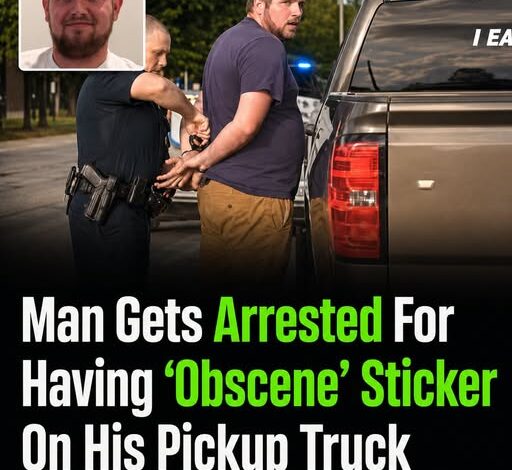
As the conversation continued, neither side backed away from its position. What had begun as a discussion over a sticker transformed into a direct conflict over the limits of government authority and individual freedom. Eventually, the deputy placed Webb under arrest, charging him with obscenity and resisting without violence.
For Webb, the consequences were immediate. He was handcuffed, taken into custody, and suddenly faced criminal charges over a message displayed on his own vehicle. What appeared to be a simple traffic stop had evolved into a case raising significant constitutional questions.
News of the arrest spread quickly, drawing attention from legal observers, civil liberties advocates, and members of the public. Many people found the language on the decal offensive and inappropriate. Others, however, argued that personal opinions about taste or decency should never determine whether speech receives constitutional protection.
The distinction proved to be an important one.
Under longstanding First Amendment principles, speech does not lose protection simply because it is rude, shocking, or offensive. Truly obscene material falls outside constitutional safeguards, but the legal definition of obscenity is far narrower than everyday vulgarity. Courts have consistently recognized that the government cannot punish expression solely because others dislike its content or find it offensive.
Only days after the arrest, prosecutors reached the same conclusion.
The criminal case against Webb was dismissed, with authorities acknowledging that the decal, despite its coarse language, was protected speech under the First Amendment. The reversal effectively recognized that the evidence could not support a criminal prosecution based on the constitutional standards governing free expression.
For Webb and his legal team, the dismissal represented more than a personal victory.
His attorney described the outcome as an important affirmation that constitutional rights belong to ordinary citizens just as much as they do to public figures or political activists. According to that view, protecting free speech often means defending expression that many people dislike, because constitutional protections lose much of their meaning if they apply only to popular or polite opinions.
Supporters argued that the case demonstrated an important limit on government power. While officials may encourage civility or criticize offensive behavior, they cannot simply criminalize speech because it provokes discomfort or disapproval.
Critics, meanwhile, continued to question whether public displays of profanity serve any constructive purpose, particularly in places where children are likely to see them. For them, the debate was less about constitutional law than about personal responsibility and common courtesy.
Yet the legal system ultimately focused on a different question entirely.
The issue was never whether the sticker was respectful or appropriate. It was whether the Constitution allowed the government to punish someone solely for displaying offensive language in public. In Webb’s case, prosecutors ultimately concluded that it did not.
The incident became a powerful illustration of how constitutional rights are often tested in unexpected ways. Landmark debates over free speech do not always unfold inside grand courtrooms or involve famous public figures. Sometimes they begin during an ordinary traffic stop, sparked by a message on the back of a pickup truck and a disagreement over where personal liberty ends and government authority begins.
For many observers, the case served as a reminder that the First Amendment was designed to protect more than agreeable opinions. Its greatest tests often come when the speech in question is unpopular, controversial, or offensive.
Dillon Shane Webb’s decal divided public opinion from the moment it appeared on the road. Some viewed it as unnecessarily vulgar, while others saw it as a straightforward exercise of constitutional freedom. Regardless of where people stood on the message itself, the legal outcome reinforced a principle that has shaped American law for generations: the government generally cannot punish speech simply because it offends.
In the end, the most significant moment was not the arrest but the reversal that followed. The charges disappeared, the constitutional limits became clearer, and an ordinary citizen’s refusal to back down forced the legal system to reaffirm one of the nation’s oldest protections. It was a reminder that the defense of free speech is often quiet, deeply personal, and sometimes decided not by dramatic courtroom speeches, but by a single individual standing firm and calmly saying, “No.”