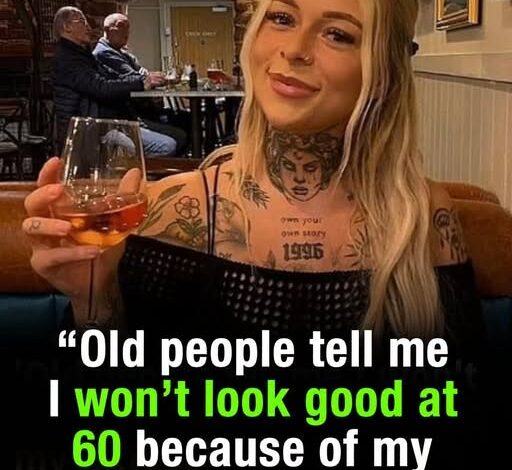
For years, strangers have confidently predicted Taylor Paige Courtenay’s future.
The message is almost always the same.
“You’ll regret those tattoos when you’re older.”
Whether she’s walking down the street or sharing a photo online, the 27-year-old from South Devon, England, has become accustomed to hearing unsolicited opinions about the artwork covering her body. Some people insist she’ll wish she had never gotten tattooed once she reaches her sixties. Others argue she’s limiting opportunities or damaging her appearance.
Courtenay, however, says those predictions have never changed how she feels about the choices she’s made.
Rather than seeing her tattoos as mistakes waiting to happen, she views them as an important part of who she is—permanent reminders of experiences, memories, and personal expression that she has chosen for herself.
Over the years, much of her body has become a canvas for that self-expression. Tattoos extend across her neck, arms, stomach, and legs, creating a look that immediately draws attention. While some people see only ink, Courtenay sees a collection of stories that reflect different chapters of her life.
“It’s my skin,” she has explained in various social media posts, making it clear that she doesn’t believe her appearance exists for public approval.
Living with highly visible tattoos means attracting attention almost everywhere she goes.
Some reactions are positive, with people complimenting the artwork or asking about its meaning. Others are far less supportive. Online, especially, strangers frequently offer opinions she never requested, questioning her decisions or predicting she’ll eventually regret them.
Rather than ignoring those comments completely, Courtenay has occasionally chosen to address them through videos shared on social media platforms such as TikTok.
In one widely discussed video, she reflected on how her appearance influences the way some people judge her before they know anything about her personality.
She admitted she had accepted that she might never fit the traditional image many people have in mind when they imagine the “perfect” woman.
She suggested she probably wouldn’t be the person some families dream of welcoming home or the partner others proudly introduce with conventional expectations in mind. She believed that, fairly or unfairly, her tattoos often became the first thing people noticed.
Still, she made it clear that trying to satisfy everyone else’s expectations was no longer something she wanted to spend energy doing.
“My skin makes me happy,” she said, explaining that her own comfort mattered more than meeting someone else’s idea of beauty.
One criticism appears more frequently than almost any other.
Many commenters—particularly older viewers, according to Courtenay—tell her that time will eventually prove them right. They predict her tattoos won’t age well and argue she’ll regret covering so much of her body once she’s older.
In another video, she responded directly to those familiar warnings.
With a touch of humor, she pointed out that aging changes everyone’s appearance, whether they have tattoos or not. She joked that it seemed rather confident for critics to assume they themselves would look flawless decades from now while predicting only her appearance would change for the worse.
More importantly, she questioned why complete strangers felt entitled to judge decisions that affected only her own body.
Her response quickly generated discussion across social media.
Some viewers continued criticizing her appearance, arguing that sharing photos publicly naturally invites public opinions. Others questioned whether she had truly considered how extensive tattoos might look later in life or suggested that body art distracted from natural beauty.
Just as many people came to her defense.
Supporters praised her confidence and argued that personal appearance is ultimately an individual choice. Many tattooed viewers shared stories of having worn their own ink proudly for years without regret, saying they expected to feel exactly the same decades from now.
Others emphasized a broader point.
Whether someone prefers tattoos or not, they argued, personal style doesn’t require universal approval. Clothing, hairstyles, piercings, and tattoos all represent forms of self-expression, and people should have the freedom to decide what feels authentic for themselves.
As debates continued growing beneath some of her videos, Courtenay eventually chose to disable comments on certain posts, limiting further arguments and allowing her content to exist without becoming a constant battleground.
Away from online discussions, her personal life has also evolved.
In December 2024, she shared that she had found a partner who accepted her exactly as she is. She also spoke about becoming a mother after welcoming her child during the summer of 2023, describing herself as finally feeling like “that girl” in the eyes of the father of her child—a remark that contrasted with earlier reflections about never fitting society’s traditional expectations.
Her journey continues to generate conversation because it touches on larger questions than tattoos alone.
It raises discussions about beauty standards, personal identity, first impressions, and the balance between expressing opinions and respecting other people’s choices.
Some people remain convinced she will eventually regret her tattoos.
Others admire her confidence and see her story as an example of living authentically despite criticism.
Neither perspective changes the central fact.
Courtenay has repeatedly said she is happy with the decisions she has made.
She isn’t asking everyone to share her taste or decorate their bodies the same way. Instead, she believes every person should have the freedom to decide what feels right for themselves without assuming that different choices require correction.
Whether people admire her tattoos, dislike them, or simply feel indifferent, the broader conversation extends beyond ink itself.
It asks a simple question that applies to many aspects of life:
How much weight should we give to other people’s expectations when making deeply personal decisions?
For Taylor Paige Courtenay, the answer appears clear.
Her tattoos may invite opinions, but they remain her choice, her story, and ultimately her skin. While public debate over body art is unlikely to disappear anytime soon, she has made one thing unmistakably known—she would rather live comfortably in her own skin than reshape it to satisfy someone else’s idea of who she should be.