I Married an Older Woman for Money and a Place to Stay – After Her Funeral, Her Lawyer Handed Me a Box and Said, ‘This Is What You Really Wanted’

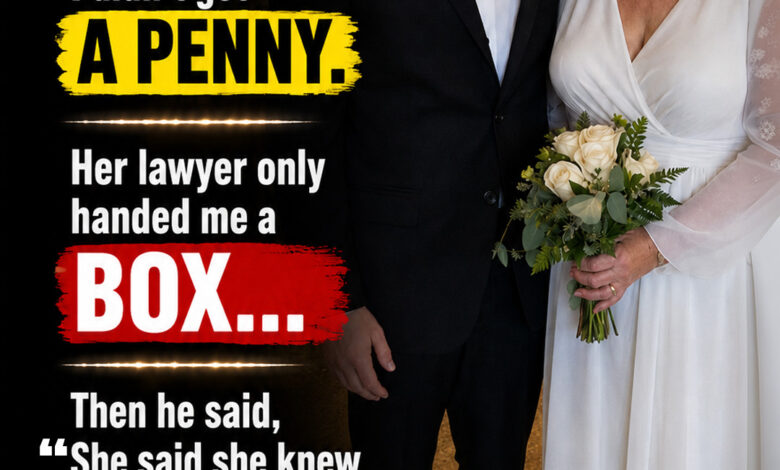
I Married Evie for a Roof Over My Head. After Her Funeral, She Left Me a Box That Changed Everything
I used to tell people I married Evie because I was trying to survive.
That version of the story sounded respectable.
Understandable, even.
It sounded like the kind of decision a desperate man might make when life had backed him into a corner.
But survival was only part of the truth.
The rest was uglier.
The rest was greed dressed up as desperation.
And for a long time, I convinced myself there was a difference.
The first winter I met Evelyn Harper, I was twenty-five years old and running out of places to hide from my failures.
Every debt collector in the county seemed to know my name.
My credit cards were maxed out.
My checking account hovered near zero.
The transmission in my truck sounded like it was dying a slow, expensive death.
Some nights I parked behind a grocery store and slept with a blanket pulled over my head while pretending the cold didn’t bother me.
It always bothered me.
The night manager knew.
He never said anything.
He just looked the other way when he saw me brushing my teeth in the employee bathroom before interviews.
Pride is strange.
It survives long after dignity leaves.
I still cared about looking respectable.
Even when I had nowhere to go.
Even when I was washing my face with paper towels and gas station soap.
Even when my entire future felt like a collection of overdue notices and bad decisions.
Then I met Evie.
She was seventy-one.
Widowed.
Soft-spoken.
The kind of woman who remembered birthdays without writing them down.
The kind of woman who always carried peppermints in her purse because she worried other people might need one.
The kind of woman who made strangers feel like guests instead of interruptions.
Most people saw an elderly widow living alone in a blue house at the end of Maple Street.
I saw central heating.
I saw a stocked refrigerator.
I saw security.
And if I’m being completely honest, I saw escape.
The proposal came six months later.
Not romantic.
Not dramatic.
Not the kind of thing movies celebrate.
We were sitting in her kitchen drinking coffee when she set down her mug and asked me a question that changed both our lives.
“Damon,” she said, “have you ever considered getting married again?”
I laughed.
Mostly because the idea seemed ridiculous.
People with stable lives got married.
People with apartments got married.
People who didn’t sleep in trucks got married.
Not men like me.
Evie smiled gently.
“I’m serious.”
The room went quiet.
I looked at her.
She looked back.
And suddenly I understood.
Not everything.
Just enough.
Enough to realize she wasn’t joking.
Enough to realize she knew exactly what she was offering.
Enough to know that if I said yes, my life would become dramatically easier.
I wish I could tell you I wrestled with my conscience.
I wish I could tell you I spent sleepless nights questioning whether it was right.
The truth is much simpler.
I was tired.
Tired of being poor.
Tired of being afraid.
Tired of wondering where I’d sleep next month.
Tired of carrying every problem alone.
So I said yes.
The first person I told was Jesse.
That was a mistake.
Jesse had a talent for turning every bad decision into a punchline.
When I told him I was marrying Evie, he nearly choked on his beer.
“The widow?” he asked.
“Yeah.”
“The one with the blue house?”
“Yes.”
He laughed so hard people at nearby tables looked over.
“Damon, that’s not a marriage.”
I stared at my drink.
“Then what is it?”
“Shelter with paperwork.”
I should have walked away.
Instead, I listened.
Because some part of me agreed with him.
And agreement is dangerous when someone is speaking your worst thoughts out loud.
Two weeks before the wedding, Evie surprised me.
She placed a folder on the kitchen table and pushed it toward me.
“A prenuptial agreement,” she said.
I remember staring at it.
Confused.
Offended.
Embarrassed.
All at once.
“You think I’m after your money?”
Evie adjusted her glasses.
“I think fear makes people do things they normally wouldn’t.”
The answer irritated me because it was smarter than mine.
She wasn’t accusing me.
She was describing me.
I signed the papers.
The house remained hers.
The savings remained hers.
The estate remained protected.
At the time, I told myself it didn’t matter.
People changed wills all the time.
Life changed people.
Circumstances changed priorities.
I convinced myself there would be opportunities later.
Looking back, that was the moment I should have understood something important.
Evie was lonely.
But she wasn’t foolish.
She saw more than I gave her credit for.
Much more.
The marriage settled into an uneasy routine.
Every morning I woke beneath a real roof.
Every evening I ate at a table instead of from convenience-store wrappers.
The panic that had followed me for years slowly began fading.
Yet something unexpected happened.
The more comfortable my life became, the worse I felt.
Not immediately.
Gradually.
In small moments.
Moments I couldn’t explain.
Evie had a habit of noticing things.
She noticed when my boots were falling apart.
A week later, new boots appeared beside the door.
She noticed my coat wasn’t warm enough.
Another coat appeared.
She noticed when I skipped dentist appointments because I couldn’t afford them.
Somehow the bill got paid anyway.
Each act of kindness felt heavier than the last.
Not because I disliked receiving help.
Because I knew why I was there.
And she deserved someone who wasn’t constantly calculating what her absence might eventually provide.
Yet she never confronted me.
Never accused me.
Never demanded honesty.
She simply waited.
As if she believed truth would eventually become too heavy to carry.
One night I found her sitting on the stairs.
The lights were off.
The house was silent.
She looked smaller somehow.
More fragile.
For a moment, fear cut through every selfish thought I had.
“Evie?”
She looked up.
“I’m fine.”
She wasn’t.
Anyone could see that.
I helped her to the kitchen.
Made tea.
Bad tea, as it turned out.
She laughed at how nervous I was.
And for a few minutes, we felt almost like a real couple.
Not a transaction.
Not an arrangement.
Just two people sharing a quiet evening.
Then my phone buzzed.
A message from Jesse.
How’s the retirement plan?
I should have ignored it.
Instead, I replied.
All good. Once she’s gone, I’m set.
Two sentences.
Eleven words.
A lifetime of shame compressed into a single text message.
I sent it without thinking.
And immediately hated myself.
Not enough to change.
Just enough to feel guilty.
Three days later, Evie collapsed.
One moment she was standing in the kitchen.
The next she was falling.
I caught her before she hit the floor.
At the hospital, the doctor spoke quietly.
Heart failure.
Sometimes grief arrives as a scream.
Sometimes it arrives as silence.
Mine arrived as disbelief.
Because despite everything, I had never imagined the world without her in it.
The funeral passed in a blur.
People cried.
Stories were shared.
Flowers filled the room.
And everywhere I looked, I saw evidence of a life that had mattered.
A life larger than I had ever bothered understanding.
Then came the meeting with her lawyer.
Part of me still expected something.
A house.
Money.
Security.
Proof that my gamble hadn’t been entirely foolish.
Instead, the lawyer slid a shoebox across the desk.
Just a shoebox.
My name written on the lid.
Nothing else.
No inheritance.
No fortune.
No property.
Just cardboard.
I almost laughed.
Then I opened it.
Inside was a folded sheet of paper.
At first I didn’t understand what I was looking at.
Then I recognized the words.
All good. Once she’s gone, I’m set.
The text message.
The message I thought nobody had seen.
My stomach dropped.
Evie had seen it.
Not only seen it.
Saved it.
Kept it.
The realization hit harder than any accusation could have.
Because suddenly I understood.
She had known.
Maybe not everything.
But enough.
Enough to recognize exactly why I had married her.
Beneath the paper sat receipts.
Boots.
The coat.
Mechanic bills.
Doctor visits.
Credit card payments.
Every kindness she had ever extended.
Every time she had quietly stepped in to help.
Every receipt carried a handwritten note.
You lied about this one.
You thanked me for this one.
You almost told me the truth here.
By the time I reached the bottom of the box, I could barely see through my tears.
Then came the letter.
The letter changed everything.
Not because it condemned me.
Because it didn’t.
That was the worst part.
She knew.
She knew why I married her.
She knew about the text.
She knew about the calculations.
She knew about the fear.
And still, she saw something else.
Something I had stopped seeing.
Potential.
Humanity.
A chance to become better than my worst decisions.
She wrote that I wasn’t honest.
But I wasn’t empty.
She wrote that she had stayed married to me because loneliness had brought us both to the same table.
She needed company.
I needed care.
But neither of us deserved to live inside a lie forever.
Then she gave me a choice.
Disappear with the box.
Or tell the truth.
The next afternoon, I walked into a church basement full of people who loved her.
People who had every reason to hate me.
When I stood in front of them, my hands shook.
My throat tightened.
Every instinct told me to run.
Instead, I spoke.
I told them why I married her.
I told them about the text.
I told them about the lies.
I told them everything.
Nobody applauded.
Nobody rushed forward to forgive me.
That wasn’t the point.
The point was finally saying it out loud.
The point was ending the lie.
Months have passed since then.
I work with the charity Evie created.
I volunteer where she volunteered.
I repay what I can.
Not because anyone asked me to.
Because she isn’t here anymore to do it for me.
Sometimes I visit her grave.
Sometimes I sit there longer than I intend.
And every time I think about the same thing.
I married Evie believing I wanted her house.
Her savings.
Her security.
Her future.
I was wrong.
What I really wanted was freedom from fear.
Freedom from shame.
Freedom from the version of myself that believed survival justified everything.
Evie never gave me money.
She gave me something much harder.
The truth.
And unlike everything else she left behind, it was the only inheritance that could actually change my life.