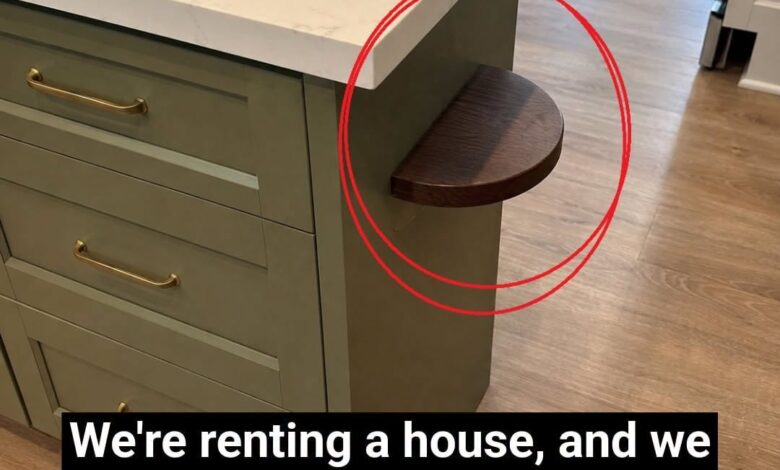
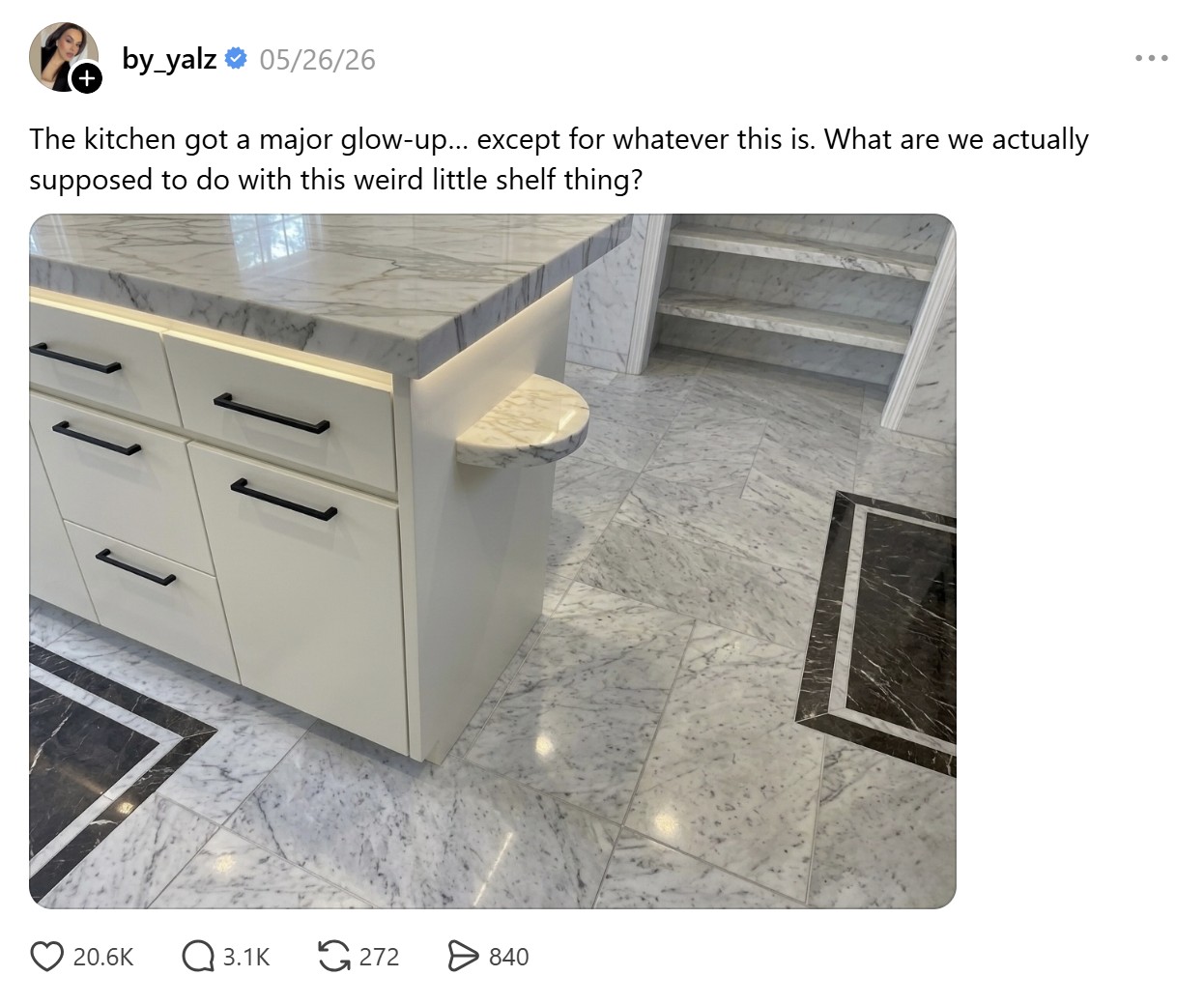
At first glance, it almost looks like a design mistake.
It’s too small to function as extra countertop space, too high to serve as a step, and certainly not sturdy enough to be used as a seat. That little rounded shelf attached to the side of some kitchen islands often leaves homeowners wondering why it’s there at all.
Surprisingly, it does have a purpose.
While it may not be an essential feature, this small side ledge is a thoughtful design element that blends practicality with style. It’s intended to provide a convenient landing spot for everyday items while also giving the kitchen island a more finished, custom appearance.
Think of it as a miniature countertop—not a workspace, but a temporary resting place for the little things that don’t need to occupy your main kitchen surfaces.
A Small Landing Spot for Everyday Items
One of the most practical uses for this shelf is as a quick “pause station.”
When you’re moving through the kitchen, there are always a few items that need somewhere to rest for a moment.
A morning coffee while chatting with family.
Your phone while following a recipe.
Keys and sunglasses after walking through the front door.
A wallet before heading out again.
Because the shelf sits slightly apart from the main countertop, it keeps these everyday objects close at hand without cluttering the space where food preparation takes place.
During parties or family gatherings, it can also become a handy place to set down a glass of wine, a cup of coffee, a small appetizer plate, or a folded napkin while people gather around the island.
It’s not designed to hold everything.
It’s simply meant to hold the right thing for a little while.
More Than Storage—It’s Part of the Design
Kitchen designers rarely leave the exposed ends of an island completely plain.
Instead, they often add architectural details that make the cabinetry feel more custom and visually interesting.
Depending on the style of the kitchen, you might see:
- Open display shelves
- Wine cubbies
- Cookbook niches
- Decorative panels
- Towel bars
- Plate racks
A small stone shelf is simply another variation of that idea.
Its rounded profile softens what would otherwise be a sharp cabinet corner, while the matching stone ties it visually to the countertop above.
Rather than looking like an unfinished cabinet end, the island gains an elegant design feature that feels intentional.
In many kitchens, this decorative function is just as important as its practical one.
Can You Use It While Entertaining?
Absolutely—but with realistic expectations.
If guests are gathered around the island, the shelf becomes a convenient place to rest a drink, dessert plate, or small serving tray without crowding the main preparation area.
It works especially well during casual get-togethers where people naturally stand and mingle in the kitchen.
However, it’s important to remember its size.
This isn’t an extension of your countertop.
It’s too narrow and too shallow to function as a serving buffet or food-preparation station.
Large casserole dishes, stacks of dinner plates, heavy mixers, or oversized serving platters belong on the main countertop instead.
A good way to think about it is this:
It’s a drink ledge—not a prep station.
Is It Useful for Storage?
Yes—but only in moderation.
Because the shelf is open and visible, it works best for one attractive item or one temporary item.
A small plant can add greenery.
A decorative bowl can hold keys.
A favorite cookbook can stay nearby while you’re trying a new recipe.
A candle or small vase can add personality without creating clutter.
The temptation is to let it become a catch-all for mail, receipts, chargers, loose change, and random household items.
That’s usually where the shelf stops looking intentional and starts looking messy.
Its small size is actually an advantage because it encourages restraint.
One carefully chosen object often looks elegant.
Five unrelated objects simply look forgotten.
What It Should Never Be Used For
Although many of these shelves are made from stone, quartz, or granite, that doesn’t automatically mean they’re designed to support significant weight.
Their strength depends largely on how they’re attached to the cabinet beneath.
For that reason, avoid using the shelf as:
- A seat
- A step stool
- A place for children to climb
- A support while reaching overhead cabinets
- A resting place for heavy kitchen appliances
- Storage for large serving dishes
- A landing spot for hot cookware straight from the oven
If the shelf ever feels loose, shifts when touched, or begins to sag, it’s worth having it inspected by a cabinet installer or stone fabricator before continuing to use it.
A decorative feature should never become a safety concern.
Could Its Location Be Awkward?
Sometimes.
Many kitchen islands are positioned within major traffic paths where people naturally walk while cooking, unloading groceries, or moving between rooms.
A shelf that extends into that walkway can occasionally become a hip or elbow magnet, especially in busy households.
That doesn’t necessarily mean it’s poorly designed.
It simply means it’s best used thoughtfully.
Keeping the shelf neat, uncluttered, and free of fragile objects helps prevent accidental bumps from turning into broken dishes or spilled drinks.
If your kitchen already feels tight, leaving the shelf mostly decorative may be the smartest choice.
The Best Way to Make It Work
The most successful use is often the simplest one.
A small vase of fresh flowers.
A shallow bowl for keys.
A decorative tray.
A tiny potted herb.
Or, when entertaining, a convenient place for a guest to rest a drink while chatting.
The goal isn’t to make the shelf work harder.
It’s to let it quietly do the small job it was designed to do.
A Small Detail That Adds Character
That unusual little shelf attached to the side of your kitchen island isn’t an accident or a forgotten construction feature.
It’s a compact side ledge designed to provide a convenient landing place for lightweight everyday items while adding architectural interest to the island itself.
It won’t replace extra cabinetry.
It isn’t meant to become a storage shelf or additional workspace.
But used thoughtfully, it can make the kitchen feel a little more welcoming, a little more organized, and a little more personal.
Sometimes the smallest design features aren’t meant to solve big problems.
They’re simply there to make everyday living a little easier—and to remind us that good design often hides in the details.