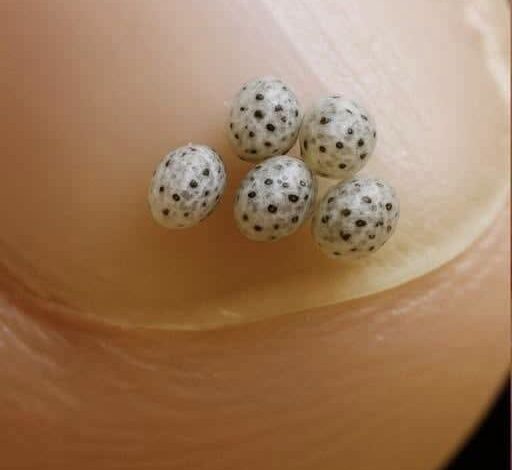
At first glance, they look too perfect to be real.
Scattered across the forest floor are tiny oval shapes no larger than a grain of corn, decorated with intricate stripes, speckles, and patterns that resemble miniature watermelons, polished seeds, or smooth pebbles. They appear almost decorative, as though nature crafted them purely for beauty. But these remarkable objects are not seeds at all—they are the eggs of stick insects, among the most extraordinary masters of camouflage the natural world has ever produced.
Their disguise begins long before they ever hatch.
Unlike many insects that fiercely guard their young or carefully hide their eggs in protected nests, stick insects take a completely different approach. After mating, the females simply release their eggs onto the ground, allowing them to tumble into layers of fallen leaves, twigs, and loose soil. At first, this strategy seems reckless. The eggs are left entirely alone, with no parent standing watch, no shelter built around them, and no protection from the countless dangers lurking in the forest.
Yet that apparent vulnerability is actually their greatest defense.
Each egg has evolved to resemble something so ordinary that predators rarely give it a second glance. Their colors blend effortlessly with the woodland floor, while their shapes mimic tiny seeds or weathered pebbles scattered naturally among the debris. To birds searching for an easy meal, these eggs simply disappear into the landscape. Even sharp eyes trained to spot movement or unusual shapes often overlook them completely.
It is camouflage at its most sophisticated—not by hiding beneath leaves, but by becoming indistinguishable from the leaves themselves.
Only when viewed under magnification does their astonishing complexity come into focus.
The smooth shells reveal delicate ridges, intricate mottled markings, and carefully textured surfaces that seem almost handcrafted. Every tiny detail contributes to the illusion, making the eggs nearly impossible to distinguish from their surroundings. What first appears to be a charming natural curiosity quickly reveals itself as an elegant piece of evolutionary engineering, refined over countless generations.
But their most remarkable feature sits at one end of the shell.
There, almost too small to notice without close inspection, is a tiny structure known as the capitulum.
It may seem insignificant, yet this microscopic knob plays a crucial role in the survival of the developing insect.
The capitulum contains nutrient-rich compounds that are irresistibly attractive to ants. To an ant passing through the forest, the egg appears to be a valuable food item. Workers eagerly pick it up and carry it back to their underground nest, believing they have discovered something worth collecting.
What happens next is a remarkable example of nature’s unintended partnerships.
Once inside the colony, the ants remove and consume only the capitulum. After enjoying this small nutritional reward, they discard the rest of the egg deep within the nest or nearby chambers, leaving the embryo itself completely unharmed.
Without realizing it, the ants have accomplished exactly what the stick insect needed.
Instead of remaining exposed on the forest floor, the egg is now protected beneath layers of soil, hidden from many predators and sheltered from environmental extremes. The underground surroundings provide a stable, secure environment where the embryo can continue developing until the time comes to hatch.
The ants receive a meal.
The stick insect gains a fortress.
Neither species enters this arrangement through cooperation or awareness. There is no mutual understanding, no communication, and no deliberate act of generosity. Each simply follows instincts shaped by millions of years of evolution. Yet together, those instincts create one of nature’s most elegant survival strategies.
Scientists describe this relationship as a remarkable example of evolutionary adaptation, where one species has evolved features that successfully exploit the predictable behavior of another. The stick insect never asks for protection, and the ant never intends to provide it. Nevertheless, both play their roles with astonishing consistency.
It is a reminder that survival in nature often depends less on strength than on subtlety.
Many animals defend themselves with speed, venom, claws, or powerful jaws. Stick insects rely on something entirely different. From the moment life begins, their greatest weapon is deception. Every stripe, every speckle, every contour of the egg has been shaped to avoid attracting attention.
Even after hatching, that strategy continues.
Young stick insects spend their lives blending seamlessly into branches, twigs, and leaves, remaining almost invisible unless they move. Their famous camouflage begins not when they emerge from the egg, but while they are still developing inside it.
The entire life cycle reflects a single extraordinary principle: survival through invisibility.
To human eyes, these tiny eggs possess an unexpected beauty. Their intricate designs rival works of miniature art, inviting admiration from anyone fortunate enough to examine them closely. Yet their true brilliance lies not in their appearance alone, but in the purpose behind every detail.
Nothing is accidental.
The shell protects the growing embryo.
The colors conceal it.
The patterns imitate seeds.
The capitulum recruits unwitting guardians.
Every feature serves a function, woven together into a strategy so effective that it has endured for countless generations.
In the quiet world beneath the forest canopy, life often depends on remaining unnoticed. There are no dramatic battles or spectacular displays of power—only patient adaptation, subtle illusion, and the quiet persistence of evolution refining each generation.
Perhaps that is what makes stick insect eggs so captivating.
They remind us that nature’s greatest masterpieces are not always the loudest or the largest. Sometimes they are almost invisible, scattered silently among fallen leaves, waiting for curious eyes to discover them.
Their beauty is undeniable, but their true genius lies elsewhere.
These miniature marvels survive not because they demand attention, but because they avoid it. Hidden in plain sight, carried underground by unsuspecting ants, and protected by a disguise perfected over millions of years, they demonstrate that in the natural world, the most successful creations are often those that seem too ordinary to notice at all.