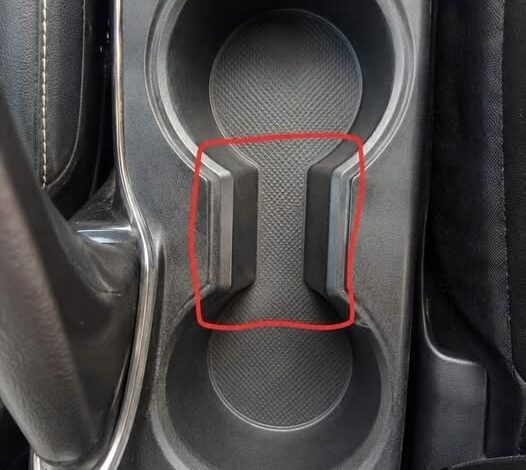
For years, I glanced at that slim opening in my car’s interior without giving it a second thought. It seemed too small to hold anything useful, too oddly shaped to have an obvious purpose. I assumed it was simply another design choice that looked interesting but served no real function—a decorative detail dreamed up by engineers who never had to juggle groceries on the drive home.
I couldn’t have been more mistaken.
The day I discovered what that little slot was actually designed for, it completely changed the way I looked at my car. Instead of being a meaningless gap, it turned out to be a surprisingly practical feature meant to secure the handles of grocery bags, shopping totes, or even purse straps, helping keep them upright instead of sliding across the floor or tipping over with every turn.
It was such a simple idea.
Yet somehow, I had driven past it for years without ever knowing.
Almost immediately, memories came flooding back.
The carton of eggs that rolled off the passenger seat and cracked before I reached home.
The bag of oranges that scattered across the floor after one sharp corner.
The takeout container that tipped over, leaving dinner spread across the car instead of inside its box.
Every one of those frustrating moments had felt like an unavoidable part of driving.
Now I realized many of them could have been prevented by a feature that had been sitting beside me the entire time.
There was something oddly satisfying about that discovery.
Not because the solution was complicated.
Because it was so wonderfully uncomplicated.
Slip the bag handles into the slot, and suddenly they stay where they’re supposed to. No balancing acts. No reaching across the passenger seat at every red light. No hoping your groceries survive the trip home without turning into a mess.
Sometimes the smartest ideas are also the quietest.
What impressed me most wasn’t the feature itself but the philosophy behind it.
No flashy advertisement had ever highlighted it.
No salesperson proudly demonstrated it during a dealership visit.
It wasn’t promoted as a revolutionary innovation or marketed as a luxury convenience.
It simply existed, waiting patiently for someone to discover it.
Its purpose was never to impress anyone.
It was designed to make everyday life just a little easier.
That realization changed more than the way I loaded groceries.
It changed the way I began looking at everyday objects.
Once I noticed one hidden convenience, I started spotting others.
Small storage compartments tucked into unexpected places.
Hooks that folded neatly out of sight until needed.
Tiny design details that solved problems so naturally they almost disappeared into the background.
The more I paid attention, the more I appreciated how much thought often goes into the products we use every day.
Many of the best design choices share one characteristic.
They don’t demand recognition.
They quietly do their job.
The door handle that fits comfortably in your hand.
The cup holder placed exactly where you instinctively reach.
The drawer that opens just far enough without falling out.
These details rarely become the focus of conversation because, when they’re designed well, they simply work.
Perhaps that’s why they often go unnoticed.
Good design doesn’t always announce itself.
Sometimes it succeeds by becoming almost invisible.
There is something surprisingly reassuring about that.
In a world filled with products competing for attention through bigger screens, brighter lights, and endless features, it’s refreshing to discover an improvement that asks for nothing except to be useful.
No dramatic promises.
No complicated instructions.
Just one thoughtful solution quietly waiting to solve an everyday problem.
The experience also became a gentle reminder about assumptions.
How often do we decide something has no purpose simply because we don’t immediately understand it?
How many useful ideas, opportunities, or perspectives do we overlook because we stop looking after the first impression?
That little slot taught me a lesson far beyond grocery bags.
Sometimes the answer isn’t hidden because it’s complicated.
It’s hidden because we’ve never thought to ask why it exists.
Once we do, the world begins revealing countless examples of quiet ingenuity that have always been there.
In many ways, that’s what thoughtful design is meant to accomplish.
It anticipates problems before they happen.
It removes small frustrations without asking for applause.
It improves everyday life so subtly that we only notice its absence when it’s missing.
The humble grocery-bag holder is a perfect example.
It doesn’t transform the driving experience.
It doesn’t make headlines.
It simply prevents small inconveniences from becoming unnecessary frustrations.
And perhaps those are the improvements that matter most.
After all, daily life is made up of ordinary moments.
The easier those moments become, the more enjoyable they are.
Now, every time I slide a shopping bag into that narrow slot, I smile a little.
Not because the feature is extraordinary.
Because it reminds me that someone, somewhere, anticipated a problem I didn’t even realize could be solved.
It’s a quiet act of consideration built into something I use every day.
And once you notice one thoughtful detail like that, you begin to see others everywhere.
The world hasn’t suddenly become more carefully designed.
You simply learn to recognize the kindness that was built into it all along.