At first, the road looked completely ordinary.
Just another stretch of cracked rural pavement cutting through quiet countryside, carrying people toward work, home, errands, and responsibilities that felt urgent enough to keep their eyes fixed forward. Tires hummed against asphalt. Engines passed in steady waves. Dust lifted briefly behind speeding vehicles before settling again into the weeds along the shoulder.
Nothing about it suggested that a tiny life was disappearing only inches away.
Most people never would have noticed.
And honestly, that is what made the scene feel so heartbreaking afterward — not cruelty, but invisibility.
The danger existed in plain sight while the world continued moving around it untouched.
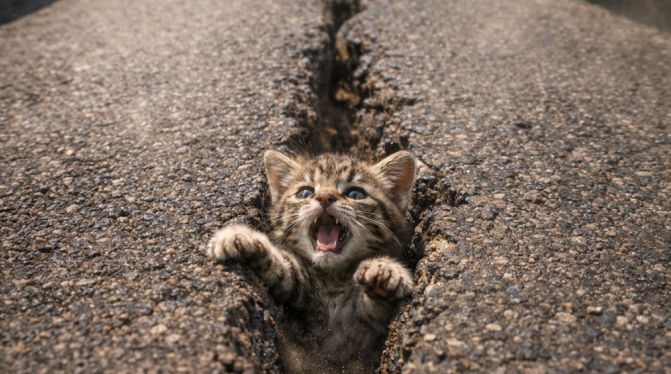
Near the edge of the road, where years of weather and neglect had split the asphalt open, a narrow crack cut deep into the pavement. It looked insignificant from above. Easy to mistake for ordinary damage. The kind of thing drivers passed every day without thinking twice about.
But trapped inside that thin dark space was a kitten so small it almost blended into shadow.
Its fur was streaked with dirt and dust. One tiny paw kept reaching upward desperately, scraping against the rough edges before slipping back down again. Every attempt to climb out ended the same way:
a scramble,
a tiny burst of hope,
then another fall into darkness.
Its cries barely carried over the noise of traffic.
Thin.
Weak.
Exhausted.
Not loud enough for people speeding by with windows closed and music playing.
The kitten had probably been trapped there for hours already.
Maybe longer.
No one knew how it ended up inside the crack. Perhaps it wandered too close while following its mother. Perhaps the pavement crumbled beneath its weight unexpectedly. Perhaps fear drove it there after some larger animal startled it from hiding.
Whatever happened, it was trapped now in a place too deep and narrow for escape.
Above, life continued with complete indifference.
A truck thundered past so closely that the gust of wind forced loose gravel down into the opening. The kitten cried harder afterward, its tiny body pressing desperately against the wall of broken asphalt as though instinct alone could somehow make it small enough to disappear from danger.
Still no one stopped.
That’s the terrible thing about emergencies involving small lives.
People often don’t notice them unless something forces them to look closer.
The world trains us to overlook quiet suffering.
Then, from the trees bordering the road, movement suddenly exploded across the grass.
A cat.
Thin-bodied and fast, her fur rough from outdoor living, she sprinted toward the roadside with absolute certainty. She did not hesitate or search around confused. She knew exactly where the kitten was before she even reached the crack.
The cries had guided her.
When she arrived at the edge, she leaned down immediately, her body tense with urgency. She called out sharply into the darkness below.
The kitten answered instantly.
The sound that came back was different this time.
Not only fear anymore.
Recognition.
If you’ve ever heard animals calling to one another in distress, you understand how unmistakable it can feel. There was panic in the kitten’s voice, yes — but also relief. A desperate tiny sound saying:
You came back.
The mother cat reached down carefully, stretching herself almost dangerously close to the road. Her paws scraped against broken pavement while cars continued rushing past only feet away. Every passing vehicle made her fur ripple violently in the wind, but she refused to move back.
She reached deeper.
Finally her teeth caught gently in the kitten’s fur.
For one suspended moment, it seemed like enough.
The kitten rose slightly from the darkness.
Its front paws reached upward frantically.
Then it slipped.
Back down.
The sound it made afterward was unbearable.
Not dramatic.
Just defeated.
The mother cat immediately tried again.
Again the same struggle.
Again the same heartbreaking fall.
The crack was simply too narrow. Too deep. The edges offered no stable grip. Every attempt ended with gravity pulling the kitten backward into darkness before she could lift it free completely.
Still, she kept trying.
Minutes passed.
Traffic continued.
People drove by.
No one slowed.
The mother cat’s movements grew more frantic now. She circled the crack, calling repeatedly into it, then tried reaching from different angles as though persistence alone might eventually change the shape of the road itself.
Watching something refuse to abandon its child affects people on a deeply instinctive level.
Because love looks remarkably similar across species in moments like that:
urgent,
fearless,
completely unwilling to surrender.
At one point, she stopped trying to pull the kitten out.
Not because she gave up.
Because she changed strategies.
She stepped closer to the road itself.
Cars rushed past while she stood there crying loudly now, her voice sharper and more desperate than before. She looked toward passing vehicles between calls, then back toward the crack, then toward the road again.
The behavior almost felt intentional.
As though she understood she could not solve this alone anymore.
As though she was asking.
Please notice.
Please stop.
Please help.
Most drivers still passed without slowing.
Then one motorcycle began reducing speed.
The rider looked uncertain initially, glancing around as though trying to understand what caught his attention. Maybe he heard the cries. Maybe he noticed the cat behaving strangely near traffic. Maybe something instinctive simply told him something was wrong.
Whatever the reason, he pulled onto the shoulder and shut off the engine.
Silence settled strangely after the noise.
The mother cat froze.
The man removed his helmet slowly and followed the sound toward the edge of the damaged pavement.
Then he saw it.
The tiny face inside the crack.
The frantic mother.
The impossible space trapping the kitten below road level while cars roared inches away.
Without hesitation, he knelt beside the opening.
People talk often about heroism as though it belongs only to dramatic acts. But most real acts of compassion look exactly like this:
someone interrupting their own day for a life that cannot repay them.
The motorcyclist studied the crack carefully before reaching inside.
It wasn’t easy.
The opening narrowed deeper down, forcing him to angle his arm painfully against rough pavement. Loose gravel shifted beneath his fingers. Every movement had to stay slow and precise because one wrong motion could push the frightened kitten further down or injure it against the jagged edges.
The mother cat stayed beside him the entire time.
That detail affected everyone who later witnessed the scene.
She did not run.
Did not attack.
Did not flee from the stranger leaning over her trapped baby.
She watched.
Closely.
Anxiously.
Trusting him because she had no other choice left.
The kitten cried louder when fingers finally touched its tiny body.
“Easy,” the man murmured softly, though whether to himself, the kitten, or the mother cat, no one could say.
He adjusted his grip carefully.
Lifted slowly.
For one terrifying second, the kitten slipped slightly again and the mother cat let out a sharp cry that sounded almost human in its panic.
Then —
finally —
the tiny body emerged fully from the crack.
Dust-covered.
Shaking.
Alive.
The man immediately placed the kitten gently onto the grass away from traffic.
For a moment, it simply stayed there frozen, overwhelmed by sudden freedom after being trapped so long in darkness.
Then the mother cat rushed forward.
She touched the kitten repeatedly with her nose and face, checking every inch of it urgently. The kitten pressed itself against her chest instantly, still trembling.
Safe.
The transformation in the mother cat was immediate.
The panic disappeared first.
Then the tension.
Her entire body softened visibly once she realized the kitten was alive and truly free.
The motorcyclist sat back quietly on the roadside watching them.
No applause.
No cameras shoved in faces.
No dramatic speech.
Just one person breathing hard beside a broken stretch of pavement while a mother cat reunited with her baby in the grass nearby.
Then traffic resumed its ordinary rhythm again.
Cars passed.
Dust rose.
Engines faded into distance.
The road itself remained unchanged.
Still cracked.
Still overlooked.
Still carrying people toward places they believed mattered more urgently.
But for one tiny life — and one frantic mother who refused to leave — the entire world had changed because a stranger chose to notice what everyone else kept driving past.
That is what lingers most about stories like this.
Not the danger.
Not even the rescue itself.
But the reminder hiding quietly underneath it all:
compassion often begins with something incredibly simple.
Slowing down long enough to see what the rest of the world has learned to ignore.