Can You Find the Hidden Mistake in This Snowy Picture?
At first glance, the scene looks almost too perfect.
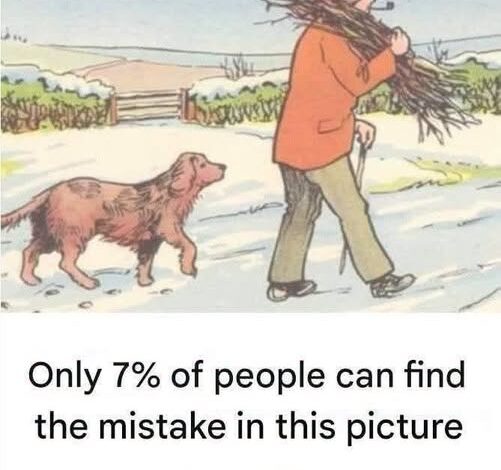
Fresh snow blankets the countryside in a smooth white layer. A man strolls peacefully down a quiet path with his faithful dog at his side. The landscape feels calm, almost frozen in time, with nothing to disturb the silence except the pair making their way through the winter morning.
It looks like an ordinary country walk.
But it isn’t.
Somewhere in this peaceful illustration is one small detail that doesn’t belong. It’s easy to miss if you’re only admiring the scenery, yet once you notice it, you can’t unsee it.
So before reading any further, take a careful look at the picture.
Challenge yourself to find the mistake without any help.
A Puzzle That Brings Back Memories
For many people, brain teasers like this bring back childhood memories.
Long before smartphones and endless scrolling, rainy afternoons were often spent with puzzle books, comic magazines, and newspapers filled with hidden-object games, riddles, and “spot the mistake” challenges. Whether it was searching for differences between two nearly identical drawings or finding a hidden object tucked into an illustration, these puzzles rewarded patience and careful observation.
The fun wasn’t about racing to the answer.
It was about slowing down enough to notice the little details everyone else overlooked.
This winter puzzle captures that same feeling.
At first, it seems incredibly simple.
Then you realize your eyes may have skipped over the most important clue.
Study the Picture Carefully
Let’s examine what we see.
The setting is unmistakably winter.
Snow covers the ground, the bushes, and the surrounding countryside, creating a peaceful landscape that looks untouched except for one traveler and his companion.
A man walks confidently along the snowy path.
Beside him trots his dog.
In the distance, a fence stretches across an open field, reinforcing the quiet rural atmosphere.
The man appears prepared for the cold.
He’s carrying a bundle of firewood, suggesting he’s headed home to feed a warm fireplace. A walking cane rests comfortably in one hand, while a cigar completes the image of someone enjoying a leisurely winter stroll despite the chilly weather.
Nothing appears rushed.
Nothing appears unusual.
Every element seems to fit naturally within the scene.
Or does it?
Look Beyond the Obvious
The trick with puzzles like this is that our brains naturally focus on the larger picture.
We notice the snow.
We notice the dog.
We notice the firewood.
We build a story in our minds about what is happening.
Because the overall scene feels believable, our brains stop questioning the smaller details.
That is exactly what makes observation puzzles so satisfying.
They rely on assumptions.
When something looks familiar, we stop looking carefully.
The hidden mistake takes advantage of that habit.
Need a Small Hint?
If you’ve been staring at the picture without finding anything unusual, don’t worry.
Most people overlook the answer the first time.
Here’s a gentle clue:
Don’t focus on what the man is carrying.
Don’t focus on the weather.
Instead, pay attention to how the characters interact with their surroundings.
Ask yourself a simple question:
If someone walks across freshly fallen snow… what should they leave behind?
That question points directly toward the solution.
The Hidden Mistake
The error is found in the snow itself.
The dog’s paw prints are clearly visible, marking every step it has taken across the snowy ground.
The man, however, leaves no footprints at all.
Despite walking right beside the dog, the snow beneath him remains completely untouched.
In real life, that would be impossible.
Fresh snow records every step. If the dog’s paws create visible tracks, the man’s boots should leave equally obvious footprints.
Instead, he appears to be gliding across the surface without disturbing it.
Once you notice the missing footprints, the mistake immediately stands out—and suddenly the entire scene feels impossible.
Why So Many People Miss It
This puzzle works because our brains are excellent at filling in missing information.
When we see someone walking through snow, we automatically assume footprints are there, even if they aren’t actually drawn.
Our minds complete the scene without asking for proof.
Psychologists refer to this as top-down processing: the brain relies on prior experience and expectations to interpret what it sees.
Most of the time, that ability helps us understand the world quickly.
Occasionally, however, it tricks us into overlooking obvious details.
That’s exactly what happens here.
The missing footprints remain hidden in plain sight because your brain quietly inserts them where they should be.
More Than Just a Fun Game
Although puzzles like this are entertaining, they also exercise important mental skills.
Observation challenges encourage you to:
- Slow down instead of making quick assumptions.
- Pay attention to small visual details.
- Compare objects logically within a scene.
- Strengthen concentration and visual awareness.
- Practice flexible thinking rather than relying on first impressions.
These are the same abilities people use every day when solving problems, driving, reading maps, editing documents, or noticing changes in their surroundings.
In other words, you’re not just playing.
You’re giving your brain a healthy workout.
Did You Spot It Quickly?
If you noticed the missing footprints in less than 15 seconds, congratulations!
You have excellent attention to detail and resisted the temptation to let your brain fill in the missing information automatically.
If it took longer—or if you needed the hint—that’s perfectly normal.
The best observation puzzles aren’t designed to fool people because the answer is impossible.
They’re designed to fool us because our brains are wonderfully efficient.
Sometimes that efficiency causes us to overlook the simplest clue of all.
And in this snowy countryside scene, the biggest mystery wasn’t hidden in the trees, the fence, or the firewood.
It was right beneath the man’s feet… where there should have been footprints, but there weren’t.