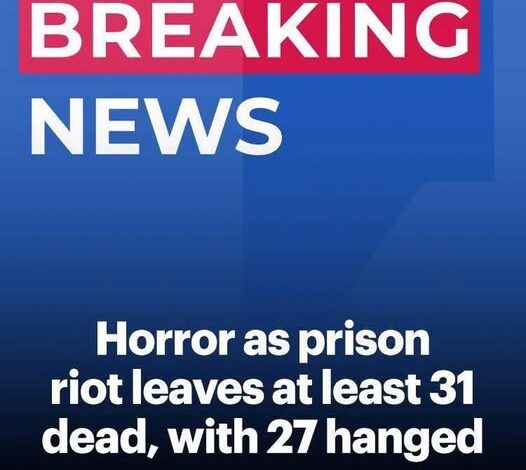
The latest massacre inside Machala Prison has once again exposed the deadly crisis gripping Ecuador’s correctional system. What unfolded behind the prison walls was not an isolated tragedy but another violent episode in a cycle of bloodshed that has plagued the country’s penitentiaries for years. By the time the violence subsided, investigators were left documenting a devastating scene of destruction, while families outside waited in anguish, desperate for news of loved ones whose fate remained uncertain.
According to authorities, 27 inmates lost their lives during the riot. Officials reported that the victims died from asphyxiation and what they described as “immediate death by hanging.” As forensic teams entered the facility, they worked through damaged cellblocks marked by gunfire, explosions, and the aftermath of intense violence, piecing together exactly how the deadly confrontation unfolded.
The toll extended beyond those who were killed.
Officials said another 33 prisoners suffered injuries during the unrest, along with one police officer who was also hurt while responding to the emergency. Medical teams rushed to treat the wounded as security forces worked to regain control of the prison and prevent the violence from spreading further.
Outside the prison gates, a different kind of suffering unfolded.
Families gathered in growing numbers, hoping for official information but often receiving little more than uncertainty. Many clung to rumors circulating among the crowd, anxiously searching for confirmation that relatives had survived. Every passing hour without answers deepened the fear that the next phone call—or the local morgue—might deliver the news they dreaded most.
For those waiting outside, the emotional burden was almost unbearable.
Yet this tragedy did not emerge from nowhere.
Machala Prison is part of a correctional system that has repeatedly been identified as one of the most dangerous in Ecuador. Experts and government officials have long warned that many of the country’s prisons have evolved beyond places of incarceration, becoming operational hubs where powerful criminal organizations continue directing activities despite being behind bars.
Overcrowding, limited resources, and persistent security challenges have created conditions that allow rival gangs to compete for influence inside prison walls. Control over individual cellblocks often carries significance far beyond the prison itself, with authorities saying these facilities have been used to coordinate drug trafficking operations and maintain territorial control linked to organized crime.
As a result, outbreaks of violence have become tragically familiar.
Since 2021, more than 500 inmates have been killed in Ecuador’s prison system, many during riots marked by extraordinary brutality. Successive incidents have highlighted the enormous challenge facing officials attempting to restore order while confronting heavily organized criminal groups operating both inside and outside correctional facilities.
The violence inside Ecuador’s prisons reflects a broader transformation affecting the country as a whole.
Positioned between Peru and Colombia—two of the world’s largest cocaine producers—Ecuador was once widely viewed as one of the more stable nations in the region. In recent years, however, authorities and analysts have pointed to the country’s growing role as a major transit route for international cocaine trafficking, increasing the influence and competition of organized criminal networks.
That shift has placed extraordinary pressure on law enforcement, the justice system, and the nation’s prisons, which have increasingly become flashpoints in conflicts between rival gangs seeking control over trafficking routes and criminal operations.
The riot at Machala stands as another stark reminder of those ongoing challenges.
While investigators continue examining the circumstances surrounding the latest violence, families mourn the lives lost and await answers about how such a deadly event could unfold once again. For Ecuador, the tragedy underscores the scale of a prison crisis that extends far beyond the walls of any single penitentiary—a crisis intertwined with organized crime, narcotics trafficking, and a continuing struggle to restore security in a system that remains under immense strain.