Dr. Gregory Alcott stepped closer to the bed with the cold impatience of a man who had spent so many years reducing human beings to billing categories that he no longer recognized suffering unless it arrived attached to premium insurance.
The fluorescent lights above him reflected sharply off his polished shoes as he flipped through the chart with visible disgust.
“You’re emotionally compromised, Bennett,” he said. “That’s the problem with nurses like you. You get attached to every stray animal dragged through these doors.”
Rachel felt exhaustion burning behind her eyes, but beneath the exhaustion something harder had settled into place.
Resolve.
“He’s not a stray animal,” she replied quietly. “He’s critically ill.”
Alcott gave a humorless laugh.
“And what exactly do you think he contributes to this hospital? No insurance. No identification. No next of kin. People like him bankrupt emergency departments.”
Rachel looked down at the unconscious man again.
Even feverish and half-delirious, there was something unmistakable about him. The scars across his shoulders were old and disciplined, not chaotic. His hands were rough, callused in ways that spoke of weapons, climbing rope, and years of surviving environments most civilians never imagined. Even unconscious, he looked dangerous.
Not criminal.
Dangerous the way trained people are dangerous.
The kind of dangerous that comes from competence.
“You don’t know who he is,” Rachel said.
“I know exactly what he is,” Alcott snapped. “A liability.”
The monitor beside the bed beeped irregularly.
104.1 temperature.
Pulse unstable.
Blood pressure dropping again.
Rachel’s jaw tightened.
Ten years in emergency medicine had taught her something Alcott never understood:
sometimes the difference between life and death comes down to whether one exhausted person decides another human being is still worth fighting for.
And Rachel Bennett had never learned how to stop fighting.
Not when she should.
Not when it cost her personally.
Not even now.
Alcott slammed the chart shut.
“Fifteen minutes.”
Then he walked out.
The silence afterward felt heavier than before.
Rain rattled softly against the trauma bay windows while the unconscious man shifted restlessly beneath sweat-soaked sheets, mumbling fragmented phrases that sounded like battlefield commands.
“South ridge… no visual… move now…”
Rachel adjusted the blanket gently.
“You’re not there anymore,” she whispered.
For a moment his breathing eased slightly, as though some buried part of him heard her voice through the fever.
Rachel glanced toward the nurses’ station.
Night shift at St. Jude’s always carried a strange emotional gravity. The hospital became quieter but somehow more intimate after midnight. During the day there were administrators, specialists, visitors, endless interruptions.
At night, people lost their masks.
Fear sounded louder at 2 a.m.
Pain felt more honest.
And nurses became witnesses to the private versions of people the daylight never saw.
Rachel had spent a decade inside those hours.
She’d held the hands of dying strangers while family members raced across town too late to say goodbye. She’d sat on supply closet floors crying quietly after pediatric codes nobody could save. She’d worked double shifts through flu outbreaks and stayed long after clocking out because someone needed comfort more than she needed sleep.
The hospital had become her entire adult life.
And somewhere along the way, she stopped noticing how much of herself she gave away there.
Until tonight.
Tonight she suddenly saw the institution clearly.
Not the idealized version from nursing school brochures.
The real version.
The budget meetings.
The insurance calculations.
The administrators who used words like resource allocation while discussing human beings attached to ventilators.
People like Rachel kept hospitals humane.
People like Alcott kept them profitable.
And profit usually outranked humanity until somebody brave enough disrupted the system.
Rachel looked at the man in bed four again.
Then she made her decision.
By 2:30 a.m., the trauma bay lights were dimmed low and bed four had disappeared behind heavy storage curtains near the back wall.
Officially, the patient had been “prepared for transfer.”
Unofficially, Rachel Bennett had committed career suicide.
She overrode the medication cabinet authorization manually, pulling broad-spectrum antibiotics Alcott would never approve for an unidentified patient. The machine beeped warning signals as she entered her credentials.
Unauthorized override.
Supervisor notification pending.
She ignored it.
Then she returned to the bedside carrying cool water and fresh IV bags.
The man’s skin burned beneath her fingers.
Sepsis moved quickly.
She knew that.
If she lost the next few hours, she lost him.
So she stayed.
For four straight hours Rachel fought for a stranger whose real name she didn’t even know.
She monitored oxygen saturation every six minutes.
Adjusted fluids.
Managed fever spikes.
Checked his wound repeatedly.
The incision bothered her most.
It was too clean to be accidental.
Too controlled.
Not emergency surgery either.
Military maybe.
Or something adjacent to military.
At 3:17 a.m., his fever spiked hard enough to trigger violent tremors.
He thrashed against the sheets suddenly, breathing ragged.
“Move! MOVE!”
Rachel grabbed his shoulders carefully.
“Hey. Hey, you’re safe.”
“Bird down—”
His eyes stayed closed.
“Get Harper out—”
“You’re in a hospital.”
Gunfire seemed to echo invisibly inside his mind.
Rachel had seen combat veterans before. Portland had enough homeless former servicemen wandering through ER doors at night to make her quietly furious at how disposable the country treated people once wars stopped being politically useful.
But this man felt different.
Even delirious, his mind stayed tactical.
Alert.
Assessing.
Fighting invisible battles.
“Listen to me,” Rachel whispered firmly. “Nobody’s shooting at you right now.”
Gradually his breathing slowed again.
Then finally around 5:30, the fever broke.
The change happened suddenly.
Sweat cooled.
Pulse steadied.
Breathing normalized enough that Rachel nearly cried from relief.
Then his eyes opened.
Gray.
Sharp.
Instantly aware despite obvious weakness.
Rachel actually stepped back slightly because the transition startled her. One second he looked half-dead.
The next second he looked like someone assessing exits, threats, and variables simultaneously.
“Where?” he rasped.
“St. Jude’s Medical Center.”
His gaze flicked around the room automatically cataloguing equipment, doors, security placement.
“How long?”
“You’ve been here about three hours.”
His hand moved instinctively toward his side wound.
Pain flashed across his face briefly but disappeared just as fast beneath disciplined control.
“What did you give me?”
“Vancomycin. Fluids. Cooling protocol.”
“You stayed.”
Not confusion.
Recognition.
Rachel nodded.
“You were septic.”
A faint crease appeared between his brows.
“Someone argued against treatment.”
Again not a question.
Rachel leaned against the rail slightly.
“The chief of surgery wanted you transferred.”
“To die quietly somewhere cheaper.”
The bluntness of the statement caught her off guard.
“Yes,” she admitted.
For a long moment he simply watched her.
Then quietly:
“Thank you.”
Something about the sincerity in those two words hit harder than dramatic gratitude ever could have.
Because he sounded like a man unaccustomed to people choosing compassion over convenience.
Rachel handed him water carefully.
“What’s your name?”
He hesitated.
Not from confusion.
Calculation.
Then:
“Elias.”
Before she could ask anything else, the curtain exploded open.
Dr. Alcott stormed inside flanked by two security guards.
His face twisted instantly when he saw the patient conscious.
“You defiant little—”
“Doctor,” Rachel interrupted sharply, stepping between him and the bed.
Alcott pointed furiously toward the IV bags.
“You stole restricted medication!”
“I used medication to save a life.”
“You violated direct orders.”
“He would have died.”
“I DON’T CARE!”
The words echoed through the trauma bay.
Even the guards looked uncomfortable now.
Alcott’s breathing shook with rage.
“You think this hospital runs on feelings, Bennett? You think compassion pays salaries?”
“No,” Rachel said quietly. “I think it’s supposed to be why we’re here.”
For one dangerous second silence filled the room.
Then Alcott extended his hand coldly.
“Badge.”
Rachel stared at him.
Ten years.
Ten years of overnight shifts.
Holiday coverage.
Trauma codes.
Missed birthdays.
Comforting strangers while her own relationships slowly dissolved from exhaustion.
Gone.
Because she refused to let a man die for accounting reasons.
Frank, one of the security guards, wouldn’t meet her eyes.
“I’m sorry,” he whispered.
Rachel unclipped her ID badge slowly.
The plastic still felt warm from hanging against her chest all night.
Then she removed her stethoscope — the one her father bought her after nursing school graduation — and placed both beside the bed.
Elias watched everything silently.
But beneath the blanket, his hand tapped lightly against his thigh.
Counting.
Measuring.
Planning.
Rachel leaned toward him quietly.
“You’re stable now,” she said. “Don’t let them move you until somebody competent evaluates that wound.”
Their eyes met briefly.
And something passed between them then:
recognition.
Two people who understood institutions fail human beings all the time.
Two people accustomed to carrying responsibility mostly alone.
Then Rachel walked away from the only career she had ever built.
Outside, rain hammered the city in cold gray sheets.
The automatic hospital doors closed behind her with terrible finality.
Rachel stood motionless beneath the awning for several seconds trying to process what had just happened.
She was unemployed.
Blacklisted probably.
Humiliated definitely.
And somehow still absolutely certain she had done the right thing.
That certainty made the fear worse somehow.
Because if she regretted it, maybe the loss would feel negotiable.
But she didn’t regret it at all.
Not even now.
Rain soaked through her scrubs almost immediately as she began walking.
Cars hissed past across wet pavement.
Her cardboard box softened from water damage within blocks.
Inside sat the leftovers of a decade:
a coffee mug,
extra socks,
a framed photo of her golden retriever Cooper.
That was all ten years became once hospitals finished with you.
Rachel laughed bitterly at that thought.
Then suddenly —
the sound began.
Low.
Heavy.
Vibrating through the air itself.
At first she thought thunder approached.
Then the noise intensified violently.
Rachel looked upward.
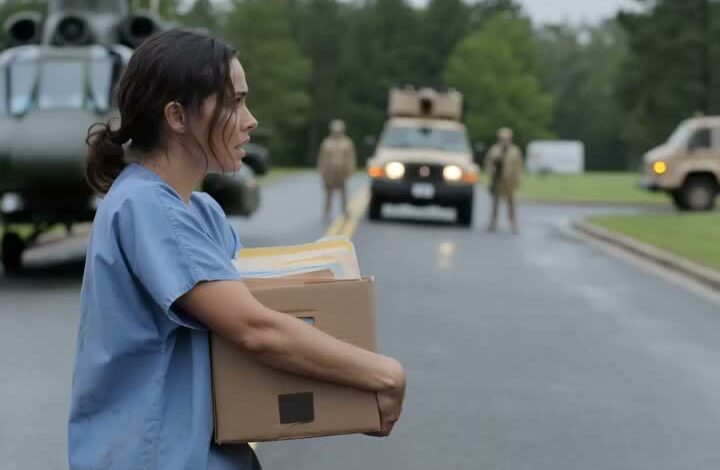
Two black helicopters emerged through rain clouds like predators descending from another world.
Not medical aircraft.
Military.
The lead helicopter banked sharply overhead, downdraft exploding rainwater sideways across the highway.
Traffic screeched to sudden stops.
People climbed from vehicles staring upward in confusion.
Rachel froze beside the guardrail clutching her collapsing cardboard box.
The helicopter descended directly onto the road.
Wind tore the box from her hands instantly.
Her coffee mug shattered across asphalt.
Cooper’s photograph spun through rainwater into roadside grass.
Operators jumped from the aircraft before the rotors fully slowed.
Fast.
Precise.
Armed heavily.
One massive bearded soldier sprinted directly toward her.
Rachel’s pulse hammered.
“Ma’am!”
He stopped several feet away, hands visible deliberately.
“Are you Nurse Rachel Bennett?”
She nodded cautiously.
The soldier touched his earpiece.
“Command, positive ID.”
Then he looked directly at her.
“That patient you saved?”
Rachel swallowed hard.
“Yes?”
“He’s Captain Elias Thorne.”
Even through exhaustion and shock, the name hit with weight.
The soldier continued:
“Delta Force. Tier One operator. Missing during an off-books mission for thirty-six hours.”
Rachel stared speechlessly.
“He regained consciousness long enough to make one secure call.” The soldier’s expression softened slightly. “First thing he said wasn’t about extraction coordinates.”
“What did he say?”
The soldier almost smiled.
“He said: ‘Find the nurse who refused to let me die.’”
Rain streamed down Rachel’s face unnoticed now.
Back at St. Jude’s Medical Center, Dr. Gregory Alcott still had absolutely no idea what kind of storm he had just invited into his hospital.
And upstairs in a hidden trauma bed, Captain Elias Thorne was awake now.
Watching.
Waiting.
Very calmly planning what happened next.