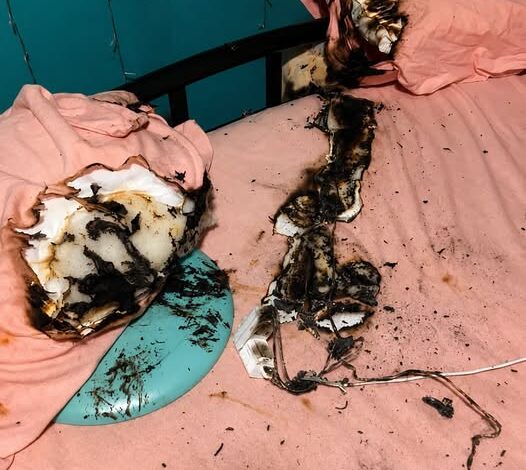
For millions of people, plugging in a phone before going to bed is as automatic as locking the front door or turning off the lights. The charger goes into the outlet, the phone is placed within easy reach, and by morning it’s fully powered for another busy day. But there is one part of that nightly routine many people never stop to question: exactly where the phone is charging while they sleep.
For some, it rests on a bedside table.
For others, it ends up tucked beneath a pillow, buried under blankets, or lying directly on the mattress only inches away. It feels convenient, especially if the phone doubles as an alarm clock or if you like having it close at hand. Yet fire safety experts say this common habit can create an unnecessary—and potentially dangerous—risk.
Fire departments across the country have repeatedly warned against charging phones in places where heat cannot escape properly.
One widely shared reminder came from the Newton Fire Department in New Hampshire, which highlighted a concerning trend among young people. According to information shared in the department’s public safety message, more than half of children and teenagers were reported to charge their phones or tablets on their beds or underneath their pillows while sleeping.
At first glance, the practice seems harmless.
Modern smartphones are designed with multiple safety features, and under normal conditions they can be charged safely. The problem isn’t usually the phone itself—it’s the environment surrounding it.
Whenever a phone charges, both the battery and the charger naturally generate heat. Under ordinary circumstances, that warmth dissipates into the surrounding air. Placing the device on a hard, flat surface such as a nightstand allows air to circulate around it, helping keep temperatures within a normal range.
Soft bedding changes that completely.
Blankets, comforters, pillows, and mattresses trap heat instead of releasing it. When a charging phone is buried beneath these materials, airflow becomes restricted, making it much harder for heat to escape. As temperatures continue rising, the charger, cable, or phone may become significantly hotter than intended.
Although serious incidents are uncommon, overheating electronics have the potential to damage batteries or, in rare cases, ignite nearby combustible materials.
Bedding is particularly vulnerable because fabrics and stuffing can retain heat for extended periods. If a device or charging accessory malfunctions while surrounded by pillows or blankets, the risk of a fire spreading increases considerably compared with charging on a solid, open surface.
The danger becomes even greater when damaged equipment is involved.
Frayed charging cables, cracked adapters, counterfeit accessories, or batteries that have been dropped, swollen, or otherwise damaged can increase the likelihood of overheating. Using manufacturer-approved chargers and replacing worn cables are simple steps that significantly improve charging safety.
Fortunately, reducing the risk requires only a few easy habits.
Charge your phone on a hard, nonflammable surface such as a bedside table, desk, or dresser where air can circulate freely. Keep chargers away from pillows, blankets, and upholstered furniture whenever possible. Avoid covering a charging phone with clothing or bedding, and unplug damaged chargers immediately rather than continuing to use them.
It’s also wise to periodically check that your charging equipment remains in good condition.
If a charger becomes unusually hot, a cable begins fraying, or the phone repeatedly overheats during charging, discontinue using those accessories until they can be replaced. Paying attention to these warning signs may prevent larger problems later.
Parents may also want to discuss safe charging habits with children and teenagers.
Because many young people use phones for alarms, music, or overnight notifications, they are especially likely to keep devices close while sleeping. Teaching them to charge electronics on a nearby table instead of under a pillow is a small lesson that can help establish safer habits for years to come.
Most nights, charging a phone ends exactly as expected—with a fully charged battery waiting in the morning. But good safety practices are about preparing for the rare occasions when something doesn’t go as planned.
In the end, protecting your home may be as simple as moving your phone a few feet away before turning out the lights. That small change costs nothing, takes only seconds, and allows heat to dissipate the way it was intended. Sometimes the simplest adjustments to our daily routines provide the greatest peace of mind while everyone sleeps safely through the night.