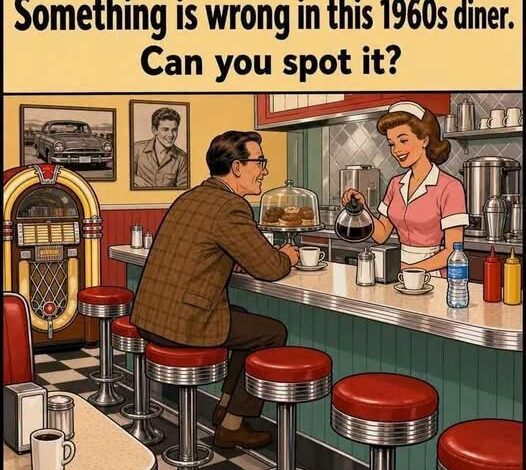
At first glance, the picture seems perfectly convincing. A black-and-white checkered floor stretches beneath polished shoes, fresh coffee sends curls of steam into the air, and a smiling waitress in a crisp vintage uniform moves effortlessly through a cozy diner that appears frozen in the 1960s. Every object feels exactly where it belongs, inviting you to relax and accept the scene without a second thought.
That confidence is exactly what the puzzle is counting on.
Instead of overwhelming you with obvious distractions, it quietly builds a believable world. Your brain immediately recognizes the familiar setting and begins filling in the missing pieces automatically. Once it decides the image makes sense, it stops examining every detail with the same level of care. The scene feels complete, so your mind assumes everything inside it must belong there.
Hidden within that sense of certainty is a single mistake.
It isn’t tucked into a dark corner or disguised beneath another object. In fact, it’s sitting in plain view the entire time. Yet countless people scan the picture again and again without noticing it because their expectations are doing most of the looking for them.
The giveaway is a plastic water bottle.
Today, seeing a disposable bottle on a restaurant table barely registers. They’re found in homes, offices, cars, schools, and nearly every café or diner you visit. They’ve become such an ordinary part of daily life that your brain accepts their presence almost automatically.
But that’s where the illusion falls apart.
A classic 1960s diner would not have featured the kind of disposable plastic water bottle we know today. Its presence quietly breaks the historical setting, yet because it feels so familiar to modern eyes, many viewers never question it. Instead of standing out, it blends into the background, protected by the simple fact that we’ve become accustomed to seeing it everywhere.
That’s what makes this puzzle so clever.
It isn’t really testing eyesight alone. It’s testing perception.
Our brains are designed to process enormous amounts of information quickly, so they constantly rely on shortcuts. Rather than inspecting every single object individually, we compare what we see to patterns we’ve stored over years of experience. If most of the scene matches what we expect, our minds often assume the remaining details belong there as well.
This mental shortcut is incredibly useful in everyday life. It allows us to navigate familiar environments without analyzing every face, sign, or object we encounter. But the same efficiency can also cause us to overlook inconsistencies hiding in plain sight.
That’s why many optical puzzles feel so surprising. They expose the gap between what our eyes capture and what our brains choose to acknowledge. We aren’t actually seeing every detail equally—we’re filtering reality through expectations built from memory and habit.
The misplaced water bottle is a perfect example. It doesn’t fool us because it’s hidden exceptionally well. It fools us because our minds quietly rewrite the story, making a modern object feel perfectly natural inside a setting where it doesn’t belong.
Once someone points it out, the mistake suddenly seems impossible to miss. You may even wonder how you overlooked something so obvious. Yet that moment of realization is precisely what makes these puzzles so satisfying. They remind us that observation isn’t simply about looking harder—it’s about looking differently.
Beyond the challenge itself, there’s a valuable lesson hidden inside this simple image. Every day we move through the world assuming familiar things deserve little attention. We overlook small changes, ignore tiny inconsistencies, and often accept appearances without questioning them because they fit comfortably within our expectations.
Sometimes that’s harmless.
Other times, slowing down and taking a second look reveals details we would have otherwise missed.
In the end, this puzzle isn’t really about a plastic water bottle in a vintage diner. It’s about the remarkable way the human mind works—brilliant, efficient, and occasionally a little too eager to believe what feels familiar. The sharpest observers aren’t always the ones with the best eyesight; they’re the ones willing to pause, challenge their assumptions, and notice the ordinary details everyone else lets slip by.