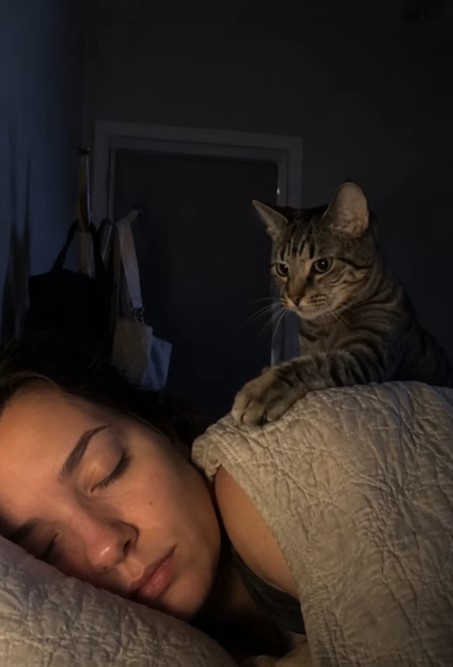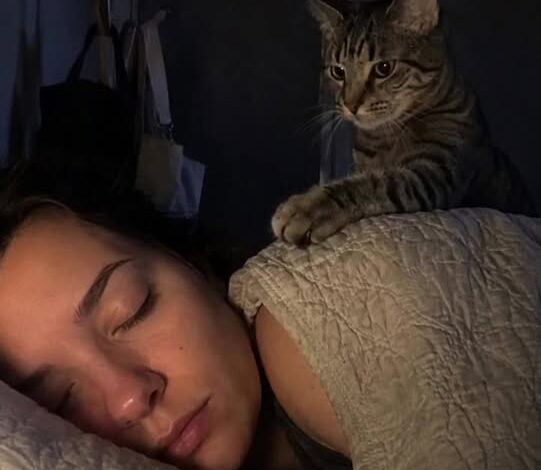
What began as a puzzling nightly routine between a woman and her beloved cat eventually led to the discovery of a serious health condition that might otherwise have gone unnoticed.
For months, Anna struggled to understand why her cat, Luna, seemed determined to keep her awake every night.
During the day, Luna was the perfect companion. The gray tabby was affectionate, gentle, and calm. She followed Anna from room to room, curled up beside her while she worked, and greeted her at the door whenever she came home. Friends often commented on how well-behaved and loving the cat was.
Nothing about Luna’s daytime behavior suggested there was a problem.
But as soon as night fell, everything changed.
At almost the exact same time every evening, Luna would begin a strange routine that gradually turned Anna’s nights into a battle for sleep.
At first, it seemed harmless.
The cat would lightly tap Anna’s cheek with a paw.
Sometimes she would nudge her shoulder.
Other times she would sit on her chest and stare directly into her face until Anna woke up.
Anna assumed Luna simply wanted attention.
Like many cat owners, she figured her pet had developed an inconvenient nighttime habit.
But the behavior didn’t stop.
In fact, it became increasingly persistent.
If Anna ignored the gentle paw taps, Luna would escalate.
She began scratching at the blankets.
She pawed at pillows.
She meowed loudly beside the bed.
Occasionally, she even delivered small, harmless nips to Anna’s hand or arm.
The goal always seemed the same:
Wake up.
At first Anna tried everything she could think of.
She changed feeding schedules.
She played with Luna before bedtime to burn off extra energy.
She purchased new toys.
She adjusted lighting.
She even tried keeping Luna out of the bedroom.
Nothing worked.
In fact, closing the bedroom door only made things worse.
The cat would scratch relentlessly at the door until Anna gave up and let her inside.
Then one night Anna noticed something strange.
After nearly an hour of interruptions, she finally became frustrated and moved to the couch in the living room.
Within minutes, Luna stopped bothering her.
The cat calmly returned to the bedroom and slept through the remainder of the night.
The same thing happened the following evening.
And the evening after that.
Eventually a bizarre pattern emerged.
Luna seemed determined to get Anna out of the bedroom.
Once Anna left the room, the cat relaxed completely.
For nearly three months, the cycle repeated itself.
Night after night.
Week after week.
Anna’s sleep deteriorated.
She woke up exhausted.
She struggled to concentrate at work.
Her patience grew thin.
Yet beneath the frustration was something else.
Concern.
Luna wasn’t acting like a mischievous cat.
She was acting as though something was wrong.
Finally, Anna decided it was time to seek professional advice.
She scheduled an appointment with her veterinarian.
When she arrived at the clinic carrying Luna’s carrier, she looked tired.
The veterinarian immediately noticed the dark circles beneath her eyes.
“You look exhausted,” he remarked gently.
Anna laughed.
“I am exhausted.”
She then described the nightly routine in detail.
The pawing.
The scratching.
The biting.
The way Luna would only calm down once Anna left the bedroom.
The veterinarian listened carefully.
Behavioral complaints involving cats were common.
Excess energy.
Nighttime activity.
Attention-seeking.
Anxiety.
These were all things veterinarians encountered regularly.
Yet something about Anna’s story stood out.
This wasn’t random behavior.
It was remarkably consistent.
Almost purposeful.
When the examination began, Luna appeared perfectly healthy.
Her heart rate was normal.
Her lungs sounded clear.
Her weight was healthy.
There were no signs of illness, injury, or neurological problems.
Physically, she seemed fine.
But during the consultation, the veterinarian noticed something unusual.
Luna never stopped watching Anna.
Every movement Anna made, the cat followed with her eyes.
When Anna shifted in her chair, Luna adjusted.
When Anna stood up, Luna became alert.
The veterinarian found it curious.
Then he asked a question that caught Anna off guard.
“How have you been sleeping?”
Anna laughed again.
“Terribly.”
“No,” he clarified. “Before Luna wakes you up.”
The question made her pause.
She thought about it for a moment.
Then she admitted something she hadn’t considered important.
Lately, she often woke feeling strange.
Her heart raced.
Her mouth felt dry.
Sometimes she felt short of breath.
Occasionally she woke gasping.
She assumed it was stress.
Or anxiety.
Or simply poor sleep.
The veterinarian continued asking questions.
Had anyone ever mentioned unusual breathing while she slept?
Actually, yes.
A neighbor who occasionally stayed overnight had once mentioned hearing long pauses in her breathing.
Then sudden gasps.
At the time, Anna dismissed it.
Now the veterinarian’s expression changed slightly.
The conversation was no longer entirely about Luna.
It was becoming about Anna.
The veterinarian explained something she had never considered.
Animals often notice physiological changes humans miss.
Dogs and cats can detect alterations in breathing patterns, heart rate, body temperature, scent, and even blood chemistry.
Many owners underestimate just how observant animals can be.
“It’s possible,” he explained carefully, “that Luna isn’t trying to bother you.”
Anna frowned.
“Then what is she doing?”
The veterinarian leaned forward.
“She may be trying to wake you up.”
The possibility stunned her.
The doctor continued.
“If your breathing becomes irregular while you’re asleep, or if your body enters a state of distress, Luna may be responding to that.”
The idea sounded unbelievable.
Yet suddenly everything began making sense.
Why Luna always targeted her during sleep.
Why she seemed so determined.
Why the behavior stopped when Anna got up and moved around.
The veterinarian recommended a full medical evaluation.
Blood tests.
Cardiac screening.
A sleep study.
Just to be safe.
A week later, Anna followed the advice.
The results surprised everyone.
Doctors discovered significantly elevated blood sugar levels.
Further testing revealed metabolic concerns requiring treatment.
Cardiac monitoring showed irregularities that needed follow-up care.
Most importantly, the sleep study confirmed repeated episodes of disrupted breathing throughout the night.
Several times every hour, Anna’s breathing became dangerously irregular.
In some instances, it briefly stopped altogether before she suddenly gasped awake.
The findings were serious.
And suddenly Luna’s behavior looked very different.
Every time the cat had clawed at blankets, tapped her face, or forced her out of bed, it likely coincided with one of these episodes.
When Anna sat up, moved around, or relocated to the couch, her breathing patterns changed.
The distress eased.
And Luna relaxed.
The cat hadn’t been misbehaving.
She had been responding.
Months of confusion instantly transformed into understanding.
Treatment began immediately.
Doctors developed a plan to manage Anna’s health conditions.
Lifestyle changes were introduced.
Monitoring continued.
Slowly, her symptoms improved.
And something remarkable happened.
Luna stopped waking her up.
The nightly interruptions disappeared almost entirely.
The scratching ended.
The pawing stopped.
The frantic attempts to force Anna out of the bedroom vanished.
Instead, Luna curled up beside her owner and slept peacefully through the night.
For the first time in months, both of them rested.
Looking back, Anna often wondered what might have happened had she ignored the problem.
She had assumed Luna was creating a problem.
In reality, Luna may have been drawing attention to one.
The experience changed how she viewed her relationship with her pet.
What once felt like a frustrating mystery became a powerful reminder of the unique bond that exists between humans and animals.
Today, Anna is healthier.
Her medical conditions are managed.
Her sleep has improved.
And every night, Luna still sleeps beside her.
Only now, when she feels the gentle weight of her cat curled against her side, she sees it differently.
Not as a nuisance.
Not as a disruption.
But as a quiet companion who may have noticed something important long before anyone else did.
Sometimes the people who care for us cannot see what’s wrong.
Sometimes even doctors need tests to uncover hidden problems.
And sometimes, the first warning comes from a pair of watchful eyes and a determined cat who simply refuses to let you sleep through the danger.