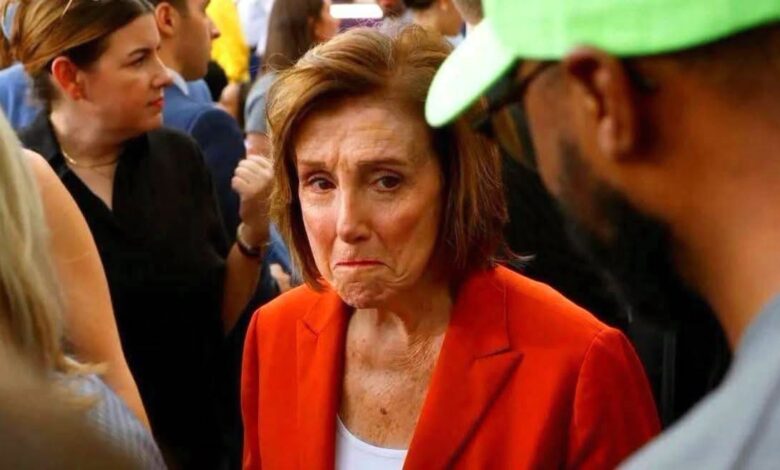
For once, Nancy Pelosi wasn’t speaking as the woman who had spent decades at the center of America’s political wars.
She was speaking as someone who knew that every era eventually ends.
The room had heard her deliver countless speeches before—arguments sharpened by years of congressional combat, celebrations after hard-won victories, condemnations delivered when Washington seemed divided beyond repair.
But this felt different.
There was less fire in the words.
More memory.
She spoke about the Capitol not merely as a building where legislation was written, but as a place that had consumed an enormous portion of her life.
There had been late nights when negotiations stretched toward sunrise.
Votes decided by margins so narrow that every conversation mattered.
Meetings behind closed doors where a few sentences could alter the direction of legislation affecting millions of people.
There had been victories.
There had also been defeats.
And behind all of them was a cost rarely visible on television.
Political power demands time.
Time away from family.
Time surrendered to airports, motorcades, meetings, fundraisers, security briefings, strategy sessions, and endless negotiations.
Years disappear into election cycles.
Children grow older.
Grandchildren arrive.
The country changes.
Then one day, the politician who spent decades thinking about the next vote has to confront a much more personal question:
When is it time to step aside?
For Pelosi, that question carried unusual weight.
Her career had broken one of the most significant barriers in American politics.
In 2007, she became the first woman to serve as Speaker of the U.S. House of Representatives.
The image itself mattered.
A woman holding the Speaker’s gavel was something generations of Americans had never seen.
To supporters, her rise represented progress that had taken far too long.
To opponents, she became one of the most recognizable symbols of Democratic power.
That polarization followed her everywhere.
Pelosi was never merely another congressional leader.
Her name became political shorthand.
Candidates campaigned against her from districts she had never visited.
Fundraising advertisements used her face to energize both supporters and opponents.
Television commentators debated her every maneuver.
Through it all, she developed a reputation for understanding one of Washington’s least glamorous but most important skills:
Counting votes.
A Speaker can make grand promises.
But promises mean little without enough members willing to press the right button when legislation reaches the House floor.
Pelosi understood that arithmetic.
She knew when to push.
When to wait.
When to negotiate.
And when a member needed permission to vote against the party because survival back home mattered more than symbolic unity in Washington.
That skill made her formidable.
It also made her controversial.
Her supporters saw discipline and strategic brilliance.
Her critics saw centralized power and relentless partisanship.
Both reactions became part of her political identity.
Yet leadership looked different when viewed from inside her own family.
Behind the motorcades and television appearances were birthdays missed, dinners interrupted, and personal moments rearranged around the demands of public office.
Power may look glamorous from outside.
Living with it rarely is.
The pressures became painfully visible in 2022 when her husband, Paul Pelosi, was violently attacked in their San Francisco home.
The assault transformed political hostility into something terrifyingly personal.
For a family accustomed to criticism, this was different.
Words had become violence.
The distance between public service and private vulnerability suddenly disappeared.
It was another reminder that political careers don’t belong solely to politicians.
Families live inside them too.
By then, Pelosi had already become one of the longest-serving and most consequential congressional figures of her generation.
She had worked with multiple presidents.
She had watched control of Congress repeatedly change hands.
She had participated in battles over healthcare, economic crises, impeachment, war, social policy, government spending, and the limits of presidential power.
She had been celebrated.
Vilified.
Parodied.
Threatened.
Applauded.
And blamed for things she controlled as well as things she didn’t.
Eventually, however, even the most powerful political figures confront something they cannot negotiate with:
Time.
When Pelosi announced in November 2022 that she would not seek another term as Democratic House leader, she framed the transition around the future rather than defeat.
“For me, the hour’s come for a new generation to lead the Democratic caucus that I so deeply respect,” she told the House.
It was an acknowledgment of something political institutions often struggle to accept.
Leadership cannot remain frozen around the same personalities forever.
A party that talks constantly about the future eventually has to allow new people to shape it.
That didn’t mean Pelosi vanished.
Stepping away from leadership was not the same as immediately leaving Congress, and her influence did not evaporate when someone else inherited the formal title.
Decades of relationships don’t disappear because an office changes hands.
Neither does institutional knowledge.
But symbolically, something had changed.
For years, it had been almost impossible to imagine House Democrats without Nancy Pelosi somewhere near the center of the picture.
Now the picture was changing.
That transition invited people to reconsider her career beyond the slogans that had accumulated around her.
History rarely remembers political leaders exactly as their contemporaries do.
The daily outrage fades.
Campaign advertisements disappear.
Social-media arguments become digital debris.
What remains are decisions.
Laws.
Votes.
Institutions.
Consequences.
And the barriers someone either broke or reinforced.
Pelosi’s legacy will therefore remain contested.
Her admirers will emphasize her historic rise, legislative victories, political discipline, and ability to hold together a diverse caucus during extraordinarily turbulent years.
Her critics will point to policies they opposed, partisan battles they believe she intensified, questions about congressional leadership, and a political culture they felt she represented.
Both belong in any serious assessment of her career.
Public service doesn’t become admirable merely because it lasts a long time.
Nor does disagreement erase historical significance.
Pelosi’s importance comes partly from the fact that she mattered enough to inspire such intense reactions.
For millions of Americans, she represented progress.
For millions of others, she represented precisely the kind of Washington establishment they wanted replaced.
Few political figures remain at the center of national attention for decades without becoming symbols larger than themselves.
Pelosi did.
And symbols eventually obscure people.
That’s why moments of transition can feel unexpectedly human.
Strip away the title.
The security detail.
The podium.
The partisan applause.
Eventually, there is simply a person looking backward at years that cannot be recovered.
Every major political victory required something.
Every defeat left something behind.
Every late-night vote was also a night not spent somewhere else.
That is the bargain of a life devoted to public power.
Perhaps that’s why a farewell from leadership can carry a strange emotional weight even for people who strongly disagree with the person delivering it.
You don’t have to admire someone’s politics to recognize the closing of an era.
Political generations arrive believing they’ll reshape Washington permanently.
Then another generation appears behind them.
The offices remain.
The portraits change.
New members occupy familiar chairs.
Different voices command the chamber.
Eventually, even names that once dominated every headline become chapters in history books.
For Pelosi, stepping away from Democratic leadership represented that inevitable transition.
The woman who had once shattered a ceiling by taking the Speaker’s gavel was now helping hand responsibility to politicians who had entered public life in a world partly changed by that achievement.
There is something fitting about that.
Breaking a barrier matters.
But eventually, the greater test is whether the path remains open after the person who broke it moves aside.
The applause eventually stops.
The chamber empties.
Staff members collect papers.
Television networks move to another story.
Washington continues because Washington always continues.
But certain departures alter the shape of the place.
For decades, Nancy Pelosi’s silhouette had been unmistakable at the center of American political conflict.
Supporters cheered it.
Opponents campaigned against it.
History will spend years deciding what it meant.
Whatever judgment ultimately emerges, one fact is difficult to dispute:
An era of congressional politics was shaped by her presence.
And when a figure who has occupied that much political space begins moving away from the center, the absence itself becomes part of the story.
Power is temporary.
Institutions outlive the people who command them.
And sometimes the final act of leadership isn’t holding the gavel tighter.
It’s knowing when to let someone else reach for it.