The day my daughter was diagnosed with leukemia, time seemed to split into two separate lives.
There was everything that came before.
And everything that came after.
Before the diagnosis, Carol was seventeen years old and bursting with plans for the future. She filled notebooks with ideas, laughed loudly at her own jokes, and talked endlessly about the milestones she couldn’t wait to experience.
College.
Road trips.
Graduation.
The freedom that comes with adulthood.
And above all else, prom.
For years, prom had occupied a special place in her imagination.
Magazine clippings covered one corner of her bedroom mirror. Photos of dresses she loved were carefully taped beside handwritten notes and little reminders. Every few months she would find a new style she adored and excitedly add it to her collection.
Sometimes she’d stand in front of the mirror and point at one of them.
“That’s the one,” she’d say.
Then a week later she’d find another.
“No, actually, this one.”
I always laughed.
And every single time she would end the conversation the same way.
“Promise you’ll help me get ready?”
“Of course.”
“You’ll do my hair?”
“Of course.”
“You won’t cry?”
That always made me smile.
“No promises.”
Back then, neither of us imagined those conversations would become some of the most precious memories I would ever have.
Because then came the diagnosis.
And suddenly, the future stopped feeling guaranteed.
The weeks that followed were a blur of appointments, specialists, scans, tests, and words I never wanted to learn.
Chemotherapy.
White blood cell counts.
Treatment protocols.
Risk assessments.
Side effects.
Every day brought another conversation.
Another update.
Another reason to hope.
Another reason to worry.
Life slowly shrank until it revolved around hospital rooms and medical schedules.
Morning began with test results.
Afternoon disappeared into treatments.
Evening ended with quiet prayers neither of us spoke aloud.
The hospital became our second home.
Then, eventually, it became our only home.
Months passed.
The energetic teenager who once rushed through life now spent most of her days connected to machines.
The strongest person I knew was slowly being worn down by a battle she never asked to fight.
And yet somehow, she remained herself.
She still laughed.
Still teased nurses.
Still rolled her eyes at my bad jokes.
Still found reasons to smile when I couldn’t.
One thing never left her side.
A small journal.
Dark blue.
Worn around the edges.
Protected like a treasure.
She wrote in it constantly.
Sometimes late at night.
Sometimes early in the morning.
Sometimes immediately after visitors left.
Whenever anyone got too close, she would close it quickly.
“It’s private,” she’d say.
And that was that.
One afternoon, I noticed it resting near her pillow.
The room was unusually quiet.
Only the steady rhythm of medical equipment filled the silence.
Carol had fallen asleep after a difficult treatment.
Her face looked pale.
Exhausted.
Older than seventeen.
For a moment, I found myself staring at the journal.
Wondering what thoughts lived inside those pages.
Wondering what fears she never shared.
Wondering whether she was as scared as I was.
Then she opened her eyes.
Caught me looking.
And immediately pulled the journal closer.
“It’s just my thoughts,” she said softly.
The familiar smile appeared.
Even then.
Even there.
She was still protecting little pieces of herself.
Still trying to maintain some sense of normal teenage life inside a world that had become anything but normal.
Not long afterward, her phone buzzed.
The screen lit up.
A message from Daryl.
Just seeing his name changed her expression.
Daryl had been part of Carol’s life since middle school.
Their friendship had survived awkward teenage years, changing schools, and now something much harder.
Cancer.
While many people struggled to find the right words, Daryl never seemed to.
He didn’t offer speeches.
He didn’t force optimism.
He simply showed up.
Sometimes through messages.
Sometimes through visits.
Sometimes through silence.
And somehow that was enough.
He reminded her that a world still existed beyond hospital walls.
A world waiting for her.
As spring approached, one reality became impossible to ignore.
Prom season had arrived.
Everywhere we looked, it was there.
Social media posts.
School announcements.
Friends discussing dresses and dates.
A celebration that had once seemed inevitable now felt painfully distant.
Then one afternoon Carol asked the question I’d been dreading.
“Do you think I’ll make it to prom?”
The words hit harder than any doctor’s report.
Because I knew she wasn’t asking about a dance.
She was asking whether life would give her one more chance to be a normal teenager.
One more chance to experience something she’d dreamed about for years.
I wanted to answer honestly.
But honesty and hope don’t always agree.
So I took her hand and smiled.
“We’ll figure it out.”
It wasn’t an answer.
But it was all I had.
The truth was far more frightening.
Her condition had worsened.
Treatments seemed less effective.
The doctors remained professional, but I could see concern hiding behind their carefully chosen words.
Carol could see it too.
Though neither of us admitted it.
The days became harder.
The treatments became harder.
The waiting became unbearable.
Some nights she stared quietly out the window.
Other nights she asked questions that broke my heart.
Questions no parent is ever prepared to answer.
And still, somehow, she kept smiling.
Then came the night that changed everything.
I was sitting outside her room when a nurse approached.
There was something unusual in her expression.
A smile she was trying unsuccessfully to hide.
“Carol wants you in the hallway.”
Immediately, my stomach dropped.
When you’ve spent months in a hospital, unexpected requests rarely feel comforting.
My mind raced through possibilities.
I stood up.
Walked toward the door.
Opened it.
And froze.
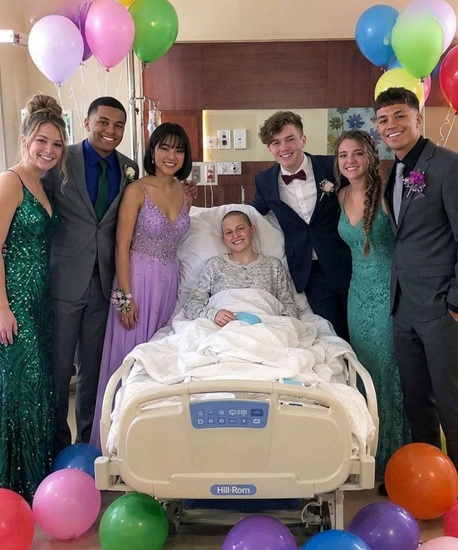
The hallway had transformed.
Completely transformed.
Colorful decorations hung from walls.
String lights glowed softly overhead.
Music drifted through the corridor.
Tables held snacks and drinks.
Balloons floated everywhere.
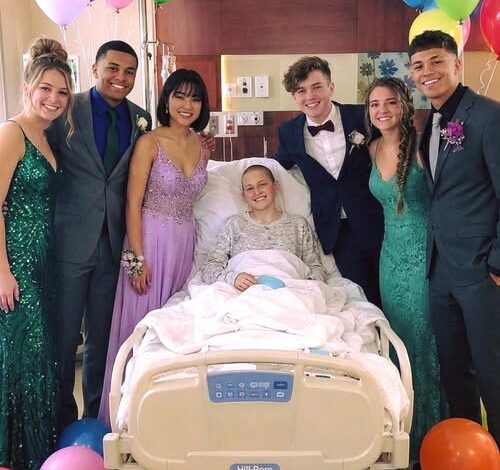
And standing in the middle of it all were dozens of teenagers dressed in formal clothes.
Friends.
Classmates.
People who had refused to let Carol miss the night she’d spent years dreaming about.
At the center stood Daryl.
Smiling.
Nervous.
Proud.
“We brought prom to her.”
For a moment, I couldn’t breathe.
Couldn’t speak.
Couldn’t think.
The sheer kindness of it overwhelmed me.
Every student there had chosen to spend their evening in a hospital.
Not because they had to.
Because they wanted to.
Because they loved her.
When Carol was brought into the hallway, the reaction was immediate.
Her eyes widened.
Her hands flew to her face.
Then came laughter.
Then tears.
Then more laughter.
The kind that comes when joy and disbelief collide at the same time.
She looked around as though she couldn’t trust what she was seeing.
Music.
Friends.
Decorations.
Life.
For one night, cancer wasn’t the center of the room anymore.
Carol was.
Her friends helped her dress up as best they could.
Photos were taken.
Food was shared.
Music played.
People danced.
And for the first time in months, I saw my daughter instead of her illness.
Not a patient.
Not a diagnosis.
Not a collection of medical charts.
Just a seventeen-year-old girl experiencing prom.
Exactly as she always dreamed.
Then something happened that changed the night forever.
I stepped into the hallway to compose myself.
Daryl followed.
His expression was serious now.
Careful.
He handed me an envelope.
“She wanted you to have this tonight.”
My heart sank.
Immediately.
Because somehow I knew.
Inside were letters.
Several of them.
One addressed to friends.
One addressed to family.
And one addressed to me.
My hands trembled as I opened mine.
And with every line, my heart broke.
Carol knew.
She had known for weeks.
Maybe longer.
She had overheard conversations.
Seen expressions.
Connected pieces nobody thought she noticed.
She understood her condition wasn’t improving the way we’d hoped.
And she never told me.
Not because she was in denial.
Because she was protecting me.
Just as I had spent months trying to protect her.
The realization shattered me.
While I worried endlessly about her fear, she had quietly carried mine.
Alone.
Then I understood something else.
This wasn’t just a prom.
It was a gift.
A memory she wanted all of us to have.
A moment of happiness she refused to let cancer steal.
When I returned, Carol immediately knew I’d read the letter.
Our eyes met.
Neither of us needed to speak.
The truth was already there.
Tears filled her eyes.
“I’m sorry,” she whispered.
I crossed the room and took her hands.
“You never have to carry this alone again.”
The room fell silent.
Friends stopped talking.
Music continued softly in the background.
Everyone watched.
Waiting.
Then I asked her something unexpected.
“Would you dance with me?”
She smiled through tears.
And nodded.
With help, she stood.
Slowly.
Carefully.
The room opened around us.
Music played.
And together we danced.
Not perfectly.
Not gracefully.
None of that mattered.
For those few minutes there were no doctors.
No treatments.
No statistics.
No fear.
Just a mother and her daughter.
Holding each other.
Sharing a moment neither would ever forget.
Many of her friends cried openly.
Nurses stood quietly along the walls.
Even strangers passing through the hallway stopped to watch.
Because everyone understood they were witnessing something rare.
A moment of pure love.
A moment stronger than fear.
Weeks later, the doctors delivered unexpected news.
Carol’s condition had stabilized slightly.
Not cured.
Not resolved.
But improved.
Enough to buy more time.
And when you’ve spent months believing time is slipping away, more time feels like a miracle.
Looking back now, I understand that the hospital prom changed us.
Not because it solved anything.
Not because it erased fear.
But because it reminded us what truly matters.
Not certainty.
Not control.
Not guarantees.
Connection.
Honesty.
Presence.
Love.
Cancer taught us how fragile life can be.
But that night taught us something else.
Even in the darkest places, people are capable of creating light.
Sometimes it arrives through doctors.
Sometimes through family.
Sometimes through a hallway filled with teenagers refusing to let a friend miss one important night.
And sometimes it arrives through a simple dance.
A dance that reminded a mother and daughter that no matter what the future held, they would face it together.
One step at a time.
One song at a time.