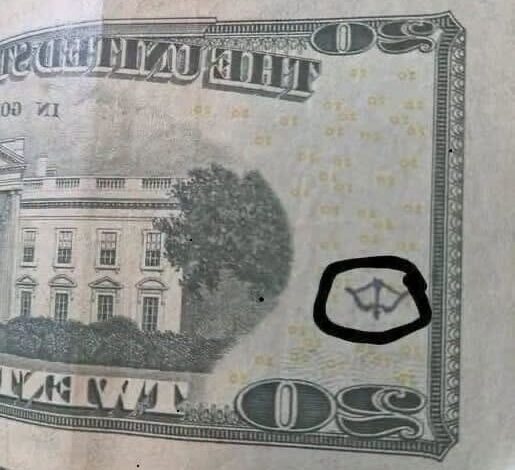
At first glance, they look like little more than random ink stains. Tiny circles, initials, symbols, or faded stamps scattered across a U.S. dollar bill might seem like damage—or even evidence that someone simply scribbled on the note. Yet in many parts of the world, those seemingly insignificant marks tell a remarkable story. They are known as chop marks, and each one represents a moment when trust had to be earned before business could continue.
Long before electronic payment systems and sophisticated counterfeit detectors became common, merchants handling foreign currency faced a difficult challenge. Every banknote carried value only if it was genuine, and in busy markets where hundreds of transactions occurred each day, there wasn’t always time—or technology—to verify every bill using specialized equipment.
Instead, traders relied on experience.
When a money changer, merchant, or financial intermediary carefully examined a U.S. dollar and concluded it was authentic, they would sometimes leave a small stamp or handwritten mark directly on the note. That simple symbol served as a personal endorsement, signaling that the bill had already been inspected and accepted in commerce.
In many places, that tiny mark carried significant weight.
It wasn’t issued by a government or central bank.
It wasn’t an official certification.
Rather, it reflected the reputation of the person who applied it. By marking the bill, the merchant was, in effect, saying, “I’ve examined this note and believe it’s genuine.” If others recognized or trusted that individual’s mark, they could feel more confident accepting the currency themselves.
This practice became especially useful in regions where counterfeit detection tools were unavailable, unreliable, or simply impractical for everyday transactions.
A quick glance at a familiar chop mark could save valuable time.
More importantly, it could reduce uncertainty.
For businesses operating in busy border crossings, wholesale markets, tourist districts, or communities where U.S. dollars circulated alongside local currencies, that confidence helped commerce move more smoothly.
Over the years, a single banknote might collect numerous chop marks.
Each stamp represented another stop on its journey.
One merchant accepted it.
Another verified it.
A third passed it along in exchange for goods or services.
As the bill traveled from one city to another—and sometimes from one country to the next—it quietly accumulated evidence of its remarkable history.
Viewed closely, a heavily marked note almost resembles a passport filled with immigration stamps.
Each symbol hints at a transaction.
A negotiation.
A moment when someone decided the piece of paper in their hand could be trusted.
Although the exact path can rarely be reconstructed, collectors often imagine the extraordinary journeys such notes may have taken. A single dollar bill might have circulated through border towns, bustling marketplaces, shipping ports, tourist destinations, wholesale warehouses, or currency exchange counters before eventually returning to a bank thousands of miles from where it began.
Of course, modern banking systems generally prefer clean, undamaged currency.
Heavily stamped or extensively marked bills may be rejected by vending machines, automated cash-handling equipment, or currency-sorting machines. Financial institutions sometimes remove excessively marked notes from circulation and replace them with fresh ones to maintain the quality of circulating cash.
For most banks, the marks are considered wear.
For many collectors, however, they represent history.
Numismatists—people who study and collect coins and paper money—often find chop-marked notes especially fascinating because each mark documents a real-world interaction that official records rarely capture. While the stamps may not increase every bill’s monetary value, they can add historical interest by illustrating how money traveled through international trade networks.
The practice also highlights something easily overlooked about currency itself.
A banknote has value not merely because of the paper it’s printed on, but because people collectively agree to trust it.
That trust is reinforced through governments, central banks, financial institutions, and legal systems.
Yet on the busiest streets and in the smallest marketplaces around the world, trust has often depended just as much on individual judgment.
One merchant examined a note.
Another respected that merchant’s experience.
Business continued.
In that sense, chop marks symbolize far more than authentication.
They reflect cooperation.
Reputation.
Shared confidence.
They remind us that global commerce has always relied not only on economics but also on relationships between people willing to honor one another’s assessments.
Today, digital payments move billions of dollars around the world in fractions of a second, often without either party ever touching physical cash. Even so, these marked banknotes remain quiet reminders of an earlier era when every transaction depended on careful inspection and personal credibility.
A small stamp might seem insignificant.
Yet behind each faded symbol lies a moment of uncertainty resolved—a decision that a simple piece of paper could be trusted enough to complete a sale, pay a debt, or keep a business operating.
What appears to be an ordinary ink mark is, in reality, a fragment of economic history.
A silent witness to countless exchanges.
A record of journeys that crossed borders, languages, and cultures.
And a lasting reminder that, long before digital verification became commonplace, the global economy often advanced one carefully inspected dollar bill at a time.