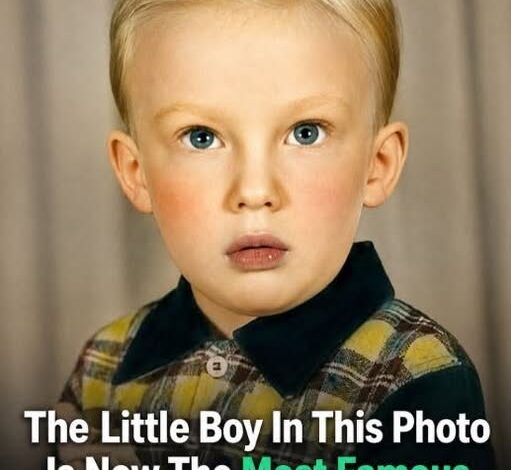
A childhood photograph of Donald Trump recently ignited a surprisingly intense debate online.
The image itself was unremarkable: a blond-haired toddler posing for a family photograph decades before politics, business fame, television stardom, or presidential campaigns entered his life. There was nothing controversial in the picture. No political statement. No headline. No conflict.
Yet once viewers learned who the child would eventually become, the photograph transformed from a simple family snapshot into something much larger.
It became a reflection of how people see Donald Trump today.
Some viewers looked at the image and saw innocence. Others looked at the exact same photograph and saw the future president, businessman, and political figure whose actions and words have generated years of fierce debate. The reactions revealed far more about public perception than about the photograph itself.
For supporters, the image served as a reminder that every public figure begins as a child. Long before political rallies, legal battles, campaign slogans, television appearances, or media scrutiny, Donald Trump was simply a young boy growing up in New York.
Many argued that a childhood photograph should be viewed through that lens alone.
To them, directing political anger toward a picture of a toddler felt unreasonable. Whatever opinions people hold about Trump’s presidency, policies, or public behavior, they argued, those views have nothing to do with an innocent child who had not yet made a single adult decision.
Others reacted differently.
Critics found it difficult to separate the child from the man he later became. For them, the photograph inevitably carried the weight of decades of public controversy. When they looked at the image, they did not merely see a young boy. They saw the future adult associated with political polarization, contentious rhetoric, legal disputes, and some of the most divisive debates in modern American politics.
As a result, the discussion surrounding the photograph quickly moved beyond the image itself.
It became a conversation about identity, memory, and how people interpret public figures.
The photo also renewed interest in Trump’s early life.
Donald Trump was born in Queens, New York, in 1946, the fourth of five children in the family of real estate developer Fred Trump and Mary Anne MacLeod Trump. Raised in a financially successful household, Trump grew up surrounded by business discussions and expectations of achievement.
Many biographers describe Fred Trump as a demanding and disciplined father who placed significant emphasis on competition, success, and toughness. Those values would later become themes commonly associated with Donald Trump’s public persona.
As a teenager, Trump was sent to the New York Military Academy, a private boarding school known for its structured environment and emphasis on discipline. According to numerous biographies and historical accounts, the academy played a significant role in shaping his adolescence.
There, he was exposed to an environment built around hierarchy, achievement, competition, and leadership. Supporters often cite the experience as helping to develop confidence and resilience. Critics sometimes point to it as reinforcing the confrontational style that would later characterize much of his public life.
Of course, childhood experiences alone cannot fully explain who a person becomes.
Human lives are influenced by countless factors: family, education, opportunity, personality, relationships, culture, ambition, luck, and personal choices. No childhood photograph contains a roadmap to the future.
Yet people naturally search for clues.
When a person becomes historically significant, observers often revisit their early years looking for signs that might explain later achievements, failures, strengths, or controversies. Childhood photos become more than memories. They become artifacts examined through the lens of hindsight.
That tendency was clearly visible in the reaction to Trump’s photo.
Some viewers searched for innocence.
Others searched for evidence.
Some searched for humanity.
Others searched for symbolism.
The image itself provided none of those answers. It was simply a frozen moment from long before anyone could have predicted the path ahead.
Over the decades, the child in the photograph would become one of the most recognizable figures in the world. Trump built a public profile through real estate development, branding, entertainment, and eventually politics. His presidency transformed him into a figure who inspired extraordinary loyalty among supporters and equally intense opposition among critics.
Few modern public figures have generated such strong reactions.
That reality helps explain why a simple childhood image could provoke such emotional responses.
The photograph forced people to confront a complicated truth: every controversial public figure was once an ordinary child. Every famous leader, celebrity, activist, entrepreneur, or politician began life without the identity history would eventually assign to them.
That contrast between beginning and outcome can be unsettling.
It reminds people that human lives are not fixed stories from the start. They unfold over time through countless choices, experiences, successes, mistakes, and circumstances.
In Trump’s case, that journey has been unusually public and unusually polarizing.
The toddler in the photograph could not have known he would one day become a businessman, television personality, president, and central figure in American political life. The people looking at the photograph today bring decades of knowledge, opinion, admiration, criticism, and emotion to an image that originally carried none of those meanings.
Ultimately, the debate surrounding the photograph was never really about the picture itself.
It was about perception.
It was about whether people can separate a child from the adult he becomes.
It was about how strongly public figures shape personal opinions.
And it was about the way history changes the meaning of even the simplest images.
In the end, the photograph remains what it always was: a snapshot of a young child at the beginning of life.
The controversy surrounding it emerged not from the image, but from everything that came afterward.