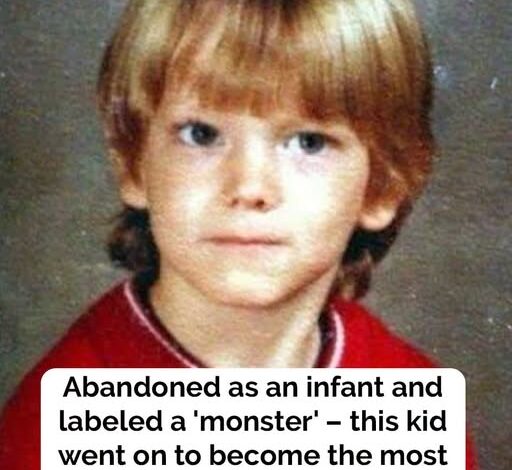
Long before the world knew him as Eminem, he was simply a boy trying to make sense of a childhood that rarely felt safe.
Marshall Mathers entered the world without the stability many children take for granted. His father left when he was an infant, disappearing before Marshall was old enough to form even a single memory of him. That absence became one of the defining questions of his early life—a silence that would echo through his music for decades.
The person who remained, his mother, struggled with challenges that created an unpredictable home environment. Their relationship has long been the subject of public discussion, with Marshall describing a childhood marked by instability, frequent moves, financial hardship, and conflict. While the details of their family life have been disputed publicly over the years, there is little question that his early years were deeply turbulent.
Home rarely felt permanent.
School offered little relief.
As his family moved repeatedly between neighborhoods in Missouri and Michigan, Marshall was forced to start over again and again. Every new classroom meant unfamiliar faces, another attempt to fit in, and another reminder that he was different. He has spoken openly about being bullied throughout his childhood, describing physical assaults, isolation, and humiliation that left lasting emotional scars.
In interviews and his music, he has recalled incidents so severe that they reportedly resulted in hospitalization after one violent attack.
For a child already struggling to find security, those experiences compounded a growing sense of anger, loneliness, and confusion.
Life often felt like something happening to him rather than something he could control.
Yet amid the instability, Marshall discovered one thing that belonged entirely to him.
Words.
At first, they were simply a fascination.
Then they became an escape.
Finally, they became survival.
He immersed himself in language, rhythm, and rhyme, studying the structure of rap with remarkable intensity. Every clever lyric, internal rhyme, and intricate wordplay offered a way to organize emotions that otherwise seemed impossible to explain.
Writing became more than a hobby.
It became both shield and weapon.
On paper, he could confront fear without appearing afraid.
He could transform humiliation into defiance.
He could give voice to emotions that many children are taught to hide.
Those notebooks eventually became the foundation of one of hip-hop’s most distinctive voices.
When Marshall Mathers evolved into Eminem, he made a choice that separated him from many artists.
He refused to sanitize his past.
Instead of presenting himself as invincible, he exposed the parts of himself that were angry, ashamed, frightened, and deeply wounded. His lyrics explored fractured family relationships, poverty, addiction, self-doubt, mental health struggles, and the consequences of his own mistakes with an honesty that was often uncomfortable for listeners.
His music sparked controversy around the world.
Critics questioned his language, his violent imagery, and the intensity of his storytelling.
Supporters argued that his work resonated precisely because it refused to disguise emotional pain behind polished narratives.
Whether celebrated or criticized, Eminem’s songs rarely left audiences indifferent.
For millions of listeners, they reflected emotions that had previously felt impossible to express.
People who had experienced bullying, family conflict, abandonment, addiction, or profound insecurity often found pieces of themselves within his lyrics. His willingness to reveal his own flaws gave others permission to acknowledge theirs.
That vulnerability became one of the defining characteristics of his career.
Success, however, did not erase the struggles that shaped him.
Throughout his life, Eminem has spoken candidly about addiction, recovery, and the difficult process of rebuilding after nearly losing himself to prescription drug dependence. Rather than pretending those chapters never happened, he incorporated them into his story, acknowledging both the damage they caused and the effort required to move forward.
Perhaps the most significant transformation, though, came in his role as a father.
Growing up without a relationship with his own father left a lasting impression on him. In interviews and songs, Eminem has repeatedly emphasized his commitment to being present for his daughters, describing parenthood as one of the most important responsibilities in his life.
The boy who once wondered why his father had disappeared became a man determined not to repeat that absence.
His journey does not erase the pain of his childhood.
Nor does it excuse harmful behavior—whether his own or anyone else’s.
Instead, it illustrates something more complicated and ultimately more hopeful.
The experiences that shape us do not have to define the limits of who we become.
Marshall Mathers carried the weight of abandonment, instability, bullying, and personal struggle into adulthood. Rather than allowing those experiences to remain silent, he transformed them into art that challenged, unsettled, and connected with audiences across generations.
His story is not one of perfection.
It is one of resilience.
It reminds us that survival is rarely graceful, healing is seldom linear, and overcoming hardship does not mean forgetting it ever existed.
For countless fans, Eminem’s greatest achievement extends beyond record sales, awards, or chart-topping albums. It lies in his willingness to expose the complicated reality of trauma—the anger, the shame, the fear, the setbacks—and to keep moving forward despite it all.
In the end, the child who once found refuge in rhyme became one of music’s most influential voices not because he hid his scars, but because he refused to pretend they weren’t there. His life stands as a testament to the idea that while pain can shape a person, it does not have to silence them. Sometimes, the loudest voice in the room belongs to the one who survived the hardest journey just to be heard.