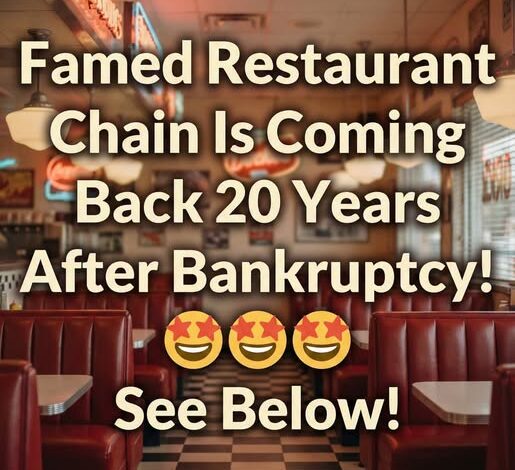
The sign disappeared years ago.
Then one morning, people began seeing it again.
At first, some assumed the photographs circulating online were old. Others thought someone was simply trying to revive a little nostalgia.
But the doors were actually opening.
A familiar American restaurant chain many families thought had been lost to history was attempting something few dead brands ever manage:
A comeback.
And the reaction revealed that people had missed far more than the food.
They had missed what happened around the tables.
For generations of families, restaurants like this weren’t special because they were glamorous.
They were special because they were familiar.
You knew what the dining room would look like before you walked inside.
You knew roughly what the menu would contain.
You knew somebody would bring coffee to the table and probably ask whether you wanted a refill.
Children slid into booths beside their parents.
Grandparents lingered after finishing breakfast.
Teenagers gathered after school.
Families stopped after church.
Birthdays were celebrated with inexpensive cake, crooked candles, and a collection of relatives squeezed around tables that were never quite large enough.
Nobody photographed most of those moments.
That’s partly why they feel so valuable now.
They happened before every ordinary family meal became potential social-media content.
You simply went somewhere together.
You ate.
You talked.
Then you went home.
Years later, those completely unremarkable evenings became memories.
That’s the strange thing about nostalgia.
You rarely recognize an era while you’re living through it.
Nobody sitting in one of those booths thought:
I’ll desperately miss this someday.
They were thinking about homework.
Bills.
Whether the kids were behaving.
Who was paying.
Whether Dad was going to order the exact same thing again.
Then time moved forward.
Children grew up.
Grandparents disappeared.
Families moved.
Restaurants closed.
And eventually, people drove past a building where they’d celebrated dozens of ordinary moments and discovered another business occupying it.
Sometimes the building itself was gone.
That’s why the return of a familiar restaurant can produce an emotional response wildly disproportionate to hamburgers, pancakes, or coffee.
People aren’t only seeing a restaurant.
They’re seeing themselves at nine years old.
They’re seeing their father across the table.
They’re remembering their mother’s order.
They’re hearing grandparents who haven’t spoken in twenty years.
They’re remembering birthday dinners that seemed insignificant at the time.
A restaurant can disappear physically while remaining surprisingly intact in memory.
But nostalgia alone can’t keep a business alive.
That’s the challenge facing any revived restaurant brand.
Recreate the past too faithfully and the business risks feeling like a museum.
Change everything and the people who wanted it back may wonder what exactly returned.
The smartest comeback therefore isn’t about freezing a restaurant in 1975.
It’s about identifying what people actually loved and carrying that feeling into the present.
That may mean brighter dining rooms.
Cleaner, simpler interiors.
Updated kitchens.
More contemporary menu options.
Greater attention to ingredient sourcing.
Technology where it genuinely makes service easier.
But underneath those changes, something recognizable has to survive.
The welcome.
The booth.
The coffee.
The plate arriving at the table.
The feeling that nobody is timing how quickly you leave.
Because the modern restaurant industry has become extraordinarily efficient.
Order on your phone.
Pick up from a shelf.
Eat in the car.
Use the drive-thru.
Have dinner delivered without speaking to another human being.
Those options are useful.
Sometimes they’re exactly what people need.
But efficiency quietly removed something too.
The pause.
Sitting down forces life to slow slightly.
Someone brings menus.
People decide what they want.
Food takes time.
Conversation fills the waiting.
Nobody can instantly skip ahead.
For families especially, that can feel increasingly rare.
Everyone is busy.
Parents work.
Children have activities.
Phones vibrate.
Schedules overlap.
Dinner becomes something consumed between obligations rather than an event around which the evening is organized.
That’s why an old-fashioned sit-down restaurant can suddenly feel almost rebellious.
You walk inside.
You sit.
You stay.
For forty-five minutes, maybe an hour, the family is physically gathered around one table.
That’s what many people are responding to when a beloved chain announces a revival.
They’re not necessarily demanding the exact wallpaper from their childhood.
They don’t need every recipe preserved untouched.
They want the experience to recognize them.
There’s a powerful difference between nostalgia and familiarity.
Nostalgia says:
“Remember how things used to be?”
Familiarity says:
“Welcome back.”
The second is much harder to create.
It begins with little things.
A menu containing enough recognizable favorites to trigger memory.
Service that feels personal rather than transactional.
Prices that make the restaurant accessible to ordinary families.
A dining room where children don’t feel like an inconvenience.
Food that isn’t trying desperately to become an internet sensation.
There is something comforting about a restaurant that doesn’t need every plate to be photographed.
Sometimes people simply want breakfast.
Sometimes they want meatloaf, mashed potatoes, pancakes, pie, or a cup of coffee that keeps getting refilled.
The ordinary can become a competitive advantage when everything else is fighting to appear extraordinary.
But reviving an old restaurant isn’t easy.
The customers who remember the original version carry extremely specific expectations.
Change the recipe?
They’ll notice.
Remove a beloved menu item?
Someone will remember.
Replace too much of the interior?
People will complain that it doesn’t feel right.
Keep too much?
Younger customers may wonder why they’ve walked into their grandparents’ dining room.
Every decision becomes a negotiation between memory and survival.
That’s why the most successful revivals understand something important:
People don’t actually want the past back exactly as it was.
They want the way the past made them feel.
Those are different things.
Nobody truly wants uncomfortable booths, dated kitchens, cigarette smoke, or every limitation of restaurant culture decades ago.
What they remember is belonging.
Predictability.
Affordability.
Family.
A place where the staff might eventually recognize you.
A place where your father always ordered the same breakfast.
A place where Grandma drank coffee slowly while everyone else waited.
A place where birthdays didn’t need reservations six weeks in advance.
That emotional architecture matters more than the physical architecture.
And that’s what gives a revived family restaurant a chance.
The first customers through the doors will probably arrive carrying memories.
Some will bring children who never experienced the original.
That’s where the comeback becomes interesting.
Imagine someone walking into the revived restaurant with their daughter and pointing toward a booth.
“My dad used to bring me here.”
The child may not care.
Not yet.
She’ll order something.
Maybe complain about vegetables.
Maybe spill a drink.
Maybe laugh at something ridiculous.
Twenty years later, she might remember that afternoon.
That’s how traditions actually survive.
Not by preserving them behind glass.
By using them again.
The revived restaurant cannot live entirely on people saying:
“I remember this place!”
Eventually, it needs people saying:
“Let’s go there tonight.”
That’s the difference between nostalgia and a functioning business.
And perhaps that’s why these comebacks attract so much attention.
America has lost thousands of familiar gathering places over the decades.
Department-store lunch counters.
Neighborhood diners.
Family restaurants.
Local bakeries.
Shopping-mall cafeterias.
Places that weren’t famous enough to appear in history books but nevertheless formed the background of people’s lives.
When they vanish, communities lose something difficult to quantify.
Not merely businesses.
Shared spaces.
Places where you could exist without needing a major reason to be there.
The revival of an old restaurant brand taps directly into that longing.
It says that perhaps everything familiar doesn’t have to disappear.
Perhaps some things can adapt without abandoning themselves.
Perhaps modern doesn’t always have to mean faster.
Maybe progress can occasionally include remembering what worked.
That doesn’t guarantee success.
A familiar name can’t compensate forever for bad food, high prices, or poor service.
Nostalgia may get someone through the door once.
Only a good experience brings them back.
But the opportunity is real.
Because what customers are searching for may be surprisingly simple.
A comfortable booth.
A warm meal.
Someone asking whether they’d like more coffee.
A conversation that lasts longer than expected.
A place where three generations can sit together without anyone feeling that the restaurant was designed exclusively for someone else.
That isn’t revolutionary.
Once, it was ordinary.
Maybe that’s precisely why it feels special now.
When those familiar doors reopen, people may initially arrive because they remember what the restaurant used to mean.
The real test comes later.
Can new memories grow beside the old ones?
Can the grandparents who once brought their children now bring grandchildren?
Can an old brand become part of a young family’s routine?
Can something return without becoming trapped in its own history?
If it can, then this revival will represent something larger than another restaurant reopening.
It will prove that nostalgia doesn’t always have to remain in the past.
Sometimes you can walk back through the door.
The tables are newer.
The lights are brighter.
The menu has changed.
But someone you love is sitting across from you.
And suddenly, for an hour or so, the years between then and now don’t seem quite so far apart.