At 82 Karen Grassle Finally Said What Michael Landon Did to Her and Nobody Who Loved Little House Was Prepared for a Single Word

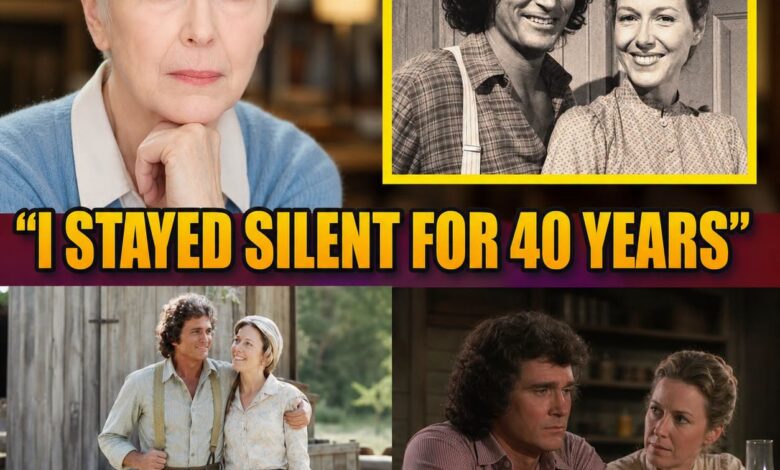
On television, Walnut Grove glowed.
The fields were golden. The lessons were clear. Charles Ingalls could gather his family around a table, admit a mistake, offer a few quiet words about decency, and by the end of the hour the world usually seemed to have recovered its moral balance.
Behind the camera, Karen Grassle remembered something far more complicated.
For decades, audiences knew Grassle as Caroline “Ma” Ingalls, the steady emotional center of Little House on the Prairie. She was patient without seeming weak, resilient without becoming hard. When the Ingalls family struggled, Caroline was often the person holding the household together while asking for very little herself.
Grassle later suggested that there was an uncomfortable irony in that role.
On screen, Ma Ingalls embodied dignity.
Off screen, Grassle sometimes felt she had to fight for her own.
In her 2021 memoir, Bright Lights, Prairie Dust, Grassle wrote candidly about her years on the enormously successful series and about her complicated relationship with Michael Landon, the man who played Charles Ingalls and exercised extraordinary creative influence over the production.
Landon wasn’t merely the star.
He was an executive producer, frequent writer and director, and one of the central forces shaping the program.
That gave him enormous authority.
Grassle entered Little House as an accomplished actress, but television power was not distributed evenly simply because two performers were playing husband and wife.
As the series became successful, Grassle began questioning her compensation.
From her perspective, Caroline Ingalls was not a peripheral character. Ma appeared at the heart of the family week after week, carrying dramatic scenes and helping create the emotional credibility on which the series depended.
Grassle has said that she believed her pay should better reflect her contribution.
That request became a turning point.
In her account, negotiations over money strained her relationship with Landon. She felt that asking to be compensated more fairly changed the atmosphere between them and that her role was subsequently reduced.
It is tempting to tell that story as a simple morality play.
Brave actress demands equal pay.
Powerful male star retaliates.
Case closed.
Grassle herself leaves room for something more complicated.
Memoirs are personal accounts, not omniscient transcripts of every person’s motives. They tell us how events were experienced and remembered by the person writing them. Landon, who died in 1991, cannot respond to every detail Grassle later published.
That does not make her testimony unimportant.
It means it should be represented accurately—as her account of what happened.
And her account disrupts the comforting assumption that a television series built around wholesome values must necessarily have embodied those values behind the scenes.
Grassle also described a working environment that could feel distinctly male-dominated.
She recalled crude humor and behavior that made her uncomfortable. She wrote about Landon’s drinking and about moments when the atmosphere behind the camera seemed dramatically removed from the family-friendly world being created in front of it.
The contrast is almost cinematic.
On one side of the camera stands Caroline Ingalls, apron tied around her waist, teaching children about compassion, restraint and respect.
Then someone calls cut.
The actors step out of character.
And suddenly the moral universe becomes much less tidy.
That does not mean Little House on the Prairie was secretly fraudulent.
Television shows are created by human beings, and human beings rarely resemble the characters they portray.
An actor who plays a saint does not promise to be saintly.
A writer who creates a story about forgiveness may still behave badly.
A director capable of producing tender scenes can also be controlling, insensitive or difficult.
Art does not become autobiography merely because viewers want it to.
That distinction is particularly important with Michael Landon.
Grassle did not describe him as nothing but a villain.
Her memories contain contradictions.
Landon could be talented, charismatic, funny and enormously hardworking. He could also, in her telling, wield power in ways that hurt people around him.
Both things can occupy the same biography.
In fact, that may be the more useful way to understand powerful figures from beloved entertainment.
We often flatten them in one direction or the other.
First comes the legend.
Then comes the revelation.
Then the culture attempts to replace the saint with a monster.
But complexity is not a failure of judgment.
Sometimes it is the judgment.
Landon’s creative contribution to Little House was enormous. His instincts helped turn Laura Ingalls Wilder’s world into television that millions of people loved. He understood emotion, family drama and the kind of storytelling capable of making audiences cry over characters they had invited into their homes.
Acknowledging that accomplishment does not require dismissing Grassle’s experience.
And believing Grassle does not require pretending that every good thing Landon ever did was secretly meaningless.
The harder truth is that talented people can mistreat colleagues.
Warm people can become controlling when challenged.
Generous people can behave selfishly.
Someone can create stories about dignity while failing, at times, to extend enough dignity to the person standing beside him.
Grassle’s decision to write openly about those contradictions mattered partly because of the character she had spent so many years playing.
Caroline Ingalls was expected to endure.
That was one of her defining qualities.
She endured bad harvests.
Illness.
Financial hardship.
Fear.
Loss.
She held the family together.
And because Grassle performed that strength so convincingly, audiences could easily merge actress and character.
Ma didn’t complain.
Ma persevered.
Ma supported Pa.
But Karen Grassle was not Ma Ingalls.
She was a working actress with a contract, ambitions, professional boundaries and the right to negotiate for herself.
There is a profound difference between endurance chosen by a fictional character and silence expected from a real woman.
That may be why her account resonates beyond one television production.
For generations, women in entertainment were frequently encouraged to be grateful simply for having a coveted role.
Don’t become difficult.
Don’t complain.
Don’t challenge the person who controls the production.
Don’t ask why someone else earns more.
Don’t risk becoming replaceable.
The pressure did not require an explicit threat.
When one person controls enough doors, everyone understands what closing one might mean.
Grassle eventually left the series as Caroline’s presence diminished.
But something interesting happened afterward.
The show survived.
So did she.
And decades later, she could finally describe Walnut Grove from a perspective the television cameras never captured.
That doesn’t require fans to stop loving Little House on the Prairie.
A childhood memory does not have to be destroyed because adulthood adds context to it.
You can still remember watching the Ingalls family gather around the dinner table.
You can still love the Christmas episodes.
You can still cry when Charles comforts Laura.
You can still admire Michael Landon’s performances and recognize his enormous influence on American television.
And you can listen when Karen Grassle says that working inside that beloved world sometimes hurt.
Those truths do not cancel one another.
They make the picture larger.
Perhaps that is what happens whenever we revisit the entertainment we loved as children.
At first, we see the story.
Later, we notice the machinery.
The contracts.
The hierarchy.
The personalities.
The compromises.
The people whose labor was essential even when their names appeared farther down the credits.
For years, Caroline Ingalls stood beside Charles while viewers saw him as the family’s towering moral center.
Karen Grassle’s memoir quietly moves the camera.
Not to erase Landon.
Not to destroy Walnut Grove.
But to place the woman beside him back inside the frame.
And once she is there, speaking in her own voice rather than Caroline Ingalls’s, the lesson feels strangely appropriate for Little House itself:
Respect is easiest to preach when nobody challenges your power.
The real test comes when someone does.