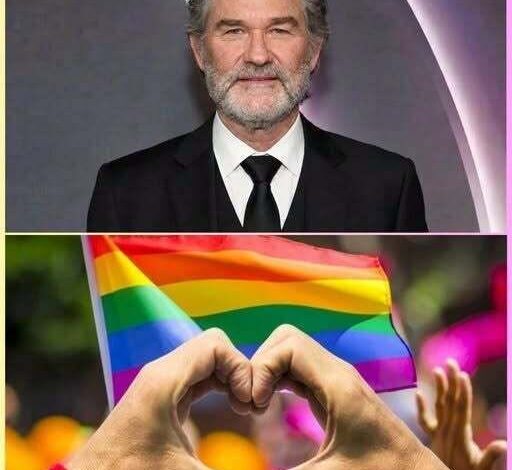
A growing online controversy has placed veteran actor Kurt Russell at the center of an increasingly heated debate about media, parenting, and representation.
The discussion began after reports circulated that Russell had expressed concerns about young children being exposed to LGBTQ-related themes in certain cartoons and family-oriented programming. According to those reports, the actor argued that children should be allowed to experience childhood without being introduced too early to social topics that he believes require greater maturity and understanding.
What might once have been a routine celebrity opinion quickly evolved into a broader cultural flashpoint.
Within hours, social media platforms were flooded with reactions from people on both sides of the issue. Some users praised Russell for voicing concerns they felt many parents share but are often hesitant to express publicly. Others strongly criticized the reported remarks, arguing that inclusive representation in children’s media plays an important role in fostering acceptance, empathy, and understanding.
As the debate intensified, calls for a boycott of the actor’s work began appearing online.
For supporters of the boycott, the issue extends far beyond a single comment.
Many believe that visibility and representation matter, especially for young audiences. They argue that when children encounter stories featuring people from different backgrounds, identities, and experiences, they gain a broader understanding of the world around them. From this perspective, inclusion is not about introducing controversial topics but about reflecting the diversity that already exists within society.
Advocates of representation often point out that children encounter different kinds of families, cultures, and identities throughout their lives. Seeing those realities portrayed in books, television shows, and movies can help normalize differences and reduce prejudice before it takes root.
To them, inclusive storytelling is not political.
It is educational.
It is human.
And it is necessary.
Many critics of Russell’s reported position argue that excluding certain identities from children’s media sends its own message—one that can make some young viewers feel invisible or excluded.
For those individuals, representation is not simply about entertainment.
It is about belonging.
At the same time, Russell’s supporters view the issue through a different lens.
Many argue that parents should have primary responsibility for deciding when and how complex social subjects are introduced to their children. They believe families, rather than entertainment companies, should determine the pace and context of those conversations.
From this perspective, the debate is not necessarily about opposition to diversity itself.
Instead, supporters often frame it as a question of parental authority and age-appropriate content.
They argue that parents have different beliefs, values, and approaches to raising children, and that those differences should be respected.
This clash of perspectives helps explain why the controversy has generated such passionate reactions.
Both sides believe they are defending something important.
One side emphasizes representation and inclusion.
The other emphasizes parental choice and personal values.
As a result, the discussion has expanded far beyond the actor himself.
Social media quickly became the primary battleground.
Hashtags supporting and criticizing Russell spread across multiple platforms. Some users pledged to avoid future projects associated with the actor. Others pushed back against what they viewed as an attempt to punish someone simply for expressing an opinion.
The divide reflected a familiar pattern seen in many modern cultural debates.
Public figures make comments.
Online communities react.
Supporters and critics organize.
And a larger conversation emerges about the values underlying the controversy.
In this case, that conversation touches on some of the most debated issues in contemporary society: identity, education, parenting, media influence, and free expression.
Advocacy groups have also weighed in.
Organizations supporting LGBTQ inclusion have used the controversy as an opportunity to highlight the importance of representation within entertainment. Many argue that diverse storytelling benefits not only LGBTQ youth but also society as a whole by encouraging understanding and reducing stereotypes.
Some activists have called on studios, production companies, and corporate partners to publicly reaffirm their commitment to inclusive content.
Others have encouraged consumers to support media that actively embraces diversity.
Meanwhile, defenders of Russell’s reported viewpoint argue that disagreement should not automatically lead to professional consequences. They caution against creating an environment in which individuals fear expressing opinions that may differ from prevailing cultural trends.
This tension between accountability and free expression has become a recurring theme in public discourse.
Underlying the controversy is a larger question that extends far beyond any one actor.
What role should media play in shaping how children understand the world?
Researchers, educators, and child-development specialists have studied this question for decades.
Many experts note that media serves as a powerful influence on young minds. Children often learn social norms, values, and expectations through the stories they consume. Exposure to diverse characters and experiences can help broaden perspectives and encourage empathy toward people from different backgrounds.
At the same time, experts also acknowledge that parents remain central figures in helping children interpret and understand those messages.
Media may introduce ideas.
Families often provide the context.
Because of this, discussions about children’s programming rarely have simple answers.
They involve questions about education, culture, family values, personal beliefs, and societal change.
The entertainment industry itself has increasingly become part of that conversation.
Many creators, writers, actors, and producers have publicly embraced broader representation in recent years, arguing that modern audiences deserve stories that reflect the diversity of contemporary life.
They contend that inclusion strengthens storytelling by allowing more people to see themselves represented on screen.
Others emphasize the importance of maintaining open dialogue rather than treating disagreements as irreconcilable conflicts.
They argue that meaningful progress often requires listening as much as speaking.
The controversy surrounding Kurt Russell ultimately highlights how deeply personal these issues can be.
Questions about childhood, identity, values, and representation touch on beliefs that many people hold passionately. As a result, discussions surrounding them often become emotionally charged and highly polarized.
Whether the boycott effort gains lasting momentum remains uncertain.
Public controversies frequently evolve quickly, and online reactions do not always translate into long-term consequences. What seems clear, however, is that this debate has become part of a much larger cultural conversation—one that extends well beyond a single interview or a single celebrity.
At its core, the discussion is about how societies choose to represent themselves, what messages are shared with future generations, and who gets to shape those conversations.
As people continue debating these questions, many observers emphasize the importance of approaching the subject with thoughtfulness, empathy, and a willingness to engage respectfully with differing viewpoints.
Because while opinions may differ, the broader goal remains the same: helping future generations navigate an increasingly complex world with understanding, compassion, and respect for one another.