Body language expert reveals ‘real reason’ Donald Trump wouldn’t move as Spain lifted World Cup trophy

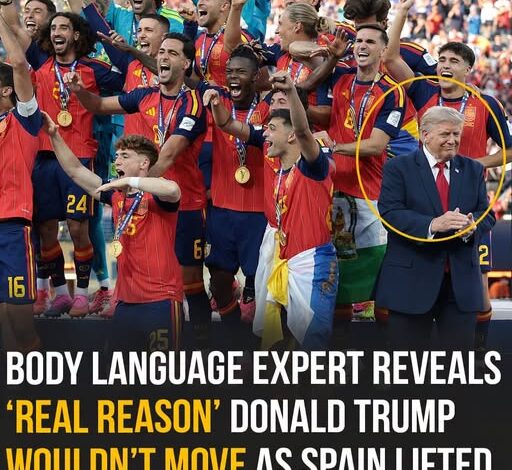
As red and gold confetti poured from the roof and Spain’s players celebrated the greatest achievement of their careers, the trophy presentation produced another set of images that quickly spread far beyond the stadium.
The champions’ attention was fixed on one thing.
The World Cup.
Players embraced one another, shouted with joy, and gathered around FIFA President Gianni Infantino as they prepared for the ceremony that every footballer dreams of experiencing. Standing alongside him was U.S. President Donald Trump, whose presence on the podium ensured that every interaction would be examined frame by frame once the celebrations reached television screens around the world.
Among those commenting on the ceremony was body-language analyst Mark Bowden, who offered his interpretation of the players’ interactions with the officials on stage. Like all body-language analysis, his observations represent an interpretation rather than a definitive account of what the participants were thinking or intending.
Bowden noted that many Spanish players appeared relaxed and expressive as they greeted Infantino, exchanging smiles, embraces, and brief conversations before continuing along the line. Their interactions with Trump, by comparison, generally appeared shorter and more formal, with most players moving quickly through the presentation while remaining focused on the celebrations unfolding around them.
The contrast became one of the ceremony’s most discussed visual details.
Of course, there are many possible explanations for brief exchanges during a medal presentation. Players have just completed one of the most emotionally exhausting matches of their careers, television schedules are tightly choreographed, and every participant is moving through the line within seconds. Without statements from those involved, assigning specific motives would go beyond what the available evidence can establish.
Even so, the images invited widespread discussion online.
Bowden also pointed to Trump’s handshake style during the ceremony.
Over the years, Trump’s firm and highly publicized handshakes have often attracted media attention, becoming the subject of countless articles and commentary. During the World Cup presentation, however, Bowden observed that Trump’s greetings appeared comparatively restrained and measured, lacking the more forceful movements that have frequently been associated with him in public settings.
Whether that reflected the formal setting, the pace of the ceremony, or simply normal variation in social interactions is impossible to determine from the footage alone.
The most scrutinized sequence came moments later.
As Spain’s captain prepared to receive the World Cup trophy, cameras captured both Infantino and Trump reaching toward the famous golden prize during the presentation. The resulting photographs circulated almost instantly, with viewers debating everything from body positioning to timing.
Some interpreted the images as a natural consequence of multiple dignitaries participating in the official handover.
Others viewed them as a symbolic visual moment because both men appeared in the frame during one of football’s most iconic traditions.
The footage also appeared to show officials subtly reorganizing positions on the podium once the trophy had been presented, allowing Spain’s players to gather together for their celebration. As is common during large ceremonies involving numerous officials, participants shifted positions while photographers and broadcasters captured the defining images of the evening.
By the time the confetti cannons erupted, the champions occupied center stage, lifting the World Cup before a global television audience.
Yet Trump’s presence remained visible in several widely shared photographs and broadcast angles, ensuring that discussions about the ceremony continued long after the players had left the podium.
The episode illustrated how modern sporting spectacles extend beyond the competition itself.
Today’s major finals are documented from dozens of camera angles, replayed in slow motion, and dissected across social media within minutes. A gesture lasting only a second can become the focus of worldwide conversation, particularly when political figures share the stage with athletes during historic moments.
That attention, however, should not overshadow the achievement that brought everyone together.
Spain had earned the right to lift football’s greatest prize through its performances on the pitch. Years of preparation, teamwork, and resilience culminated in those unforgettable moments beneath a shower of confetti.
The debates surrounding the podium may continue, and viewers will likely keep interpreting the body language and choreography in different ways. But those interpretations remain just that—interpretations.
The indisputable fact is far simpler.
When the final whistle had long since faded and the celebrations reached their peak, Spain stood as world champions, lifting the trophy that every nation dreams of winning. Everything else became part of the conversation surrounding the ceremony, but the night’s enduring legacy belonged to the team that earned its place at the top of world football.