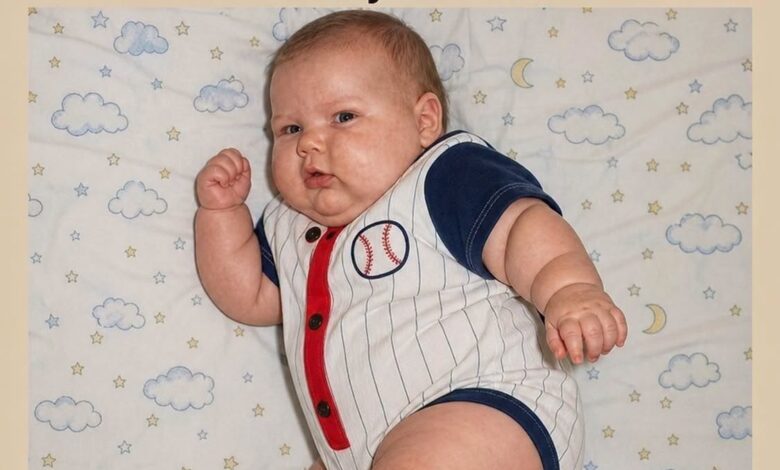
Kevin became a headline before he was old enough to understand what a headline was.
Before he could speak his own name, strangers were already talking about him.
They talked about the number.
His weight.
His size.
How unusual he was.
How remarkable.
How unbelievable.
To the outside world, Kevin’s arrival was a story.
To his parents, he was simply their baby.
That distinction would become one of the most important battles of his childhood.
Because when a child enters the world carrying something extraordinary, people can forget that extraordinary children still need ordinary lives.
They need bedtime stories.
scraped knees.
Bad moods.
Birthday cakes.
Someone telling them to clean their room.
They need the freedom to become people rather than spend their childhood preserving whatever made strangers notice them in the first place.
Kevin’s parents understood that early.
They couldn’t stop people from staring.
They couldn’t prevent every question.
They couldn’t erase the fascination surrounding the unusually large baby whose birth had attracted attention.
But they could control what happened when the front door closed.
Inside their home, Kevin was not a record.
He was Kevin.
That sounds simple.
It wasn’t.
Public curiosity has a way of following unusual people into ordinary spaces.
At the grocery store, someone might look twice.
At school, children might compare.
Adults could be worse because adults often disguise intrusive questions as harmless curiosity.
“How big were you when you were born?”
“How tall is your father?”
“How tall are you going to get?”
“Do you play basketball?”
“What’s it like being that big?”
One question isn’t necessarily cruel.
A lifetime of them can become exhausting.
Because underneath repeated curiosity is a message:
The first thing I notice about you is your body.
For a growing child, that can become dangerous territory.
Children are already learning to understand themselves through other people’s reactions.
If every new person responds primarily to height, weight, appearance, or some unusual physical characteristic, the child can begin believing that characteristic is the most important thing about them.
Kevin’s parents tried to interrupt that lesson.
They reminded him that numbers described his body.
They did not measure his worth.
Height was information.
Weight was information.
Neither was character.
What mattered was how he treated people.
Whether he kept his word.
Whether he worked hard.
Whether he could laugh at himself without learning to hate himself.
Whether he understood that being noticed and being known were completely different things.
That last lesson took time.
As Kevin grew, so did the thing everyone had always noticed.
He became tall.
Very tall.
There is no way to hide extraordinary height.
You enter a room and people see it before they hear your voice.
You walk through a doorway and someone makes a joke.
You sit in a car and suddenly everyone wants to discuss legroom.
Clothes become complicated.
Beds become complicated.
Airplane seats become negotiations with geometry.
Even photographs can turn into demonstrations.
“Stand next to him!”
People want comparison because comparison helps them understand scale.
Kevin learned that resisting every curious reaction would make life exhausting.
So he developed another strategy.
Humor.
A joke could disarm a stare.
A friendly answer could transform awkward curiosity into an ordinary conversation.
Instead of allowing every question to become an insult, he learned to distinguish between cruelty and genuine fascination.
That requires a particular kind of confidence.
Not every person who looks at you means harm.
Not every question deserves anger.
But not every question deserves an answer either.
That second part mattered just as much.
Grace without boundaries can become another form of captivity.
If you’re unusual in some visible way, people may begin treating access to you as automatic.
They want the story.
The number.
The photograph.
The comparison.
The explanation.
Eventually, you have to learn that curiosity is not ownership.
Kevin could be polite without surrendering his privacy.
He could laugh without turning himself into the joke.
He could answer a question and then change the subject.
He could decide that some parts of his life belonged only to him.
That was how the famous baby gradually became an ordinary man.
Not by shrinking.
Not by pretending the unusual parts of his story never happened.
By making them proportionate.
His birth was one moment.
His life would contain thousands more.
There is something almost unfair about childhood fame because the child never chooses the original story.
Adults make that decision.
Doctors speak.
Reporters call.
Photographs circulate.
Headlines appear.
Years later, the child grows old enough to inherit a public identity they had no role in creating.
Then comes the difficult work:
Do I become what everyone says I am?
Do I reject it completely?
Or do I accept that this happened without allowing it to explain everything that happened afterward?
Kevin chose the third path.
He didn’t need to spend his adulthood running from the story.
He simply refused to live inside it.
Work mattered.
Relationships mattered.
Home mattered.
Private routines mattered.
The quiet architecture of an ordinary life mattered.
That choice can look surprisingly radical in a culture obsessed with visibility.
We are constantly told that being known is an achievement.
More followers.
More attention.
More interviews.
More people recognizing your name.
But Kevin had experienced a version of visibility before he could even understand it.
Perhaps that made privacy easier to appreciate.
Being looked at is not the same as being loved.
Being remembered is not the same as being understood.
A headline can make millions aware that you exist while telling them almost nothing about who you are.
The people who truly knew Kevin didn’t need the old statistics.
They knew what made him laugh.
What irritated him.
What kind of day he’d had at work.
How he behaved when nobody was impressed.
Those details sound small because they are.
That is exactly why they matter.
A human life is built mostly from small things.
The spectacular moments receive headlines.
The ordinary ones create identity.
This is especially important for children who become publicly known because of something they cannot control.
An unusual appearance.
A medical condition.
An extraordinary talent.
A viral video.
A family tragedy.
A remarkable birth.
Adults often believe attention is harmless if it is positive.
“Everyone thinks you’re amazing!”
But praise can become a cage too.
If a child is constantly celebrated for one trait, they may begin wondering what happens when that trait changes.
What if the child prodigy becomes an average adult?
What if the adorable child actor grows up?
What if the athlete gets injured?
What if the unusually large baby simply becomes a tall man with bills, relationships, responsibilities, and a dog waiting at home?
Does the world lose interest?
Probably.
And perhaps that is freedom.
Kevin didn’t need to remain extraordinary for strangers.
He needed to become himself.
His parents helped by refusing to make home another stage.
They didn’t need every dinner conversation to return to his birth.
They didn’t need him to perform gratitude for being unusual.
They gave him something more valuable:
normal expectations.
Be decent.
Do your responsibilities.
Treat people properly.
Build a life.
Those instructions aren’t glamorous.
They are grounding.
They tell a child:
Your body may attract attention, but your choices will build your character.
As Kevin entered adulthood, that distinction became increasingly important.
People could still stare.
They could still ask.
They could still bring up the story that had followed him since infancy.
But now he had decades of evidence that the headline was incomplete.
A number could describe the beginning.
It could not describe the man.
This is where his story becomes larger than height or birth weight.
Almost everyone carries some label they did not entirely choose.
The smart one.
The difficult one.
The poor kid.
The rich kid.
The sick child.
The beautiful one.
The awkward one.
The athlete.
The failure.
The miracle baby.
The labels differ.
The danger is the same.
Eventually, other people’s description of you can become louder than your own voice.
Then you start making decisions for the label.
The smart child becomes terrified of being wrong.
The strong person becomes afraid to ask for help.
The funny person believes sadness will disappoint everyone.
The unusual child begins thinking their difference is the only reason anyone cares.
Growing up often means discovering that you are allowed to disappoint the label.
You can become more complicated.
Kevin did.
He became a man whose life could not be summarized by the measurement taken shortly after he was born.
There was work.
Love.
Responsibility.
Privacy.
Humor.
Ordinary frustrations.
Ordinary happiness.
None of it would make the same headline.
That doesn’t make it less meaningful.
In fact, perhaps the greatest victory was that his life eventually became boring enough to belong entirely to him.
No reporters waiting.
No strangers treating his body like public property.
No requirement to remain a spectacle.
Just life.
There is dignity in that.
A quiet home.
Someone who loves you without needing the origin story.
A job where your usefulness depends on what you do rather than what you weighed as an infant.
Friends who have heard the famous story so many times that it no longer matters.
A dog who certainly doesn’t care.
That is how a label finally loses power.
Not because everybody forgets it.
Because the person accumulates enough life around it that the label becomes too small.
Imagine Kevin looking at one of those early photographs.
There is the baby everyone discussed.
The enormous infant.
The curiosity.
The story.
But Kevin can see something the original audience couldn’t.
Everything that came afterward.
The child learning to walk.
The awkward school years.
The jokes.
The questions.
The growth spurts.
The friendships.
The mistakes.
The adult relationships.
The private victories.
The mornings nobody photographed.
The difficult days nobody reported.
The life.
That is the problem with headlines.
They freeze people.
A headline says:
This is who he is.
Life says:
Keep watching.
Children especially deserve that freedom.
They deserve the right to outgrow the story adults first told about them.
A viral child should be allowed to become an anonymous adult.
A remarkable baby should be allowed to become an ordinary man.
A child known for one unusual characteristic should be allowed to discover a hundred other things about themselves.
Parents cannot control everything the world says.
But they can create a counterweight.
They can say:
I know what everyone notices.
Now let me remind you what matters.
Your kindness.
Your judgment.
Your effort.
Your boundaries.
Your ability to get back up.
Your ability to care about somebody besides yourself.
Those qualities rarely appear in measurements.
They take years to reveal themselves.
Kevin’s parents could not stop the world from counting.
So they taught him not to confuse counting with value.
That may have been the most important thing they ever gave him.
Because eventually Kevin had to live without them standing beside him explaining who he really was.
He had to do it himself.
When someone stared, he decided how much energy the stare deserved.
When someone asked a question, he decided whether to answer.
When someone reduced him to the old story, he knew they were seeing only a fragment.
He didn’t need to become angry every time.
He didn’t need to prove them wrong.
He could simply continue living.
There is enormous confidence in refusing to turn every misunderstanding into a battle.
Sometimes the strongest response to being reduced is expansion.
Keep becoming more.
More experienced.
More loving.
More private.
More complicated.
More yourself.
Eventually, the old label cannot contain you.
That is what happened to Kevin.
The remarkable baby became a child.
The child became a teenager.
The teenager became a man.
And the man discovered something the headline could never have predicted:
Being extraordinary at birth did not obligate him to spend the rest of his life performing extraordinariness.
He was allowed to be ordinary.
He was allowed to want peace.
He was allowed to build relationships that weren’t based on fascination.
He was allowed to protect parts of himself from public curiosity.
He was allowed to answer with humor.
He was allowed not to answer at all.
Most importantly, he was allowed to decide what mattered.
The world had begun his story with a measurement.
Kevin continued it with choices.
That’s the difference between being described and being known.
Measurements tell us how much space a body occupies.
Character tells us what someone does with that space.
A child cannot control the body they arrive in.
They cannot control the family, circumstances, attention, advantages, difficulties, or labels waiting for them.
But adulthood offers a gradual possibility.
Authorship.
Not complete control.
Nobody gets that.
But enough control to say:
That happened to me.
It is not all of me.
Perhaps that is the real meaning of Kevin’s story.
It isn’t about becoming comfortable with being unusually tall.
It isn’t even about surviving unwanted attention.
It is about refusing to let the first interesting thing about you become the last word on who you are.
Somewhere there is still an old photograph of an enormous newborn surrounded by amazed adults.
People can look at it.
Smile.
Repeat the number.
Shake their heads.
Kevin doesn’t have to stop them.
He knows something they don’t.
The most important part came after the photograph.
Decades of it.
A life too large to fit beneath any headline.
And after spending his earliest years being measured by everyone else, Kevin finally discovered the only measurement that mattered:
whether the life he built felt like his own.