Breaking News Reports Indicate That a Mass Shooting Has Just Occurred Prompting Immediate Responses From Law Enforcement and Emergency Services


It took only minutes for a place built around prayer to become unrecognizable.
One moment, people were gathered inside the Church of Jesus Christ of Latter-day Saints in Grand Blanc Township expecting something familiar: worship, conversation, routine, perhaps the quiet comfort of seeing the same faces they had seen many times before.
Then everything changed.
The sanctuary became a scene of panic.
Worshippers tried to understand where the danger was coming from.
Some searched for exits.
Others moved toward people who needed help.
Police rushed in with one objective.
Firefighters faced another.
Medics prepared for injuries.
Ordinary people who had arrived expecting nothing more dangerous than an ordinary Sunday suddenly found themselves making decisions they had never imagined needing to make.
Move.
Hide.
Help.
Call someone.
Stay with the injured.
Find a child.
Find a spouse.
Get outside.
For those inside, there was no time to understand the larger story.
There was only the next second.
Police stopped the attacker quickly.
But “quickly” can become a painfully relative word during violence.
A few minutes are enough to divide lives permanently into before and after.
By the time the immediate threat was over, people had been killed.
Others were wounded.
Parts of the building had been damaged by fire.
A place associated with safety and community had become something else entirely.
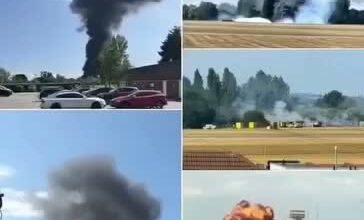
Smoke.
Debris.
Emergency lights.
Crime-scene tape.
Officers moving through spaces where families had once gathered without thinking twice about danger.
Numbers would eventually begin appearing in reports.
Dead.
Injured.
Hospitalized.
Investigated.
Those numbers are necessary.
They help authorities explain the scale of what happened.
But numbers are almost useless at describing what violence actually does.
One death can mean a parent who never comes home.
A spouse whose phone will never ring again.
A child being told something no child should have to understand.
One injury can mean surgery.
Rehabilitation.
Pain.
Fear.
A body that will never feel quite as safe as it did before.
Behind every official count are people sitting beneath fluorescent hospital lights waiting for doctors to return.
People staring at phones.
Relatives calling relatives.
Someone driving too fast toward a hospital without knowing what they will find when they arrive.
Someone else standing in a parking lot unable to process that the building behind them is the same place they entered only hours earlier.
That disorientation can last long after the sirens leave.
Places hold emotional meaning.
A church is not merely walls and seating.
For congregants, it can be where children were blessed.
Where marriages were celebrated.
Where funerals were held.
Where people went during grief.
Where they learned names.
Made friends.
Asked for help.
Sat quietly when life felt too loud.
When violence enters such a place, the damage extends beyond what can be photographed.
A sanctuary can be rebuilt.
Trust is harder.
For some worshippers, the next visit may begin in the parking lot.
They may sit in the car longer than usual.
Look toward entrances differently.
Notice who is standing near the doors.
Listen more carefully to unfamiliar sounds.
A slammed object that once meant nothing may suddenly produce a rush of adrenaline.
A person walking quickly through a hallway may attract attention.
Children may ask whether they are safe.
Parents will have to answer while privately wondering the same thing.
That is what trauma does.
It changes ordinary details.
The building may eventually look familiar again.
The nervous system may not.
Meanwhile, investigators face a different task.
Their work begins where public certainty often arrives too early.
Within minutes of major violence, speculation spreads.
Someone claims to know the motive.
Another person identifies an ideology.
A social-media account produces an old photograph.
Political commentators connect the event to whatever argument they were already making before the violence occurred.
Rumor begins filling every space where confirmed information has not yet arrived.
Investigators cannot responsibly work that way.
They have to reconstruct.
Who was the attacker?
What happened immediately before the violence?
What weapons or materials were involved?
How did the person enter?
What evidence exists in digital records?
Were there writings, messages, searches, purchases, or communications relevant to motive?
Who witnessed what?
Which accounts agree?
Which do not?
What does physical evidence show?
Did anyone else participate?
Were there warning signs?
Could any of them realistically have changed the outcome?
Those questions require patience.
Crime scenes do not surrender truth simply because the public wants an answer before nightfall.
Evidence has to be collected.
Photographed.
Preserved.
Compared.
Records must be obtained.
Witnesses interviewed.
Timelines corrected as new facts emerge.
Some early assumptions will prove wrong.
That is not necessarily evidence of incompetence.
It is often what investigation looks like.
The first version of a chaotic event is rarely the most accurate one.
That is why restraint matters.
Especially after mass violence.
People naturally want a reason.
A motive offers psychological structure.
If we can explain why something happened, perhaps we can convince ourselves it can be prevented from happening to us.
But premature explanations can become another kind of harm.
Families may see false claims about their loved ones circulating before they have even buried them.
Entire communities can be blamed.
Political identities assigned without evidence.
Fabricated quotes shared thousands of times.
The need to know becomes permission to invent.
That is why truth must move more slowly than outrage.
The community surrounding the church has another kind of work ahead.
It will not happen in evidence bags or laboratories.
It will happen in kitchens.
Hospital rooms.
Funeral homes.
Living rooms.
Temporary gathering spaces.
Someone will organize meals.
Someone will create a list of families who need help.
People will donate.
Drive.
Sit quietly beside someone who has no words.
A child may need somewhere safe to stay while a parent remains at the hospital.
An elderly congregant may need transportation.
Someone who survived may suddenly realize they cannot sleep alone.
Those acts will rarely become national headlines.
They are still part of the response.
Violence is dramatic.
Recovery usually isn’t.
Recovery looks like paperwork.
Therapy appointments.
Physical rehabilitation.
Replacing identification lost in the chaos.
Insurance calls.
Returning borrowed clothing.
Finding somewhere else to worship while damaged spaces are repaired.
Calling someone on the anniversary because you know the date will hurt.
It is mundane and exhausting.
And it matters.
Security will almost certainly become part of the conversation too.
After an attack, every institution asks the same painful question:
What could we do differently?
Entrances may be reconsidered.
Emergency exits reviewed.
Communication plans updated.
Staff or volunteers trained.
Some congregations may introduce drills that would once have seemed unthinkable.
People may discuss cameras, access control, emergency procedures, or law-enforcement coordination.
Those conversations are necessary.
They can also be emotionally difficult.
A place of worship is supposed to feel open.
Welcoming.
Theologically, spiritually, culturally, many religious communities are built around the idea that the door should not feel like a checkpoint.
Violence creates tension between openness and protection.
How do you remain welcoming without becoming vulnerable?
How much security reassures people?
At what point does it change the nature of the space?
There is no perfect answer.
Different communities will make different choices.
But fear should not be allowed to make every decision.
That may be one of the most difficult challenges after an attack.
Safety matters.
Hypervigilance can become its own prison.
The goal is not to pretend nothing happened.
Nor is it to allow one violent person to redefine every stranger as a threat.
Communities have to find a middle path.
Remember.
Prepare.
Protect.
Then continue living.
Continuing can feel almost disloyal at first.
People laugh again and immediately feel guilty.
Children begin playing in the parking lot.
Someone talks about an ordinary church program.
A meeting begins on time.
Life returns in fragments.
That return does not mean the dead have been forgotten.
It means grief is learning to coexist with life.
Memorials will help.
Names will be spoken.
Photographs displayed.
Stories repeated.
Not only stories about the final moments.
That is important.
Violence has a way of stealing a person’s biography.
A victim becomes “one of those killed.”
But before that final event, each person had an entire life.
Habits.
Jobs.
Families.
Private jokes.
Favorite foods.
Annoying tendencies.
Things they were looking forward to.
The most humane memorials restore those details.
They refuse to let the attacker become the most important fact about the people who died.
The injured deserve the same care.
Survival is often presented as uncomplicated good fortune.
But surviving violence can create a long road.
Some wounds are obvious.
Others aren’t.
A person may physically recover while still struggling with fear, guilt, anger, or intrusive memories.
They may ask why they survived when someone beside them did not.
They may replay decisions made in seconds and judge themselves with information they only learned later.
Communities need patience with that too.
There is no timetable for returning to normal.
And perhaps “normal” is the wrong goal.
After something this severe, people rarely return to exactly who they were.
The better hope is integration.
To carry what happened without allowing it to occupy every room in the future.
That takes time.
Months.
Years.
Sometimes a lifetime.
For investigators, eventually there will be reports.
Findings.
Perhaps charges, if others are implicated.
Official conclusions about motive and sequence.
Those answers matter.
They may help identify failures.
They may support future prevention.
They may correct rumors that spread during the first hours.
But even the most complete report will not restore what was lost.
Facts can explain.
They cannot undo.
The community’s response therefore has to become larger than the investigation.
Truth and compassion have different jobs.
Truth tells people what happened.
Compassion helps them survive knowing it.
Both are necessary.
Without truth, rumor fills the vacuum.
Without compassion, facts become sterile.
The challenge is holding both at once.
Do not speculate beyond evidence.
Do not reduce victims to statistics.
Do not use grief merely as ammunition for a political argument.
Do not allow understandable fear to harden into suspicion of everyone.
And do not imagine that resilience means pretending the trauma never occurred.
Resilience can look much quieter.
Opening the doors again.
Sitting in the same room.
Singing despite the memory of sirens.
A parent letting a child walk down a hallway without gripping their hand quite so tightly.
A survivor choosing a seat without first calculating the fastest exit.
Those moments may take time.
That is okay.
The building may eventually be repaired.
Burned materials removed.
Walls replaced.
Carpet changed.
Smoke washed away.
At some point, the crime-scene tape will disappear.
But the real reconstruction will happen in people.
In whether they can return without feeling that violence owns the space.
In whether they can remember the dead without remembering only how they died.
In whether children can once again associate the building with community rather than fear.
In whether people can sit beside one another and understand that being present is itself an act of defiance.
That may be the deepest answer available after violence enters a place built for worship.
Not pretending danger does not exist.
Not turning every service into a fortress.
Simply refusing to let the person who brought terror become the permanent architect of the community’s future.
The attacker had minutes.
The community has everything that comes afterward.
Years of meals shared.
Families supported.
Children raised.
Prayers spoken.
Questions asked.
Memories preserved.
Doors opened carefully, intelligently, but still opened.
In the immediate aftermath, the parking lot may feel foreign.
The sanctuary may feel wounded.
Every familiar sound may carry a new meaning.
But places can acquire new memories too.
One day, another wedding may happen there.
Another child may laugh during a service.
Someone may receive comfort in the same building where others once experienced terror.
That does not erase what happened.
It proves the story continued.
And perhaps that is the most stubborn response a wounded community can offer:
Tell the truth.
Honor the dead.
Care for the living.
Prepare wisely.
Refuse easy rumors.
Then gather again.
Not because nothing happened.
Because something terrible did—and it still does not get to decide everything that happens next.