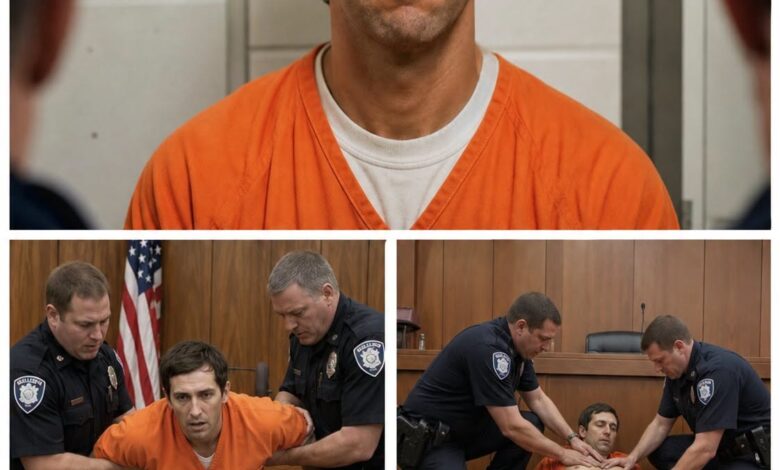
The courtroom emptied, but the verdict never truly left.
In the days that followed, it traveled home with everyone who had been there, clinging to them like smoke after a fire. Jurors heard it in the silence of their kitchens. Reporters remembered it while staring at blank screens, trying to reduce what they had witnessed to headlines and column inches. Family members carried it into sleepless nights. Even strangers who had crowded the wooden benches found themselves replaying those final minutes when there was nothing left to argue, nothing left to prove, and nowhere left for him to run.
They remembered the judge’s voice first—steady, controlled, almost painfully calm.
Then they remembered his.
The instant the sentence became real, something inside him seemed to collapse. His shoulders folded forward. His face lost whatever composure he had managed to preserve throughout the trial. For weeks, he had sat beneath the courtroom lights listening to witnesses, lawyers, experts, and grieving relatives speak about what had happened and what it had cost them. He had endured photographs, accusations, testimony, and silence.
But the verdict was different.
The verdict turned possibility into certainty.
Until that moment, however faintly, there had still been a future he could imagine. Perhaps not the future he once expected, but some version of one. A door might open. An appeal might succeed. Time might soften what seemed unbearable.
Then the judge spoke, and those possibilities disappeared one by one.
The sound that escaped him was not eloquent. It was not dignified. It was the raw, involuntary cry of someone realizing that the life he had known was over.
That sound stayed with them.
For some who had watched the trial, this created an uncomfortable fracture in everything they believed about justice. They had arrived expecting clarity. There had been evidence. There had been arguments. There had been rules governing what could be admitted, what could be challenged, and what conclusions could legally be drawn. The process had unfolded as it was supposed to.
The law had worked.
And yet, watching a human being break beneath its final judgment did not feel clean.
That was the contradiction none of them had prepared for.
They had assumed justice would bring certainty—that when the right sentence was handed down, morality itself would somehow snap into place. Instead, they discovered that justice could be precise without being painless. A verdict could be legally sound and still leave everyone in the room feeling as though they had witnessed another kind of death.
For the families, there was no simple relief.
Some embraced the ruling fiercely because they needed to. They had spent too long waiting for someone in authority to acknowledge what had been taken from them. They had sat through hearings, delays, testimony, arguments, and endless retellings of the worst moments of their lives. The sentence could not return the people they had lost, but it could say that those lives mattered. It could say that what happened to them had consequences.
For those families, the verdict became something solid to hold.
Not healing.
Not closure.
But recognition.
Others found themselves caught in emotions they had never expected to feel.
They had wanted accountability. They had wanted the court to speak clearly. Yet when it finally did, they watched another person disintegrate only a few yards away, and the sight disturbed them in ways they could not easily explain.
Grief was supposed to make hatred simple.
Instead, it complicated everything.
At night, some of them returned unwillingly to that courtroom. They remembered his hands trembling. They remembered the stunned expression on his face as the meaning of the sentence settled over him. They remembered the helpless noise that followed.
Then came the guilt.
Not guilt because they believed the verdict was wrong. Not forgiveness for what had happened. Something harder to name.
It was the recognition that punishment did not reverse loss.
Their loved ones were still gone.
And now another life had been reduced to a locked door, a numbered cell, and years measured by concrete walls.
Nothing had been restored.
The wreckage had merely been rearranged.
Outside the courthouse, the world moved on with astonishing speed.
For several days, cameras crowded the steps. Reporters repeated the sentence beneath bright studio graphics. Commentators debated whether justice had been served. Photographs appeared on television screens and across front pages. Every detail seemed urgent.
Then another story arrived.
The satellite trucks disappeared. The microphones were packed away. The courthouse steps became ordinary stone again. Headlines shifted to newer tragedies, newer defendants, newer families standing beneath unfamiliar lights.
But those who had been inside could not move on so easily.
The memory followed them.
Months later, a news report about another sentencing could bring it back without warning. A judge’s measured voice. A defendant waiting to hear how much of life remained. A family holding photographs of someone who would never return.
Again came the same uneasy question:
What does it really mean to say justice has been served?
Perhaps justice was never meant to erase suffering.
Perhaps that had been the mistake—to imagine that the law could somehow balance human loss so perfectly that everyone could leave the courtroom feeling whole.
It could not.
The law could establish guilt. It could assign responsibility. It could punish. It could protect. It could draw a boundary and declare that something had been done which society refused to accept.
But it could not resurrect the dead.
It could not return stolen years.
And it could not impose a devastating sentence without creating another human consequence.
That did not make accountability meaningless. If anything, it made it heavier.
Because justice was not a machine into which suffering could be placed and from which fairness emerged untouched. It was carried out by people, against people, on behalf of people who had already been wounded.
There would always be a cost.
The families knew that better than anyone.
So did those who had watched him collapse.
Years might eventually soften the details—the exact words spoken, the arrangement of the courtroom, the faces in the gallery—but that final sound would remain.
Not as proof that the sentence had been wrong.
Not as proof that mercy should have replaced accountability.
But as a reminder of something far more difficult to accept.
Sometimes justice is necessary precisely because something irreversible has happened. And when the damage cannot be undone, no verdict can truly repair it. The most a courtroom can do is name the wrong, determine responsibility, and decide what must follow.
After that, everyone is left to live with what remains.
That was what the people in the courtroom finally understood.
Justice could be deserved.
Justice could be lawful.
Justice could even be necessary.
And still, when the gavel fell and another future disappeared, there was no triumph in the room.
Only the terrible weight of the price.