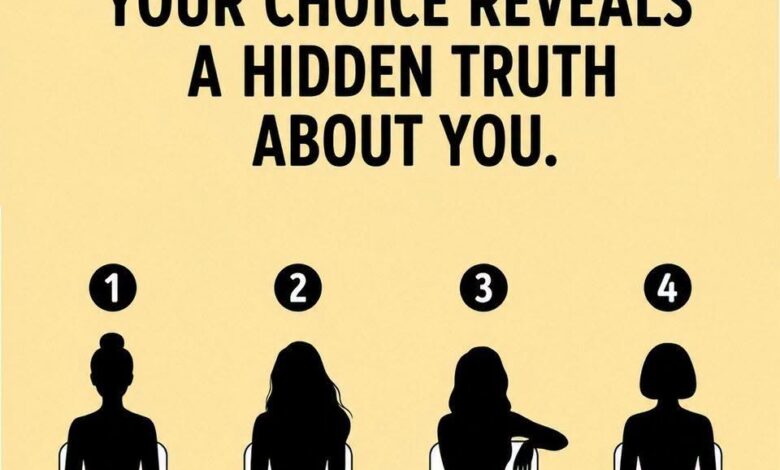
Four women are sitting in front of you.
You can’t see their faces.
You don’t know their ages.
You know nothing about their lives.
Yet there’s a good chance your brain has already decided which one looks oldest.
Take another look.
Which woman would you choose: 1, 2, 3, or 4?
Don’t analyze it too much.
Go with the person who caught your attention first.
Got your answer?
Good.
Now here’s what makes this little visual quiz interesting.
There is no objectively correct answer.
They’re silhouettes. We don’t have enough information to determine anyone’s actual age.
The real game is noticing why your mind made the choice it did.
Human beings form impressions incredibly quickly. Posture, clothing, hairstyle, body language, and countless other visual cues can influence what we assume about another person.
Sometimes those assumptions are useful.
Sometimes they’re completely wrong.
And sometimes they reveal more about our expectations than about the person we’re judging.
This isn’t a scientific personality assessment, so don’t take the result too seriously.
But it can be a surprisingly entertaining exercise in self-reflection.
Remember your number?
Let’s see what your choice might say about you.
If You Chose Woman #1
You may be someone who strongly associates maturity with discipline, responsibility, and composure.
Look at her posture.
She’s sitting upright, with both feet positioned firmly beneath her and her body appearing controlled and composed.
Her hairstyle also looks neat and structured.
Those details may have caused your brain to associate her with experience and maturity.
If Woman #1 immediately stood out to you, organization may be important in your own life.
You probably appreciate people who keep their promises.
When you say you’ll do something, you make an effort to follow through.
You may prefer having a plan rather than improvising everything at the last second.
When problems appear, you’re often the person trying to remain calm while everyone else reacts emotionally.
People may describe you as dependable.
That’s one of your greatest strengths.
You understand that exciting ideas don’t mean much without the discipline required to turn them into reality.
However, there’s another side to this personality.
Because you’re good at noticing patterns and making decisions, you may occasionally reach conclusions too quickly.
You see someone’s appearance.
Their behavior.
One mistake.
And your mind starts constructing the rest of their story.
Sometimes you’re right.
Sometimes you’re not.
Your reminder is simple:
Leave room for people to surprise you.
Not everything important can be understood from the first impression.
If You Chose Woman #2
Your attention may naturally gravitate toward emotion, warmth, and imagination.
Woman #2 has a softer, more relaxed appearance.
Her long hair and posture create a different impression from the structured silhouette beside her.
If you interpreted those characteristics as signs of age or maturity, you may instinctively connect life experience with emotional depth.
You’re probably interested in what people feel beneath what they say.
Someone can tell you they’re fine, but you’ll notice the hesitation.
The changed tone.
The expression that doesn’t quite match the words.
You value meaningful conversations.
Surface-level interactions can become tiring because you’re naturally curious about what people genuinely think and feel.
Kindness matters to you.
Authenticity matters even more.
You’d often rather spend an evening having a real conversation with one close friend than trying to impress an entire room of strangers.
Your intuition can be powerful.
But there’s a potential downside.
You may absorb too much.
Someone you love has a problem, and suddenly you’re carrying it too.
A conversation ends strangely, and hours later you’re still replaying it.
“Did I say something wrong?”
“Are they upset?”
“Should I have handled that differently?”
Sometimes your empathy becomes overthinking.
Your challenge is remembering that caring about someone doesn’t require solving everything for them.
Some things aren’t yours to carry.
If You Chose Woman #3
You may associate maturity with confidence, independence, and self-assurance.
Woman #3 appears noticeably relaxed.
One arm rests casually while her posture seems to say:
“I know exactly where I belong.”
That confidence may be what your brain interpreted as experience.
If you selected her, there’s a good chance you admire independence.
You don’t necessarily need everyone to agree with you before making a decision.
When you believe something is right, you’re willing to move.
Challenges can actually energize you.
Where another person sees uncertainty, you may see possibility.
You aren’t afraid of taking the lead when nobody else wants responsibility.
That’s why people may naturally come to you for advice.
You project certainty.
Even when you’re not completely certain inside.
But strong independence has a blind spot.
Sometimes confidence becomes stubbornness without us noticing.
You may become so accustomed to trusting your own judgment that listening to another perspective feels unnecessary.
The strongest leaders aren’t people who always know they’re right.
They’re people confident enough to consider that they might be wrong.
Your challenge?
Keep the confidence.
Keep the independence.
But remain curious.
Someone else’s perspective doesn’t weaken yours.
Sometimes it improves it.
If You Chose Woman #4
You may associate age and wisdom with stability, simplicity, and tradition.
Woman #4 has perhaps the most understated appearance of the group.
Nothing about her silhouette seems designed to demand attention.
And that may be precisely why you chose her.
You may believe that genuinely confident people don’t need to advertise themselves.
You appreciate consistency.
Loyalty matters enormously to you.
You’re likely the kind of person who would rather have a few trustworthy relationships than dozens of superficial ones.
Small pleasures matter.
A peaceful morning.
A familiar meal.
A conversation with someone you trust.
A home that feels comfortable.
You understand something many people spend years learning:
A good life doesn’t always have to be an exciting one.
There is tremendous value in stability.
People probably trust you because you don’t make commitments casually.
If you promise something, you mean it.
However, comfort can occasionally become a cage.
Routine feels safe.
Predictability feels good.
And before you realize it, you may start rejecting unfamiliar experiences simply because they’re unfamiliar.
Your challenge isn’t to abandon stability.
It’s to occasionally interrupt it.
Take the trip.
Try the restaurant.
Learn the skill.
Talk to the stranger.
Say yes to something that makes you slightly nervous.
You might discover that adventure and stability don’t have to be enemies.
What Does Your Answer Actually Reveal?
Here’s the most important part.
Choosing Woman #1, #2, #3, or #4 does not scientifically reveal your personality.
There isn’t a psychological formula proving that picking one silhouette makes you disciplined, emotional, independent, or traditional.
Personality is far too complicated for that.
Your character has been shaped by years of experiences, relationships, successes, failures, beliefs, habits, and circumstances.
Four silhouettes can’t summarize all of that.
But the quiz can still reveal something interesting:
What did you notice first?
Maybe posture mattered to you.
Maybe hairstyle.
Maybe clothing.
Maybe confidence.
Perhaps you couldn’t even explain your choice.
That’s interesting too.
Our brains constantly make rapid judgments using incomplete information.
We do it while meeting strangers.
Walking into rooms.
Looking at photographs.
Interviewing candidates.
Choosing whom to approach at a party.
Sometimes we aren’t even conscious of the assumptions guiding us.
That’s why this simple picture can become more than a guessing game.
It reminds us how quickly perception turns into judgment.
You looked at four anonymous silhouettes.
Within seconds, your mind started inventing information that wasn’t actually provided.
Age.
Experience.
Personality.
Maybe even lifestyle.
That’s what brains do.
The useful skill isn’t eliminating first impressions completely.
It’s remembering that they’re only first impressions.
They can change.
They can be challenged.
And they can be wrong.
So go back to the picture one final time.
Look at the woman you chose.
Then look at the other three.
Would you still make the same choice?
Maybe.
Maybe not.
Either answer is fine.
Because the most interesting thing hidden in this picture isn’t the age of four mysterious women.
It’s how quickly your mind decided it already knew them.