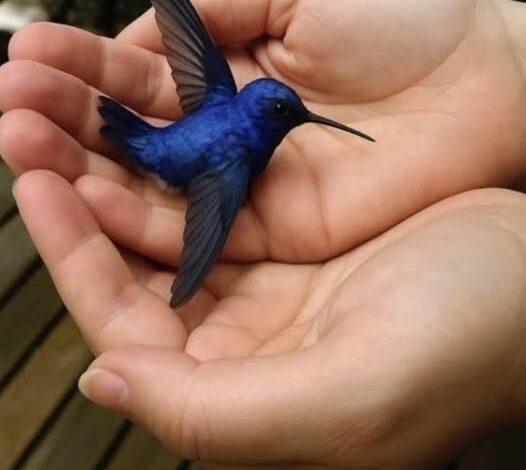
A hummingbird appears outside your window, and for a few seconds, everything else seems to disappear.
The phone can wait.
The dishes don’t matter.
Whatever you were worrying about suddenly becomes quieter.
There is only this impossibly tiny bird hovering in the air, wings moving so quickly they almost vanish, its feathers flashing like jewels whenever the sunlight catches them.
And if you’ve ever wondered whether a hummingbird visiting your home means something, you’re far from alone.
Across cultures and generations, hummingbirds have accumulated powerful symbolic meanings. They have been associated with joy, resilience, hope, renewal, and the remarkable ability to survive despite appearing so delicate.
For some people, seeing one during a difficult period feels almost perfectly timed.
Life has been heavy.
Then something weighing only a few grams arrives outside the window and seems to carry an enormous message:
Keep going.
Scientifically, of course, the hummingbird probably hasn’t arrived to deliver a personal prophecy.
It may simply be searching for nectar, insects, water, shelter, or a suitable place to rest. Bright flowers, feeders, and favorable habitat can naturally attract these extraordinary birds.
But knowing the biological explanation doesn’t necessarily erase the emotional meaning of the encounter.
Sometimes meaning isn’t about proving that the universe deliberately sent something.
Sometimes it’s about recognizing what an experience awakens inside us.
Hummingbirds are especially powerful symbols of resilience because their lives require extraordinary energy.
Their hearts can beat hundreds of times per minute, and their rapid wingbeats allow them to hover with remarkable precision. Some species undertake astonishing migrations despite their tiny size.
Everything about them seems to challenge our assumptions about strength.
They are small without being weak.
Delicate without being helpless.
Restless yet astonishingly controlled.
Perhaps that’s why someone struggling through a difficult chapter can look at a hummingbird and see themselves differently.
You don’t have to feel powerful to keep moving.
You don’t have to be enormous to survive enormous things.
And exhaustion doesn’t mean the journey is over.
For people experiencing grief, hummingbirds can carry an even deeper significance.
Some families and spiritual traditions interpret their appearance as a reminder of loved ones who have died—a brief visitor arriving at exactly the moment someone’s absence feels particularly painful.
There is no scientific way to establish that a hummingbird carries a message from someone who has passed away.
But grief doesn’t always speak the language of proof.
Sometimes a familiar song comes on unexpectedly.
A particular flower blooms.
A butterfly lands nearby.
A hummingbird appears outside the window.
And for one quiet moment, the person you miss feels strangely close again.
That feeling doesn’t need to be mocked or turned into certainty.
It can simply be cherished.
Because perhaps the most extraordinary thing about a hummingbird isn’t what it supposedly predicts.
It’s what it makes us do.
Stop.
Really stop.
In a world engineered to fracture our attention, this tiny creature somehow captures all of it.
You watch.
You listen to the faint buzz of its wings.
You notice the light.
You become curious.
You wonder where it came from and whether it will return tomorrow.
For those few seconds, you’re completely present.
And maybe that is the message worth keeping.
Not that good fortune is guaranteed.
Not that every hardship is about to disappear.
Not that the bird possesses supernatural knowledge of your future.
Simply this:
There is still beauty here.
Even after disappointment.
Even during grief.
Even while you’re tired.
Even when life has become so repetitive that you’ve stopped expecting anything to surprise you.
Something extraordinary can still appear outside an ordinary window.
If you’d like hummingbirds to return, you can make your outdoor space more welcoming with native nectar-producing flowers and a properly maintained feeder. If using a feeder, keep it clean and use an appropriate plain sugar-water mixture rather than dyes or artificial sweeteners.
Then watch.
Maybe one will return.
Maybe it won’t.
Either way, the first visitor has already given you something valuable.
It interrupted you.
It made you look up.
It reminded you that wonder doesn’t always arrive dramatically.
Sometimes it is only a flicker outside the window.
A flash of color.
A heartbeat with wings.
And perhaps the hummingbird’s deepest meaning isn’t something hidden inside the bird at all.
Perhaps it lies in the part of you that suddenly becomes awake when you see it.
The part that still notices beauty.
The part that still misses someone.
The part that still hopes.
The part that, despite everything you’ve experienced, can still be astonished.
Maybe that’s enough.
Because sometimes grace doesn’t arrive with answers.
Sometimes it simply hovers outside your window for a few extraordinary seconds—and reminds you to look.