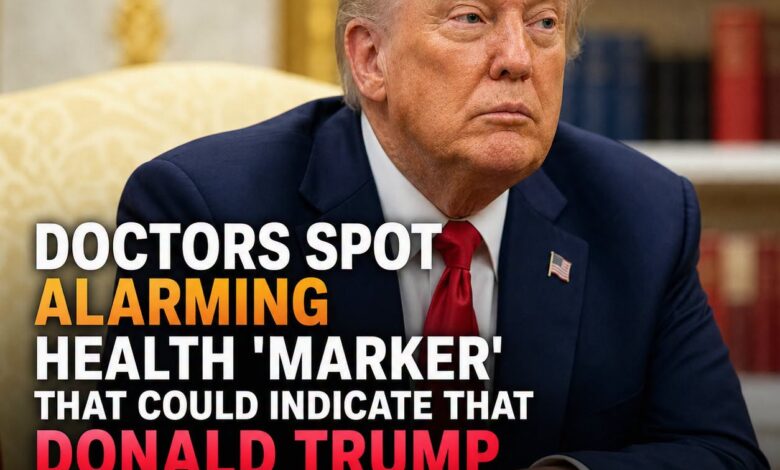
Doctors spot alarming health ‘marker’ that could indicate that Donald Trump doesn’t have much time left to live

The most concerning health stories rarely begin with one dramatic collapse.
More often, they develop quietly.
A few extra pounds.
Less energy.
An unexplained bruise.
A moment of apparent fatigue.
A schedule change.
Individually, each observation may mean very little. Together, they can invite a much darker narrative—especially when the person being scrutinized is an aging president whose every movement is photographed, recorded, slowed down, enlarged, and debated.
But that is precisely where caution matters most.
A photograph is not a blood test.
A video clip is not a cardiac examination.
And visible weight gain, while potentially relevant to health, cannot by itself tell outsiders what is happening inside someone’s heart, liver, pancreas, blood vessels, or metabolism.
Still, the broader medical question behind the speculation is legitimate.
What happens when significant weight gain occurs late in life?
And why might physicians take it seriously in an older adult?
The answer is less sensational than many headlines suggest, but more important.
Weight is not simply cosmetic.
Particularly when excess fat accumulates around the abdomen and internal organs, it can be associated with metabolic changes that affect several systems simultaneously.
Visceral fat—the fat stored deeper within the abdominal cavity—is biologically active.
Higher amounts are associated with insulin resistance, abnormal blood lipids, inflammation, high blood pressure, type 2 diabetes, fatty liver disease, cardiovascular disease, and other health problems.
That does not mean every person who gains abdominal weight has these conditions.
It means the change can be one piece of a much larger risk profile.
For an 80-year-old, context becomes especially important.
A younger body often has greater physiological reserve—the ability to compensate when one system is under stress.
Aging gradually reduces some of that margin.
The heart changes.
Blood vessels become less elastic.
Muscle mass tends to decline.
Metabolism changes.
Recovery from illness can take longer.
Multiple medications or chronic conditions may complicate one another.
This is why doctors generally do not evaluate an older patient’s health by staring at the number on a scale.
They look at the entire picture.
Blood pressure.
Blood glucose.
Cholesterol and triglycerides.
Kidney and liver function.
Cardiovascular history.
Medications.
Sleep.
Mobility.
Exercise tolerance.
Nutrition.
Body composition.
Changes over time.
Symptoms.
Only then does weight begin to acquire useful meaning.
That distinction becomes especially important when the patient is a public figure.
Presidents create an unusual medical problem for the public.
Their health genuinely matters.
A president’s ability to perform the duties of office is a legitimate public concern.
Yet presidents retain personal medical privacy, and the public usually receives only selected information through physicians, official reports, appearances, and statements.
Into whatever gaps remain rushes speculation.
A bruise becomes evidence of serious disease.
A canceled appearance becomes proof of incapacity.
A moment with closed eyes becomes a diagnosis.
A late-night social-media post becomes evidence of neurological decline.
Weight gain becomes a prediction of imminent death.
Medicine does not work that way.
Bruising, for example, can have many explanations, particularly in older adults. Aging skin bruises more easily, and common medications can make bruising more noticeable.
Fatigue is even less specific.
Someone appearing sleepy during a meeting could be tired.
They could be bored.
They could have slept poorly.
They could be taking medication.
They could have an underlying medical condition.
Or a short clip may simply capture an unrepresentative moment.
The observation may justify a question.
It does not answer it.
The same principle applies to unexplained absences.
A public schedule can change for medical reasons.
It can also change for political, security, personal, logistical, or strategic reasons.
Without reliable information, absence is absence.
It is not a diagnosis.
This does not mean health concerns should be dismissed simply because definitive medical records are unavailable.
It means the line between risk and diagnosis must remain visible.
An older person who gains substantial weight may indeed warrant medical evaluation.
If that person also has known cardiovascular or metabolic risk factors, doctors may pay particular attention to the change.
But predicting “premature death” for a specific individual requires far more information than photographs, public appearances, and body weight.
A responsible physician would want objective evidence.
How quickly did the weight appear?
Was it actually fat?
Could some of the increase represent fluid retention?
Has activity decreased?
Have medications changed?
What is happening with blood pressure?
Blood sugar?
Cardiac function?
Liver markers?
Kidney function?
Sleep?
Breathing?
Without answers to questions like those, certainty becomes performance rather than medicine.
There is another complication.
Politics makes medical uncertainty almost impossible to discuss calmly.
Supporters may see an energetic speech and conclude that every health concern is fabricated.
Critics may see an awkward movement or tired expression and treat it as confirmation that severe decline is already underway.
Neither approach is medically sound.
A person can deliver a vigorous speech and still have meaningful health risks.
A person can look exhausted in a photograph and still be medically stable.
Appearance provides clues.
It does not provide a complete chart.
That is why presidential health disclosures matter.
The purpose of credible medical transparency is not to satisfy curiosity about someone’s body.
It is to reduce the space in which partisan interpretation substitutes for clinical evidence.
Useful disclosure should provide enough objective information for the public to understand whether a president remains capable of carrying out the demands of office.
That might include relevant diagnoses, medications, examination findings, cardiovascular risk information, laboratory results, and physicians’ assessments where appropriate.
When information is incomplete, public anxiety predictably grows.
But silence does not give outsiders permission to manufacture certainty.
“I don’t know” remains a legitimate answer.
In fact, it is often the most medically responsible one.
What can be said with confidence is broader.
Age matters.
Cardiovascular risk matters.
Metabolic health matters.
Significant changes in weight can matter.
Sleep matters.
Mobility matters.
Blood pressure matters.
Diabetes risk matters.
And the combination of several genuine risk factors can be more important than any single one viewed alone.
This concept is sometimes lost in public discussion.
People search for the one thing that will explain everything.
The bruise.
The weight.
The stumble.
The fatigue.
But chronic disease often develops through accumulation.
Years of elevated blood pressure can strain blood vessels.
Insulin resistance can progress quietly.
Excess visceral fat can contribute to metabolic dysfunction.
Poor sleep can interact with cardiovascular and metabolic health.
Reduced activity can accelerate loss of muscle and physical reserve.
None of these necessarily produces a dramatic warning.
The danger, when it exists, may be cumulative.
That is the medically serious version of the concern.
It requires no sensational prediction.
An 80-year-old body does not have unlimited reserve.
Neither does anyone else’s.
Age makes preventive care, objective monitoring, and management of modifiable risks increasingly important.
But there is a crucial difference between saying biology matters and pretending biology has already revealed an individual’s outcome.
It hasn’t.
Even physicians treating the same patient rarely predict an exact future from one risk factor.
People with substantial risk sometimes remain stable for years.
People who appear healthy can experience sudden illness.
Medicine works in probabilities, not prophecies.
Presidential status does not change that.
Neither does political allegiance.
The heart does not vote.
The pancreas does not read polls.
Blood vessels do not care whether a crowd is cheering or protesting.
But that biological neutrality cuts both ways.
It means political power cannot protect someone from disease.
It also means political dislike cannot diagnose disease into existence.
The standard should therefore remain the same regardless of who occupies the White House.
Ask legitimate questions.
Expect meaningful transparency.
Take documented medical findings seriously.
Distinguish known diagnoses from visual speculation.
And resist converting ambiguous photographs or isolated behavior into conclusions that require clinical evidence.
If reliable medical information eventually shows worsening cardiovascular, metabolic, hepatic, neurological, or other disease, that information should be discussed plainly.
If physicians identify substantial risk, the public should understand what that risk means.
And if the evidence remains incomplete, the uncertainty should be stated just as plainly.
There is no need to soften biological reality.
Aging is real.
Chronic disease is real.
Obesity and visceral fat can carry serious health consequences.
An older president operates under extraordinary physical and psychological demands.
Those facts are significant enough without embellishment.
The more powerful observation is not that one bruise, one absence, one apparent nap, or one change on the scale predicts catastrophe.
It is that health is cumulative.
Bodies keep records differently from headlines.
They record blood pressure over years.
Metabolic strain.
Sleep.
Movement.
Inflammation.
Illness.
Medication.
Recovery.
Age.
Eventually those variables matter, whether the person involved is anonymous or one of the most powerful people on Earth.
That is the real limit of power.
A president can control a message.
A political team can dispute a narrative.
Supporters can cheer.
Critics can speculate.
But nobody can negotiate with physiology.
What we should resist is pretending we know what physiology is saying before the evidence allows us to hear it.
Biology does not care about politics.
Good medicine shouldn’t either.