Dolly Parton Covered Her Tattooed Hands With Skin-Colored Gloves, Here’s What She Was Really Hiding

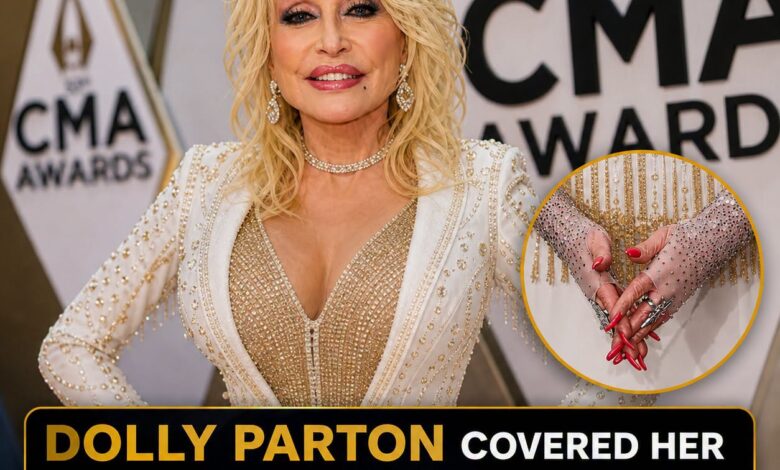
For decades, Dolly Parton seemed willing to show the world almost everything.
She joked about her wigs.
She laughed about cosmetic surgery.
She discussed growing up desperately poor in the Smoky Mountains, talked openly about heartbreak, and turned deeply personal experiences into songs heard by millions.
Yet there was one small detail she rarely explained completely.
Her hands.
As Dolly grew older, fans began noticing something unusual about her appearance. Whether she was performing onstage, attending an event, filming an interview, or posing for photographs, she frequently wore fingerless gloves or fabric coverings over portions of her hands.
They were usually coordinated perfectly with whatever she was wearing.
Sometimes glittering.
Sometimes pale and delicate.
Sometimes decorated with rhinestones.
On Dolly, almost anything could be transformed into fashion.
But people still wondered.
Why did she wear them so often?
The question became another enduring Dolly Parton mystery.
And like many mysteries surrounding her appearance, the answer appeared to exist somewhere between medical necessity, personal preference, and Dolly’s extraordinary ability to turn vulnerability into style.
There was never anything accidental about the way Dolly presented herself.
She understood spectacle.
The enormous blond hair, towering heels, dramatic makeup, bright colors, tiny waist, and rhinestones weren’t evidence that she didn’t know how exaggerated she looked.
They proved that she knew exactly what she was doing.
Dolly created Dolly.
That distinction mattered.
Her appearance allowed her to control the first impression before anybody else could.
If people were going to stare, she would give them something worth staring at.
If they were going to make jokes, she would often make the joke first.
But the gloves seemed different.
They weren’t designed primarily to draw attention.
They appeared designed to conceal.
Over the years, several explanations circulated.
Some reports connected the coverings to Dolly’s tendency toward keloid scarring.
Keloids develop when scar tissue grows beyond the boundaries of an original injury. They can become raised, thickened, and sometimes darker or more noticeable than surrounding skin.
Dolly had acknowledged having scars and had also explained that some of her small, pastel tattoos were created partly to cover areas she didn’t like looking at.
Instead of elaborate sleeves of ink, she favored delicate imagery.
Butterflies.
Flowers.
Bows.
Small splashes of color.
It was an approach that seemed perfectly consistent with her personality.
When her body left a mark she couldn’t erase, Dolly found another way to reclaim it.
She decorated it.
That history inevitably made people wonder whether the gloves served a similar purpose.
There was also speculation about previous medical procedures, corrective surgery, discoloration, or changes to the skin of her hands.
As Dolly aged, another explanation became increasingly simple: perhaps she simply preferred not to display every physical change that came with getting older.
That possibility shouldn’t be shocking.
Hands can reveal age in ways carefully applied makeup cannot easily disguise.
Skin becomes thinner.
Veins become more prominent.
Pigmentation changes.
Joints can swell.
Scars become visible.
And for a woman whose appearance had been analyzed publicly for most of her adult life, deciding that one part of her body was nobody else’s business may have felt entirely reasonable.
Dolly never owed the public an inventory of every scar.
That is what makes the fascination with the gloves revealing.
People were accustomed to Dolly being open.
Because she joked about plastic surgery, audiences sometimes assumed there were no boundaries left.
But Dolly’s openness was highly controlled.
She told stories she wanted told.
She answered questions she wanted answered.
She could make an interviewer believe they had received an intimate confession while still protecting enormous pieces of her private life.
Her marriage to Carl Dean was perhaps the clearest example.
Dolly became one of the most photographed women on Earth.
Carl managed to remain almost invisible.
That wasn’t an accident.
It was a boundary.
Dolly understood that fame could consume everything offered to it.
So she didn’t offer everything.
The gloves may have represented that same instinct on a much smaller scale.
You can have the performance.
You can have the songs.
You can have the rhinestones.
You can laugh about the wigs and the heels.
But you don’t automatically get access to every inch of the woman underneath them.
There is something unexpectedly powerful about that distinction.
Especially for an aging female celebrity.
Women in entertainment are placed inside an impossible contradiction.
Age naturally, and people inspect every wrinkle.
Have cosmetic work, and people mock you for refusing to age.
Cover something, and they demand to know what you’re hiding.
Reveal it, and photographs are enlarged and analyzed.
Dolly spent her career navigating that trap with humor.
She never pretended her appearance was effortless.
Quite the opposite.
She treated artificiality almost like another art form.
She once built her image around the kind of glamorous woman polite society might have considered excessive, then turned that supposedly “cheap” aesthetic into one of the most recognizable looks in entertainment history.
She wasn’t fooled by the illusion.
She was its architect.
So when gloves became part of that architecture, Dolly did what she had always done.
She made them beautiful.
Instead of appearing clinical, they sparkled.
Instead of looking like something she had to wear, they looked like something she had chosen.
A possible insecurity became another accessory.
A covering became decoration.
A vulnerability became part of the costume.
That transformation mirrors so much of Dolly’s life.
She was born into poverty and eventually wrote about it with tenderness rather than shame.
She experienced heartbreak and turned it into songs.
She encountered sexism and often defeated it by allowing men to underestimate her.
She endured criticism of her appearance and transformed the very things people mocked into trademarks.
Even her scars could become butterflies.
Perhaps the gloves belonged to the same philosophy.
Don’t deny the wound.
Decide what it gets to become.
Still, there is an important difference between understanding that philosophy and claiming certainty about what Dolly was hiding.
Unless Dolly herself gave a definitive explanation for every period in which she wore the gloves, outsiders cannot responsibly know exactly what was underneath them.
Maybe scars played a role.
Maybe medical procedures did.
Maybe pigmentation did.
Maybe aging did.
Maybe she simply liked them.
Perhaps the answer changed over time.
Human bodies do.
And that uncertainty may actually make the story more meaningful.
Because the public doesn’t need to solve every mystery.
Dolly spent a lifetime sharing extraordinary amounts of herself.
She gave audiences songs drawn from pain most people would struggle to say aloud.
She told stories about her childhood.
She discussed her insecurities with humor.
She talked about faith.
Marriage.
Ambition.
Sacrifice.
Success.
She allowed generations to feel as though they knew her.
But feeling close to someone famous is not the same as owning them.
There were rooms the public couldn’t enter.
Carl was one.
Her private health was another.
Perhaps her hands were too.
That doesn’t make Dolly deceptive.
It makes her human.
There is a strange expectation placed on beloved celebrities that they should eventually become public property.
Fans want photographs of the house.
Details of the marriage.
Medical diagnoses.
Last conversations.
Private letters.
Final moments.
The affection may be genuine, but affection can still become invasive.
Dolly seemed to understand that better than most.
Her solution wasn’t to disappear.
She gave people more Dolly than almost anyone could have imagined.
She just kept enough for herself.
That may be why her carefully constructed appearance deserves more respect than it sometimes receives.
The wigs weren’t necessarily hiding something.
They were also creating something.
The makeup wasn’t simply camouflage.
It was expression.
The rhinestones weren’t evidence of insecurity.
They were joy.
And the gloves need not be treated as clues to some embarrassing secret.
Maybe they were simply another example of Dolly deciding how she wanted to be seen.
That right doesn’t disappear with fame.
Nor does it disappear with age.
If scars were underneath, they belonged to her.
If medical procedures left marks, those marks belonged to her.
If she disliked the way aging changed her hands, she had every right to cover them.
And if she simply thought sparkling fingerless gloves looked fabulous, that would have been reason enough.
There is almost something poetic about focusing on Dolly’s hands anyway.
Think about what those hands accomplished.
They held guitars.
They wrote thousands of lyrics.
They signed contracts when women in country music were routinely underestimated.
They built businesses.
They wrote checks for causes she believed in.
They held Carl’s hand through nearly six decades of marriage.
They turned pages in children’s books.
They waved to crowds.
They clasped microphones while she sang songs that became part of other people’s lives.
Whatever scars those hands carried were only evidence that the woman attached to them had lived.
Dolly understood that bodies change.
The image could be refreshed.
A new wig could be styled.
Another rhinestone could be added.
But underneath the costume was always a mortal person moving through time like everyone else.
Perhaps that is why the gloves feel more poignant now.
They remind us that even someone who seemed almost permanently sparkling had things she wanted to protect.
Dolly could be astonishingly candid without surrendering every secret.
She could make millions feel loved without allowing millions unrestricted access to her.
She could reveal her heart through music while covering her hands with fabric.
There is no contradiction in that.
There is wisdom.
Privacy doesn’t invalidate authenticity.
Mystery doesn’t mean dishonesty.
And covering a scar doesn’t mean being ashamed of surviving whatever caused it.
Sometimes privacy is simply ownership.
Dolly spent much of her career proving that a woman could decide for herself what femininity looked like, what ambition looked like, what intelligence looked like, and what success looked like.
Why shouldn’t she also have decided what vulnerability looked like?
Maybe the gloves concealed scars.
Maybe they concealed age.
Maybe they concealed something far less dramatic than generations of speculation suggested.
Ultimately, the answer matters less than the choice.
Dolly chose what the world saw.
And beneath all the glitter, that may have been one of her greatest acts of control.
The public got the rhinestones.
The impossible hair.
The laughter.
The songs.
The jokes.
The enormous generosity.
But some things remained beneath the fabric.
Not because Dolly owed anyone an explanation.
Because she didn’t.
In the end, perhaps the mystery of Dolly Parton’s gloves was never really about what they covered.
It was about what they protected.
A small piece of a woman who had already given the world almost everything.
And after a lifetime of opening her heart through music, Dolly had earned the right to keep a few scars beneath her sleeves.