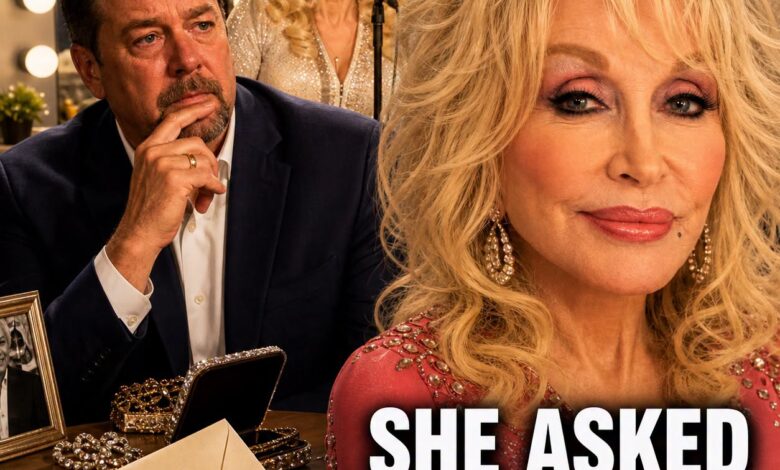
Dolly Parton spent most of her life understanding the difference between being known and being loved.
To the world, she was unmistakable.
The hair.
The rhinestones.
The laugh.
The voice.
The songs people carried through breakups, long shifts, funerals, road trips, weddings, and ordinary Tuesday mornings.
But inside her family, there were people who knew a version of Dolly that fame could never fully reach.
Bryan was one of them.
To everyone else, she was Dolly Parton.
To him, she was Aunt Dolly.
That difference may explain why choosing him for one of her most personal final responsibilities felt so meaningful.
She had spent decades speaking directly to millions of people, but when the time came for someone to tell those people she was gone, she reportedly did not want the message to feel corporate.
Not a press release stripped of personality.
Not a statement polished until grief disappeared beneath careful wording.
She wanted someone close.
Someone who knew the woman beneath the mythology.
Someone whose connection to her existed long before a final announcement ever became necessary.
That kind of trust cannot be manufactured at the end of a life.
It is built quietly.
Years of birthdays.
Family gatherings.
Private conversations.
Inside jokes.
Moments nobody photographs because nobody realizes they will someday become precious.
Bryan had watched Dolly move between two worlds.
There was the public woman, spectacular by design.
And there was the private aunt who could step away from the lights and become simply part of the family again.
Those two versions were never really opposites.
Dolly had always understood performance.
She knew exactly what the wigs, makeup, sequins, and jokes accomplished.
They created a larger-than-life character the public could instantly recognize.
She often laughed about that image herself.
But beneath the humor was control.
If the world was going to stare, Dolly would decide what it saw.
That principle appeared to extend even to the way she imagined saying goodbye.
After a lifetime associated with glittering costumes and theatrical entrances, her reported final wishes were strikingly simple.
Soft clothing.
Comfortable fabric.
A private service.
No enormous spectacle.
No demand that grief become another performance.
There is something deeply fitting about that contrast.
The woman who turned sequins into an international signature did not necessarily need sequins at the end.
The public image had done its work.
She did not need to remain inside it forever.
Instead, she seemed to want comfort.
Privacy.
Family.
The things that mattered before anyone knew her name.
It is tempting to describe that as contradiction.
It probably wasn’t.
Public Dolly and private Dolly had always existed together.
One could walk onto a stage beneath blinding lights.
The other could go home afterward.
One belonged, in some sense, to millions.
The other belonged to herself.
That balance may have been one of the secrets of her longevity.
She gave the public extraordinary access without surrendering everything.
Fans knew the stories she chose to tell.
They knew where she came from.
They knew about the poverty of her childhood, the songs, the ambition, the humor, the marriage she fiercely protected, and the causes she cared about.
But there were always rooms in her life where the cameras did not enter.
Those boundaries were not coldness.
They were survival.
A person cannot belong completely to the public and still remain whole.
Dolly seemed to understand that earlier than many celebrities do.
She could be generous without being completely exposed.
Warm without being available for consumption.
Famous without letting fame make every relationship performative.
That is why entrusting Bryan with such an intimate responsibility carries symbolic weight.
He represented continuity.
Someone who could stand between the private family and the public mourning without turning one into the other.
If millions of admirers were going to hear the most painful news imaginable, Dolly apparently wanted that message carried by a voice connected to the person behind the image.
There is tenderness in that.
And perhaps a little practicality too.
Dolly had spent her career mastering communication.
She knew words matter most when the person delivering them understands what they carry.
A death announcement is not merely information.
For devoted fans, it becomes a dividing line.
Before this sentence, Dolly Parton is alive in the present tense.
After it, she belongs partly to memory.
That transition deserves care.
Who better to hold it than someone she trusted?
Someone who did not first encounter her on a record sleeve or concert stage.
Someone who had watched her be ordinary.
Someone who could remember the famous woman without forgetting the aunt.
That may also explain the simplicity of the farewell she reportedly wanted.
There is a strange pressure surrounding the deaths of iconic people.
Everything becomes larger.
More ceremonial.
More elaborate.
Every flower arrangement becomes symbolic.
Every guest list becomes news.
Every decision is interpreted.
For someone whose life was already enormous in public, there can be dignity in refusing one final production.
Soft cotton instead of stagewear.
A smaller room instead of an arena.
People who genuinely knew her instead of a crowd that merely knew of her.
That kind of farewell does not diminish the scale of a life.
It puts the scale into perspective.
Dolly had nothing left to prove.
The songs already existed.
The businesses.
The philanthropy.
The Imagination Library.
The memories held by generations of listeners.
No funeral could make her legacy larger than it already was.
So perhaps the most honest ending was not another spectacle.
It was comfort.
That feels especially appropriate for someone who spent so much of her career giving comfort to other people.
A song for heartbreak.
A joke when things became too serious.
A book sent to a child.
Money sent quietly after disaster.
Encouragement offered to someone younger.
Her public life was filled with gestures designed to make other people feel less alone.
At the end, she appears to have chosen the same thing for herself.
People she trusted.
Familiarity.
Softness.
Privacy.
There is also something moving about the idea of Dolly choosing the person who would speak when she no longer could.
For most of her life, she had written her own lines.
Not literally every interview or appearance, but the larger narrative.
She decided how she wanted to be understood.
She took poverty and transformed it into pride.
Took heartbreak and turned it into songs.
Took an exaggerated visual image and made it impossible to mock because she had already made the joke first.
She controlled the frame.
Even vulnerability became something she shared on her own terms.
So the final act of choosing who would deliver the news feels consistent.
She could not control grief.
But she could choose who carried the first message through it.
That is not the same as controlling people.
It is stewardship.
She knew how deeply fans cared.
She had spent decades telling them they mattered.
Whether through letters, interviews, concerts, books, or charitable projects, Dolly cultivated an unusually personal relationship with the public.
The people listening were rarely treated as an anonymous market.
They were “my people.”
That language mattered.
It made success sound communal.
If that connection mattered during life, it makes sense that she would care how the final message reached them.
Not from a faceless institution.
From family.
And perhaps that was her last way of keeping the boundary intact.
The family spoke.
The public received.
The intimate and enormous met briefly without becoming the same thing.
Then came the funeral wishes.
No final costume designed to stop cameras.
No attempt to turn death into one last legendary appearance.
Just softness.
There is something almost humorous about it in a very Dolly way.
The woman famous for saying that it took a lot of money to look cheap allegedly wanted something almost aggressively comfortable at the end.
After decades of towering hair, sparkling gowns, dramatic silhouettes, and meticulously constructed glamour, perhaps she simply wanted fabric that felt good against her skin.
If so, the choice carried both humor and wisdom.
Costume had always been part of the job.
Death was not.
There would be no audience to charm.
No stage entrance to make.
No need to become Dolly Parton for anybody.
She could finally just be Dolly.
That may be the most poignant part.
Fame often convinces the public that the persona is the person.
But costumes come off.
Lights shut down.
A dressing room becomes quiet.
The person remains.
Dolly never seemed embarrassed by the artificiality of her image.
She celebrated it.
But perhaps precisely because she understood how constructed it was, she also understood what mattered beyond it.
Love.
Trust.
Family.
Comfort.
The right people in the room.
A goodbye that belonged to them before it belonged to history.
Bryan’s role therefore feels larger than simply delivering information.
He represented the final handoff.
Dolly had carried her public story for decades.
Then she entrusted someone else with the first sentence she could no longer speak herself.
That person was not chosen because he could perform grief beautifully.
He was chosen because he knew what the grief meant.
There is a difference.
Anyone can read a statement.
Only someone who loved you can carry the silence around the words.
Fans would hear the announcement and immediately remember their own Dolly.
A favorite song.
A concert.
A childhood memory.
A parent who played her records.
A book arriving in the mail for a child.
Bryan would hear something else too.
A family voice.
A person who had existed before all those memories became public property.
That dual meaning gave the message weight.
Perhaps that is why the final image is not really one of death.
It is one of trust.
An aunt choosing a nephew.
A famous woman choosing privacy.
A performer choosing comfort.
A storyteller choosing who would finish the sentence.
For decades, Dolly had made the world feel as though it knew her.
Near the end, she seems to have remembered exactly who actually did.
And she placed the final responsibility there.
Not with the loudest person.
Not with the most important executive.
Not with whoever could create the grandest farewell.
With family.
That may have been the last quiet joke beneath all the glitter.
The world spent a lifetime watching Dolly Parton shine.
But when the stage finally darkened, she chose something softer.
Cotton instead of sequins.
A private room instead of a spotlight.
A trusted voice instead of an announcement machine.
The rhinestones had never been the whole woman.
They were the armor, the fun, the signature, the magnificent costume she wore while doing the work.
Underneath was someone who understood that the most important promises are rarely public.
They are made between people.
Kept privately.
Remembered quietly.
And when her own voice could no longer deliver the final line, Dolly reportedly gave it to someone whose love had never depended on the spotlight.
That may have been the most personal choice of all.
She spent a lifetime writing her story herself.
And at the end, she trusted someone who knew the woman behind the story to close the book gently.