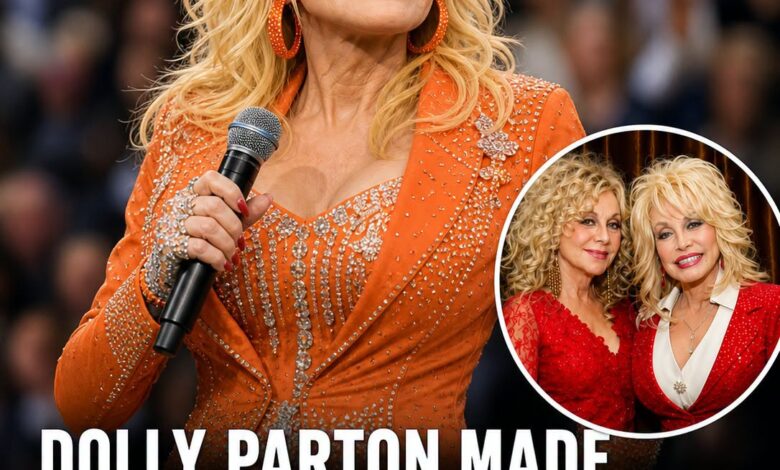
Dolly Parton made selfless offer to doctors during cancer battle before death, singer’s sister reveals..

Dolly Parton spent a lifetime making sure the audience saw the sparkle before they saw the struggle.
The rhinestones caught the light.
The hair was always high.
The jokes arrived at exactly the right moment.
And that unmistakable Tennessee voice could turn heartbreak into something people somehow wanted to sing together.
But in her final months, according to those closest to her, the woman behind that carefully constructed image was confronting something she had chosen not to share with the world.
Cancer.
While fans saw the Dolly they had always known—funny, glamorous, reassuring—her sister Stella saw something else.
She saw a woman who understood that time might be running out.
And even then, Dolly was apparently asking a question that had defined so much of her life:
How can I help?
That question reportedly led to one of the most extraordinary requests of her final illness.
If doctors reached the point where there was no realistic hope for her recovery, Dolly was willing to let them try experimental treatments on her.
Not because she expected a miracle.
Not because she wanted to become part of some dramatic medical spectacle.
But because, if her own life could no longer be saved, perhaps something learned from treating her could eventually help somebody else’s.
For almost anyone, that would be a remarkable decision.
For Dolly, it felt almost painfully consistent.
She had spent decades turning personal success into something other people could use.
Money became scholarships.
Fame became fundraising power.
Childhood poverty became motivation to send books into children’s homes.
Her father’s inability to read became part of the inspiration behind a literacy mission that eventually reached millions of families.
Disaster brought checks to people who had lost homes.
Scientific research received financial support.
Songs became emotional shelter for people Dolly would never meet.
So when her own body began failing, the instinct remained familiar.
Give.
Even now.
Especially now.
The public, however, was not invited into every detail of what was happening.
That mattered to Dolly.
She had always lived with a fascinating contradiction.
Few celebrities seemed more open.
She talked freely about growing up poor in the mountains of East Tennessee. She joked about her appearance, cosmetic procedures, wigs, breasts, clothes, and the elaborate construction of the public figure called Dolly Parton.
She could tell a deeply personal story and make millions of strangers feel as though they were sitting beside her at the kitchen table.
Yet she also understood boundaries.
There were doors fame wasn’t allowed to open.
Her marriage to Carl Dean was perhaps the clearest example. Dolly spent decades as one of the world’s most recognizable women while her husband remained astonishingly private.
That wasn’t accidental.
It was protection.
In her final months, the same instinct appears to have surrounded her illness.
The public knew she was experiencing health problems.
But the complete picture remained inside the family.
Her hospitalization was connected publicly to kidney and autoimmune complications rather than presented as the beginning of a celebrity farewell.
There was no grand announcement designed to dominate television.
No carefully marketed final tour.
No endless medical bulletin transforming each development into breaking news.
Dolly went into the hospital as a patient.
Not a spectacle.
Her family guarded the exact details of her diagnosis, allowing her to face what was happening with a degree of privacy almost unimaginable for someone of her fame.
To outsiders, secrecy inevitably creates questions.
When did she know?
How advanced was the cancer?
Which treatments had she undergone?
How much pain was she experiencing during her final appearances?
Who knew?
Why didn’t she tell the public?
But those questions assume fame creates ownership.
It doesn’t.
Dolly gave audiences songs.
She gave interviews.
She gave performances.
She gave decades of herself.
She did not owe strangers access to every medical chart or every frightened conversation.
There is something deeply human about choosing not to turn dying into content.
Perhaps she wanted people to look at her and still see Dolly.
Not a diagnosis.
Not a prognosis.
Not a countdown.
Dolly had spent her entire career understanding the difference between truth and total exposure.
You can be authentic without surrendering everything.
You can love the public without belonging completely to it.
You can tell millions of people about your childhood and still reserve the right to close a hospital door.
Stella, however, was on the other side of that door.
That makes her perspective especially heartbreaking.
To the world, Dolly’s final months could still contain performances, photographs, jokes, familiar clothes, and reassuring glimpses of the woman everyone thought they knew.
To a sister, those moments carried information invisible to everyone else.
A change in energy.
A pause.
A difficult day.
A conversation that suddenly sounded like preparation.
The particular intimacy of sibling grief comes from knowing the person before the world created the legend.
Stella didn’t first encounter Dolly beneath stage lights.
She knew her from the beginning.
Before Nashville.
Before record deals.
Before “Jolene.”
Before “9 to 5.”
Before Dollywood.
Before the wigs became architecture and the rhinestones became armor.
They shared the Parton family’s crowded beginnings in Tennessee.
That history changes what it means to watch someone die.
The public loses an icon.
A sister loses a witness to her own life.
And yet, even as the family prepared for loss, Dolly’s thoughts reportedly kept moving outward.
Her willingness to consider experimental treatment if conventional hope disappeared is especially striking because it reframes the final stage of illness.
If her body could no longer carry her forward, perhaps it could carry knowledge forward.
Maybe doctors could learn something.
Maybe another patient could benefit someday.
There was no guarantee.
Medical experimentation is complicated, tightly controlled, and never as simple as volunteering to become a test subject.
But the impulse itself says something important.
Dolly wanted usefulness to survive hope.
That instinct had followed her for decades.
Her Imagination Library may be its most beautiful expression.
The program’s genius was never complicated.
Give children books.
Put them directly into homes.
Let a child who may have very little receive something addressed specifically to them.
Dolly knew the emotional geography of those homes because she had grown up in one.
She understood what it meant for money to be tight.
She understood parents making something out of almost nothing.
She understood the difference between being poor and believing poverty should determine the size of a child’s imagination.
Then there were scholarships and educational programs.
Disaster relief.
Support for communities devastated by wildfires.
Medical research.
Individual acts of generosity that never became headlines.
And, of course, the songs.
It is easy to underestimate music as philanthropy because it doesn’t arrive as a check.
But songs shelter people too.
They accompany funerals.
Divorces.
Weddings.
Long drives.
Lonely nights.
First loves.
Last goodbyes.
“I Will Always Love You” began as Dolly’s intensely personal farewell to Porter Wagoner and became something much larger than either of them.
Generations adopted it for their own departures.
After Dolly’s death, the song inevitably changed again.
Now every performance carries her absence.
That was especially visible when Harry Styles led an arena filled with voices through “I Will Always Love You.”
The moment wasn’t powerful because anyone could replace Dolly.
Nobody could.
It was powerful because thousands of people knew the words.
That is what happens when a song stops belonging solely to its writer.
It enters people’s lives.
The audience becomes part of it.
Elsewhere, grief took quieter forms.
Flowers appeared outside Dollywood.
Fans gathered.
People shared photographs and stories.
Some remembered meeting her.
Others had never come within miles of her but still felt as though someone familiar had disappeared.
That connection can seem strange until you consider how long Dolly had been present.
For some fans, her voice had existed through nearly every chapter of their lives.
Their parents listened to her.
Then they did.
Then their children did.
Dolly aged without becoming distant.
She somehow remained both an institution and a person people called simply “Dolly.”
No explanation required.
Her family now appears determined to preserve that human scale in death.
Rather than creating a giant public funeral worthy of the size of her celebrity, they planned a small, private service in Nashville.
That choice feels appropriate.
The world can hold memorials.
The world can sing.
The world can fill arenas with her songs and cover fences with flowers.
But burial belongs to family.
There must be some final place where Dolly Parton is allowed to stop performing.
No cameras.
No applause.
No obligation to make strangers comfortable.
Just people who knew her when she wasn’t required to be an icon.
Stella’s request to those grieving therefore carries unusual weight.
Don’t honor Dolly merely by making noise.
Honor her by behaving like the values people admired in her were worth continuing.
Be kind.
Help someone.
Sing.
Give.
Open your hands rather than simply posting another tribute.
That may be the most difficult kind of memorial because it requires participation.
It is easy to praise generosity.
It is harder to practice it.
Easy to quote Dolly talking about kindness.
Harder to show kindness when nobody is watching.
Easy to mourn the woman who sent books to children.
Harder to ask which child still needs one.
If Dolly’s life meant anything beyond entertainment, perhaps that’s where the answer lies.
Not in preserving her as an untouchable monument.
In continuing the motion she started.
One book becomes another reader.
One scholarship becomes another opportunity.
One donation becomes another experiment.
One song becomes thousands of voices.
One act of kindness creates another.
That is how a person keeps moving after death.
Not literally.
Through consequence.
And Dolly Parton left consequences everywhere.
In Tennessee.
In Nashville.
In the Smoky Mountains.
In children’s bedrooms where books arrived with their names on the package.
In laboratories.
In families rebuilding after disaster.
In younger artists who walked through doors she helped push open.
In anyone who heard one of her songs during the exact moment they needed it.
The rhinestones will be preserved.
The costumes will survive.
The recordings will continue playing.
People will tell stories about the hair, the jokes, the voice and the impossible journey from a mountain cabin to global fame.
But Stella’s account of those final months points toward something quieter.
At the end, when there was nothing left to prove and perhaps very little left to hope for personally, Dolly was reportedly still thinking about what she might give away.
Even her final uncertainty could potentially become somebody else’s chance.
For a woman who spent her life transforming what she had into something others could carry, there may be no more fitting farewell.
Dolly Parton spent decades singing “I Will Always Love You.”
In the end, according to those closest to her, she didn’t merely leave the world with those words.
She tried to leave it one final gift.