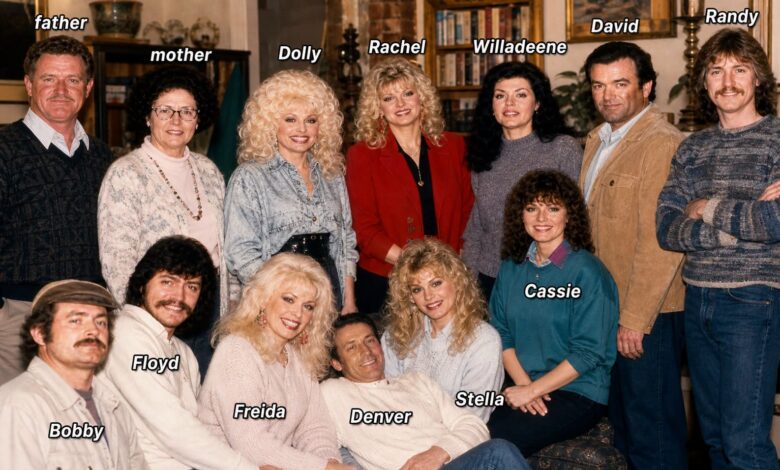
Before the rhinestones, before Nashville, before Dollywood, and long before the world knew her simply as Dolly, there was a small house in the mountains filled with children.
Twelve of them.
Dolly Rebecca Parton was born in 1946 to Robert Lee Parton Sr. and Avie Lee Owens Parton, the fourth of their twelve children—six daughters and six sons. The family lived in rural East Tennessee, where money was scarce and privacy could be scarcer.
But music was everywhere.
It came through church.
Through relatives.
Through the radio.
Through Avie Lee, who sang old songs to her children and filled the household with stories.
And through the children themselves.
Years later, one of those children would become an international superstar whose songs crossed genres and generations. But Dolly’s extraordinary success can make it easy to forget that her musical story began inside a much larger family story.
The Parton siblings were Willadeene, David, Denver, Dolly, Bobby, Stella, Cassie, Randy, Larry, Floyd, Freida and Rachel.
Some would follow Dolly into entertainment.
Others would deliberately remain outside the spotlight.
And one would barely have time to enter the world at all.
Larry, born after Randy, died as an infant in 1955.
Dolly was still a child herself.
She has spoken over the years about the devastating effect his death had on the family. In a household already accustomed to hardship, grief became another thing the children learned could arrive without asking permission.
But so did resilience.
Willadeene, the oldest, occupied a special position in the family.
In a household containing twelve children, older siblings inevitably became part of the machinery that kept daily life moving. Willadeene later preserved pieces of the Parton family’s history through writing, including books about the family’s memories, food and traditions.
That role matters.
Fame tends to simplify families.
One person becomes the headline, and everyone else becomes “the famous person’s sibling.”
But families remember differently.
They remember who someone was before the public image hardened around them.
Before Dolly Parton became an icon, Willadeene knew her as a little sister.
Stella Parton carved out one of the most visible careers of the siblings.
She became a singer and songwriter in her own right, building a country-music career rather than simply existing in Dolly’s shadow. The comparison was probably unavoidable—the same family, similar musical roots, the same instantly recognizable surname—but Stella developed her own body of work.
Cassie also performed, carrying the family’s musical tradition onto stages without seeking anything resembling Dolly’s level of celebrity.
Freida pursued music as well before later moving in a more spiritual direction, including ministry.
Then there was Rachel.
For television viewers in the early 1980s, Rachel Dennison became a familiar face through the sitcom adaptation of 9 to 5. The connection was almost irresistible: Dolly had starred in the enormously successful 1980 film alongside Jane Fonda and Lily Tomlin, and Rachel later played Doralee Rhodes—the character associated with Dolly—in the television version.
It was an unusual family echo.
One sister creates an unforgettable movie character.
Another eventually carries that character onto television.
Yet the Parton family was never composed entirely of performers.
Several brothers lived considerably more private lives.
Bobby Parton largely stayed away from celebrity.
So did David and Denver.
That choice deserves as much respect as the siblings who stepped onto stages.
Being related to one of the most famous entertainers on Earth does not automatically make someone public property.
Not everyone wants applause.
Not every meaningful life leaves behind a discography.
Two brothers, however, became more directly connected to Dolly’s musical world.
Randy Parton was a singer and musician who performed with his sister and became closely associated with entertainment at Dollywood. For visitors, he represented another branch of the family’s musical inheritance.
His death in 2021, after cancer, was a painful loss for Dolly and the family.
Floyd Parton also shared Dolly’s gift for songwriting.
He co-wrote songs with her, including “Rockin’ Years,” which Dolly recorded with Ricky Van Shelton.
Floyd died in 2018.
By then, the Parton siblings had already traveled astonishingly different distances from the circumstances into which they had been born.
One became a global superstar.
Some became professional entertainers.
Some wrote.
Some pursued faith.
Some built private lives.
And some died before the family was ready to lose them.
David Parton died in 2024, followed by Denver Parton in 2025.
Each loss changed the shape of the family again.
But there is an important correction to make when telling the story from the perspective of 2026.
Claims that Dolly Parton herself died in 2026 should not be repeated as fact without reliable confirmation.
A dramatic social-media post, memorial graphic, AI-narrated video, or article written in the past tense is not enough to establish the death of a living public figure. A development of that magnitude should be supported by clear statements from family or representatives and reporting from established news organizations.
Until such evidence exists, the responsible approach is not to turn rumor into obituary.
That matters especially with Dolly because the internet has repeatedly demonstrated how quickly celebrity death claims can spread.
Familiar faces make powerful clickbait.
Age makes rumors sound plausible.
A photograph from an unrelated event becomes a memorial image.
Concern becomes certainty.
Then repetition does the rest.
The Parton family’s real history contains enough love and loss without inventing another death.
And that history helps explain something essential about Dolly herself.
Her famous public persona can seem almost self-created.
The enormous hair.
The rhinestones.
The jokes.
The unmistakable voice.
The business instincts.
The carefully cultivated combination of glamour and accessibility.
But underneath that singular identity sits something plural.
A family.
Dolly did not grow up as the center of a universe.
She grew up as one child among twelve.
She waited her turn.
Shared space.
Shared food.
Shared songs.
Shared grief.
The crowded conditions that might sound picturesque from a distance were also the product of genuine poverty. Romanticizing that hardship would miss part of the story. The Partons did not need poverty in order to become creative, loving or musically gifted.
They created beauty despite scarcity, not because deprivation was somehow beautiful.
Music offered something money could not.
Space.
A child could sing beyond the walls of a small house.
A melody didn’t care how many people shared the room.
And Dolly eventually carried those sounds farther than anyone in the family could reasonably have imagined.
But she never completely left the mountains behind.
They resurfaced in her songwriting, storytelling, philanthropy, humor and carefully maintained connection to East Tennessee.
Even Dollywood, despite becoming a major tourist destination, remains geographically and emotionally connected to the region that formed her.
Perhaps that is why looking at Dolly through her siblings changes the picture.
Celebrity encourages us to imagine greatness as solitary.
One extraordinary person rises.
One name becomes famous.
One voice is remembered.
Family history reminds us that nobody begins alone.
Before audiences listened to Dolly, siblings listened to her.
Before strangers knew her stories, her family had lived inside them.
Before her name appeared in lights, it was one surname shared by twelve children.
And those twelve did not become twelve versions of Dolly.
That may be the most beautiful part.
They became themselves.
Willadeene preserved memories.
Stella built her own musical career.
Cassie performed.
Freida followed music and faith.
Rachel acted.
Randy sang.
Floyd wrote songs.
Bobby chose privacy.
David and Denver largely did the same.
Larry’s tragically short life remained part of the family’s memory.
And Dolly became Dolly.
Not twelve identical voices.
A chorus.
Some loud.
Some quiet.
Some preserved on recordings.
Some known mostly around family tables.
Some already silenced by death.
The world’s fascination will understandably remain focused on the sister whose songs became international standards and whose image became instantly recognizable.
But Dolly Parton’s story was never created by rhinestones alone.
Long before the world claimed her, she belonged to Robert and Avie Lee, to eleven brothers and sisters, and to a crowded East Tennessee childhood where being heard required finding your own voice.
Dolly found hers.
The remarkable thing is that she came from a family full of voices—and each had a story worth hearing.