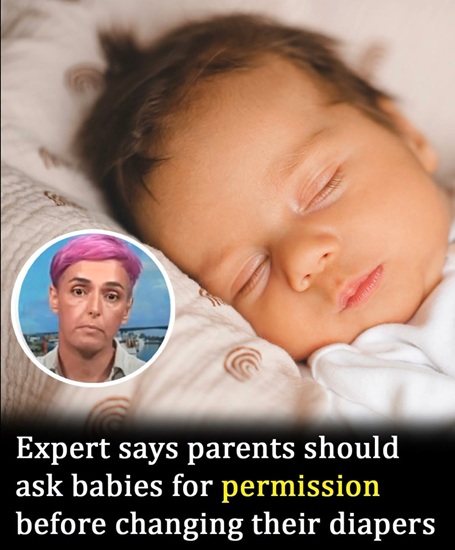
The idea sounded absurd to millions of people the moment they heard it.
Ask a baby for permission before changing a diaper?
Within hours, the phrase spread across social media like wildfire. People laughed. Commentators mocked it. Parents rolled their eyes. Memes appeared almost instantly, imagining exhausted mothers and fathers negotiating with newborns at three in the morning while a baby screamed on a changing table.
To many, it sounded like modern parenting taken to an impossible extreme.
But beneath the viral outrage was a more complicated conversation—one about language, respect, bodily autonomy, and how early children begin learning what it means to be treated as a person.
The debate began after Australian sexuality educator Deanne Carson suggested that parents could introduce a “culture of consent” from birth by verbally communicating with babies before routine caregiving tasks, including diaper changes.
Her comments were quickly reduced to a single shocking headline:
Parents should ask babies for consent before changing diapers.
That headline was enough to ignite a global reaction.
For critics, the idea seemed ridiculous on its face. Babies cannot understand consent in the way adults do. They cannot verbally agree. They cannot evaluate whether a diaper needs changing. They cannot participate in decision-making about basic hygiene, health, or safety.
From that perspective, asking for permission appeared not only impractical but meaningless.
Parents have a responsibility to care for infants. A soiled diaper must be changed. A hungry baby must be fed. A sick child must receive care. These are not optional interactions requiring negotiation. They are essential duties of caregiving.
That is why many people reacted so strongly.
They heard the phrase “ask for consent” and imagined a parent waiting for an infant to approve a necessary task.
But according to Carson and those who defended the broader idea, that was never the point.
Carson clarified that she did not expect babies to give verbal consent. Her argument was not that a parent should wait for a newborn to say “yes” before changing a diaper. Rather, she encouraged parents to narrate what they were doing, pause briefly, make eye contact, observe body language, and create a pattern of respectful communication from the earliest stage of life.
In practice, that might sound like a parent saying, “I’m going to change your diaper now,” before beginning.
Not because the baby can formally agree.
Not because the baby controls whether the diaper gets changed.
But because the parent is treating the child as someone whose body deserves care, explanation, and gentleness.
Supporters of this view argue that babies learn long before they understand words. Infants respond to tone, facial expression, rhythm, touch, repetition, and emotional atmosphere. They may not understand the sentence being spoken, but they can begin to experience caregiving as something predictable, calm, and connected rather than abrupt or frightening.
From that perspective, the idea is less about literal consent and more about respectful caregiving.
That distinction, however, was largely lost once the debate moved online.
Social media thrives on extreme interpretations.
Nuance rarely goes viral.
A measured discussion about infant communication quickly became a punchline. People joked about babies refusing diaper changes. Some compared the idea to asking permission from pets before grooming them. Others argued that the concept was a symptom of modern society overcomplicating parenthood with unnecessary terminology.
The criticism was not entirely baseless.
Words matter.
Consent is a serious concept, particularly in conversations about personal boundaries, sexual education, medical care, and bodily autonomy. When applied to infants, the term can create confusion because babies are not capable of meaningful informed consent.
A newborn cannot understand options, consequences, or context.
A baby cannot decide whether hygiene care is necessary.
A parent cannot ignore a basic need simply because a baby cries or squirms.
This is why many critics argued that the language itself was the problem.
They were not necessarily opposed to speaking gently to babies. Few people would object to parents explaining what they are doing, moving slowly, or responding to signs of discomfort. Those practices are widely accepted in early childhood care.
The disagreement centered on whether calling that behavior “consent-based parenting” made sense.
For some, it sounded like a useful reminder that children deserve respect from the beginning.
For others, it sounded like forcing adult concepts onto infants in a way that muddied the meaning of consent.
That tension explains why the topic became so polarizing.
On one side were people emphasizing practical caregiving.
They argued that babies need responsible adults who can make decisions on their behalf. Parenting requires judgment, not constant negotiation. A baby crying during a diaper change does not mean the diaper should remain unchanged. It may simply mean the baby is cold, tired, uncomfortable, overstimulated, or frustrated.
From this viewpoint, the parent’s duty is to meet the child’s needs with care, not to seek permission for every necessary action.
On the other side were those emphasizing early patterns of communication.
They argued that respectful interaction does not begin only when a child can speak. Even before language develops, babies are learning whether caregivers respond to them with warmth, patience, and attentiveness. Supporters believed that narrating actions and noticing cues can help build trust and eventually support a child’s understanding of boundaries.
To them, the issue was not whether an infant could say yes or no.
The issue was whether adults practiced treating children as people rather than objects to be handled.
In many ways, both sides were reacting to different versions of the same idea.
Most parents already communicate with babies during caregiving.
They say things like:
“Let’s get you cleaned up.”
“I know, this is cold.”
“Almost done.”
“There we go.”
“It’s okay.”
These words are not legal consent requests. They are emotional signals. They reassure the baby. They help the caregiver slow down. They turn a routine task into an interaction rather than a mechanical process.
Child development research has long supported the importance of talking to infants, responding to their cues, maintaining eye contact, and creating predictable routines. Babies learn through repeated experiences. They begin forming expectations about whether the world is safe, whether discomfort is noticed, and whether their signals matter.
A parent who narrates care and responds calmly to distress is not asking an infant to manage adult decisions.
They are building connection.
That is the strongest version of Carson’s argument.
The weakest version is the one critics attacked: the idea that a baby must somehow grant permission for necessary care.
The problem is that public debates rarely separate the strongest version of an idea from the most ridiculous version.
Instead, they reward the most emotionally charged interpretation.
As the story spread, the phrase “ask babies for consent” became detached from its explanation. What might have been a conversation about mindful caregiving turned into a cultural battle over modern parenting, political correctness, and whether society had become too sensitive.
In reality, the practical middle ground is simple.
Parents should meet babies’ needs promptly and responsibly.
A diaper must be changed.
A child must be kept clean, safe, and healthy.
At the same time, parents can still communicate respectfully during care.
They can speak before touching.
They can move gently.
They can notice when a baby is distressed.
They can avoid treating routine care as something done to a child without emotional awareness.
These two ideas do not have to conflict.
A parent can be fully in charge and still be respectful.
A parent can make necessary decisions and still narrate what is happening.
A parent can understand that a baby cannot consent while still modeling the kind of bodily respect that becomes meaningful as the child grows older.
That may be the most useful lesson from the controversy.
The debate was never truly about diapers.
It was about how adults think about children.
Are children merely dependents whose needs must be managed?
Or are they developing human beings whose dignity should be recognized from the very beginning?
The healthiest answer is both.
Babies are completely dependent on adults.
They cannot make decisions about hygiene, safety, medical care, or nutrition.
But they are also people.
They deserve gentleness.
They deserve communication.
They deserve caregivers who pay attention not only to what must be done, but how it is done.
As children grow, those early habits can evolve naturally.
A toddler can be offered simple choices: “Do you want the red shirt or the blue one?”
A young child can be taught that private areas deserve privacy and respect.
An older child can learn that they have the right to speak up when touch feels uncomfortable, unsafe, or confusing.
A teenager can understand consent in deeper emotional, social, and relational terms.
Those lessons do not begin with one dramatic conversation.
They are built gradually through thousands of small interactions.
That is why the conversation, despite its awkward phrasing, matters.
It reminds parents and caregivers that children learn from the way adults treat them long before they can explain what they have learned.
They learn whether their discomfort is ignored or acknowledged.
They learn whether adults rush through care or offer reassurance.
They learn whether their bodies are treated with impatience or respect.
Still, language should be used carefully.
Calling every act of infant caregiving “consent” risks stretching the word beyond its useful meaning. Consent requires understanding, agency, and the ability to refuse. Babies do not possess those capacities in the formal sense.
A clearer phrase might be “respectful caregiving” or “body-aware parenting.”
Those terms preserve the valuable idea without implying that infants are responsible for approving necessary care.
In the end, the viral debate revealed less about diaper changes and more about the challenges of discussing parenting in public.
A thoughtful idea can become absurd when reduced to a headline.
A questionable phrase can obscure a meaningful principle.
And a serious conversation about respect can quickly become a fight over words.
Parents do not need to ask a baby’s permission in order to change a diaper.
But they can still speak gently before doing it.
They can still pause long enough to make eye contact.
They can still treat even the youngest child as worthy of dignity.
That is not weakness.
It is not overcomplication.
It is not surrendering parental responsibility.
It is simply mindful care.
And perhaps that is the best conclusion to draw from the controversy.
Babies need adults who will act decisively on their behalf.
They also need adults who remember that care is not only about completing a task.
It is about building trust.
So no, a newborn cannot give consent.
But a parent can still begin teaching respect long before a child knows the word for it.
And that lesson, quietly repeated through ordinary moments, may be far more powerful than the viral debate that made it famous.