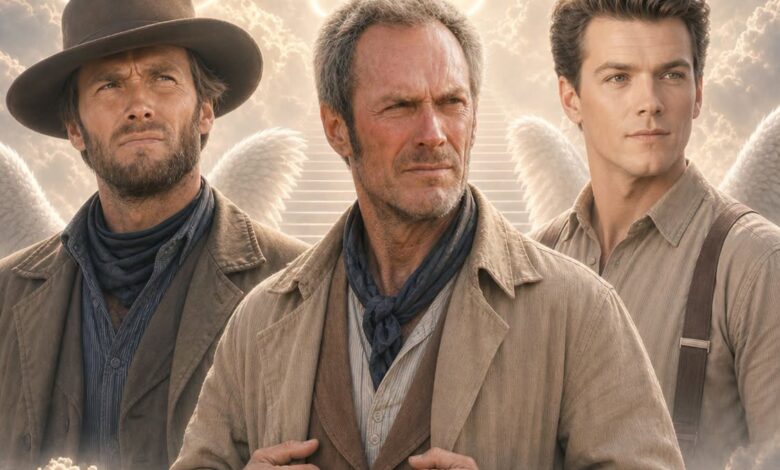
For generations, Clint Eastwood seemed like the kind of man time itself would have trouble defeating.
He was the figure who rarely flinched. The narrowed eyes, the measured voice, the unmistakable silhouette—everything about his screen presence suggested permanence. Through gunfire, grief, revenge, war, and moral reckoning, he projected the same extraordinary calm.
But eventually, even the strongest image meets something it cannot intimidate:
Time.
And as Eastwood has grown older, the public conversation around him has inevitably changed. The actor and filmmaker who once appeared almost indestructible is increasingly viewed through a more human lens—not merely as an American screen legend, but as an aging father whose years are precious precisely because they are no longer unlimited.
That distinction matters.
For audiences, Clint Eastwood exists partly as an idea.
For his children, he is Dad.
They know the person behind the famous stare.
They know his ordinary routines, private jokes, habits, silences, frustrations, and tenderness. They have memories that never appeared on a movie screen and stories that belong to them rather than Hollywood.
And that is why any public concern surrounding an aging icon can strike such an emotional nerve.
It forces people to separate the myth from the man.
The myth doesn’t age.
The films remain exactly as they were.
The young gunslinger still walks into the frame.
Dirty Harry still delivers his lines with cold certainty.
The cowboy still rides.
The director’s best work remains available at the press of a button, permanently preserved at whatever age he happened to be when the cameras rolled.
But the man continued living after every final scene.
He became older.
His children became adults.
Friends and collaborators passed away.
Hollywood transformed around him.
And audiences who first watched him decades ago grew older too.
Perhaps that explains why conversations about beloved performers in their later years can feel surprisingly personal.
People aren’t only confronting the mortality of a celebrity.
They’re confronting their own passage through time.
A man they remember watching with their father is now elderly.
A movie that still feels recent was released decades ago.
The child who sat cross-legged in front of the television now has children—or grandchildren—of their own.
Suddenly, nostalgia becomes something heavier.
Eastwood’s career makes that feeling especially powerful because strength has always been central to his public image.
His characters rarely begged the world for sympathy.
They endured.
They carried pain privately.
They walked forward when other people might have collapsed.
That restraint became part of his cinematic language.
Yet real life eventually asks something different of every family.
It asks people to accept that strength doesn’t make anyone permanent.
Age does not diminish what came before, but it changes how we look at it.
The face once associated almost entirely with toughness begins to reveal decades of living.
The intimidating silence becomes quieter.
The legend becomes visibly human.
And perhaps there is something valuable in allowing that transformation instead of resisting it.
We often do famous people a strange injustice by demanding that they remain the versions of themselves we first loved.
We want athletes forever young.
Musicians forever rebellious.
Actors forever recognizable as the characters who made them famous.
But nobody owes an audience immortality.
A long life should not be treated as a disappointing sequel to youth.
It is an achievement of its own.
For Eastwood, that long life includes far more than the tough-guy persona that made him instantly recognizable. He evolved from actor to filmmaker, from an emblem of a particular kind of masculinity into a director willing to examine regret, violence, aging, responsibility, and the consequences of choices made decades earlier.
In some ways, his later work complicated the mythology his earlier performances helped create.
The invincible man became interested in vulnerability.
The gunslinger began asking what violence costs.
The hero grew old enough to examine what heroes leave behind.
That may ultimately be one of the most meaningful dimensions of his legacy.
Not that he remained unchanged.
That he didn’t.
And now audiences inevitably view him differently too.
There is gratitude where there was once simple admiration.
People revisit favorite performances and notice details they missed when they were younger.
They remember who introduced them to his movies.
They recognize how deeply certain images and stories entered popular culture.
The reaction can feel almost like saying goodbye before any goodbye has actually arrived.
But there is an important difference between honoring someone’s mortality and prematurely mourning a person who is still here.
Age alone is not a farewell.
Nor should concern, speculation, or rumor be allowed to write an ending before reality does.
Perhaps the more meaningful response to an aging cultural figure is not to imagine the moment he disappears.
It is to appreciate the fact that his work—and the human being behind it—has traveled such an extraordinary distance.
There will eventually come a time when every career reaches its final frame.
That’s true for movie stars and for everyone who ever bought a ticket to watch them.
What remains afterward isn’t simply a collection of films.
It’s memory.
It’s influence.
It’s the way a particular performance made someone feel when they were sixteen.
It’s a father introducing a son to an old Western.
It’s a young filmmaker watching Unforgiven and realizing that familiar genres can still reveal uncomfortable truths.
It’s generations recognizing the same face for entirely different reasons.
Clint Eastwood spent decades portraying men who looked as though they could stare down anything.
Perhaps that was always the illusion.
The deeper courage was never invincibility.
It was continuing despite knowing that nobody is invincible.
So when people look at Eastwood now, they may see something different from the figure they first encountered on a theater screen.
They see age.
They see history.
His children see their father.
And somewhere behind all of that remains the unmistakable presence that made millions of strangers stop and watch whenever he entered the frame.
One day, audiences will have to say goodbye.
But until that day actually comes, perhaps gratitude is more appropriate than mourning.
The legend belongs to cinema.
The man belongs to himself and to those who love him.
And the extraordinary body of work he has already created?
That isn’t going anywhere.