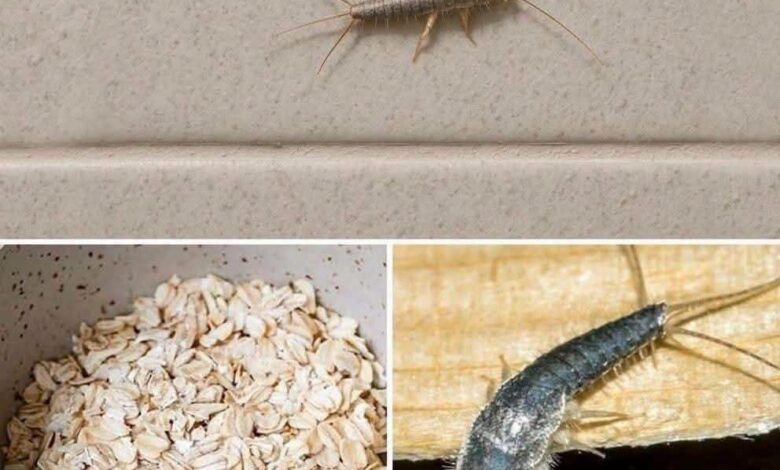
You switch on the bathroom light in the middle of the night, and something silver shoots across the floor.
For half a second, you wonder what you just saw.
It is tiny, strangely shiny, and astonishingly fast. Before you can get a closer look, it wriggles beneath the vanity and disappears into a gap barely wider than a crack.
For many homeowners, this is their first encounter with a silverfish.
And while finding one crawling through your bathroom is unsettling, the insect itself is usually not the danger people imagine.
The more important question is why it is there.
Silverfish are small, wingless insects recognizable by their flattened, tapered bodies, long antennae, silvery scales, and three bristle-like projections extending from the rear. Their peculiar side-to-side movement resembles a fish swimming through water, which helps explain their common name.
They have also been living alongside humans for an extraordinarily long time.
Unlike cockroaches, mosquitoes, ticks, or bed bugs, silverfish are not primarily a health threat.
They generally don’t bite people.
They don’t sting.
They aren’t known as significant transmitters of human disease.
They usually have little interest in you at all.
What interests them is your house.
More specifically, they are looking for three things:
Moisture.
Shelter.
Food.
And when silverfish repeatedly appear, your home may be providing all three.
That makes them less like miniature attackers and more like tiny inspectors revealing conditions you haven’t noticed yet.
Why They Keep Appearing in Bathrooms
There is a reason people so often encounter silverfish after turning on a bathroom light.
These insects generally prefer dark, protected environments with relatively high humidity.
A bathroom can be nearly perfect.
Hot showers create moisture.
Condensation forms on surfaces.
Plumbing creates hidden cavities.
Cabinets provide darkness.
Cracks around pipes offer shelter.
Then the lights go out for hours at a time.
To a silverfish, that’s excellent real estate.
But bathrooms aren’t their only destination.
They may also establish themselves in basements, kitchens, laundry rooms, attics, closets, storage spaces, and wall voids.
Anywhere that stays relatively humid and undisturbed can become attractive.
Because silverfish are mostly active at night, homeowners can live alongside them without realizing how many are present.
During daylight hours, the insects retreat into narrow spaces.
They may hide behind baseboards.
Under cabinets.
Inside wall gaps.
Around plumbing.
Behind stored boxes.
Beneath flooring edges.
Then, when the house becomes dark and quiet, they emerge to search for food.
That is why seeing one occasionally doesn’t necessarily mean you have a major infestation.
It may simply have wandered into view.
Seeing them regularly is different.
And if silverfish begin appearing during daylight, it can be worth investigating more carefully.
Frequent activity may indicate a larger population, overcrowded hiding areas, disturbed shelter, or environmental conditions that strongly favor them.
What Are They Eating?
This is where silverfish become more than an unpleasant surprise.
Their menu overlaps remarkably well with things humans store inside their homes.
Silverfish are attracted to carbohydrates and starches found in materials such as paper, cardboard, book bindings, wallpaper paste, cereal, flour, fabric sizing, and certain adhesives.
They may also consume molds and other organic material.
In other words, your bookshelf can become a buffet.
So can your storage room.
That cardboard box filled with family photographs?
Potential food and shelter.
Old newspapers in a damp basement?
Even better.
Books packed tightly into a humid closet?
Another attractive environment.
The damage usually isn’t dramatic overnight.
Silverfish don’t normally destroy a book in the way a mouse might tear through packaging.
Their destruction tends to be quieter.
Slower.
Almost invisible at first.
They scrape at surfaces as they feed.
Over time, paper may develop irregular holes or worn areas.
Wallpaper can become damaged.
Photographs and documents may show signs of feeding.
You might discover yellowish stains, tiny droppings, scales, or shed skins.
Textiles can sometimes be affected as well, particularly materials containing starch or suitable plant-based fibers.
That makes long-term storage conditions especially important.
An ordinary paperback can be replaced.
Your grandmother’s letters cannot.
Neither can childhood photographs, certificates, archival documents, or other irreplaceable keepsakes.
Storing valuable paper items in damp cardboard boxes for years creates exactly the kind of environment you want to avoid.
Your Pantry Can Attract Them Too
Silverfish aren’t restricted to bathrooms and bookshelves.
They can also wander into kitchens and food-storage areas.
Dry foods such as flour, cereal, grains, and similar products may provide food sources, especially when packaging is damaged or left open.
This doesn’t mean finding a silverfish somewhere in your kitchen requires throwing away everything in the pantry.
Inspect first.
Look for signs of insect activity or damaged packaging.
Anything visibly contaminated should be discarded.
Then reconsider how vulnerable foods are stored.
Transfer susceptible dry goods into sturdy containers with tightly fitting lids.
This protects food from silverfish while also making it less accessible to many other household pests.
Again, the concern is primarily contamination and property damage.
Finding a silverfish is unpleasant.
It generally isn’t a medical emergency.
Don’t Just Kill the Insect
Imagine discovering water dripping onto your floor.
You could wipe up the puddle every morning.
But unless you repair the leak, you’ll keep needing the towel.
Silverfish can work the same way.
Killing the insect running across your bathroom floor removes one silverfish.
It doesn’t answer why silverfish are comfortable living there.
That is the problem worth solving.
Start with moisture.
Check beneath sinks.
Inspect exposed pipes.
Look around toilets, showers, washing machines, water heaters, and other plumbing fixtures.
Search for slow leaks that may not produce an obvious puddle.
A tiny plumbing leak hidden beneath a cabinet can keep nearby materials damp enough to support pests without attracting immediate attention.
Condensation can create similar conditions.
Bathrooms and laundry rooms need adequate ventilation.
Use exhaust fans where available and practical.
Allow damp surfaces to dry.
Persistent basement humidity may justify using a dehumidifier.
The objective isn’t to turn your home into a desert.
It is to eliminate unnecessarily damp environments where moisture-loving pests can thrive.
This can have benefits beyond silverfish.
Excess indoor moisture can contribute to mold problems, material deterioration, and conditions favorable to other pests.
So the silverfish you dislike seeing may inadvertently be pointing toward a maintenance issue worth discovering.
Then Look at Clutter
Silverfish love places where humans rarely disturb them.
Think about the cardboard boxes that haven’t moved in seven years.
Stacks of magazines.
Old newspapers.
Unused wrapping paper.
Forgotten paperwork.
Books packed into a damp corner.
The problem isn’t simply that clutter looks untidy.
It creates protected hiding places and, depending on the material, possible food.
You don’t need to throw away your library.
You do need to think carefully about storage.
Move important documents and keepsakes out of damp locations.
Use more protective storage containers when appropriate.
Avoid leaving unnecessary cardboard accumulated indefinitely.
Give yourself access to walls and corners so those areas can actually be inspected and cleaned.
Then vacuum thoroughly.
Don’t concentrate only on the middle of the floor.
Silverfish aren’t generally spending their afternoons relaxing in the center of your living room.
Focus on edges and hidden spaces.
Vacuum along baseboards.
Inside cupboards.
Behind movable appliances.
Around plumbing penetrations.
Near stored materials.
Along accessible cracks.
Vacuuming can remove more than visible adults.
It can also reduce food debris, scales, shed material, and potentially eggs in accessible locations.
Close Their Highways
A silverfish doesn’t need a doorway.
Tiny gaps are enough.
Inspect accessible cracks around baseboards, cabinets, utility penetrations, and other structural openings.
Where practical and appropriate, seal gaps that provide movement between rooms or access to protected wall spaces.
This works best as part of a larger strategy.
Sealing cracks while ignoring a leaking pipe won’t solve the moisture problem.
Running a dehumidifier while keeping mountains of damp cardboard may not solve the shelter problem.
Effective control comes from changing the environment itself.
Think of it as removing the invitation.
Find Out Where They’re Coming From
One silverfish can disappear so quickly that it’s difficult to determine its source.
Monitoring can help.
Sticky traps placed appropriately along walls or near suspected activity areas may reveal patterns.
Instead of constantly moving them, note where each trap is located and check them periodically.
You may discover that nearly all activity is concentrated near one bathroom.
Or a basement storage wall.
Or a laundry area.
That information can direct your inspection toward the underlying problem.
Identification matters too.
Not every fast-moving, bristled household insect is necessarily a silverfish.
Firebrats, for example, can look similar but favor somewhat different environmental conditions.
If you’re unsure what you’re dealing with—or if activity continues despite environmental changes—a qualified pest professional can identify the insect and determine where treatment should be focused.
Be Careful With Pesticides
The sight of several silverfish can tempt people to reach immediately for the strongest chemical product they can find.
That isn’t necessarily the most effective approach.
Silverfish spend much of their time concealed.
Spraying exposed surfaces indiscriminately may do little to reach the places where they actually live.
And unnecessary pesticide use introduces risks of its own.
If a pesticide is used, follow the product label exactly.
Never assume that using twice as much makes treatment twice as effective.
Keep products away from children, pets, food, and food-preparation surfaces as directed.
Different products have different permitted uses and application requirements.
If you have persistent activity, valuable collections at risk, or an infestation you cannot locate, calling a licensed pest-management professional may be safer and more effective than repeatedly experimenting with chemicals.
A professional can combine identification, inspection, monitoring, environmental correction, and targeted treatment.
That’s much more useful than simply spraying whatever insect happens to cross the floor.
Does Finding Silverfish Mean Your House Is Dirty?
No.
This is one of the most persistent misconceptions surrounding household pests.
A beautifully maintained home can still have a leaking pipe.
A spotless bathroom can still remain humid after showers.
A carefully organized basement can still contain cardboard boxes and condensation.
An older house can have countless tiny structural gaps.
Silverfish aren’t delivering a moral judgment on your housekeeping.
They’re responding to biology.
If the environment provides moisture, shelter, and food, they may move in.
That’s all.
And that is why panic isn’t useful.
Observation is.
Instead of thinking:
My house is disgusting.
Ask:
What conditions are allowing this insect to thrive?
That question produces solutions.
And No, They’re Not a Mysterious Omen
Household insects often accumulate strange folklore online.
People assign symbolic meanings to unexpected creatures appearing indoors.
Sometimes the explanations become supernatural.
A silverfish suddenly gets described as a warning of bad luck, hidden energy, impending change, or some other mysterious event.
There is a much more useful interpretation.
It may mean your bathroom is humid.
It may mean your basement has damp cardboard.
It may mean a pipe is leaking.
It may mean there’s a crack providing access to a protected wall cavity.
Those explanations aren’t mystical.
But they’re actionable.
And that’s far more valuable.
When One Silverfish Becomes Useful Information
The next time you switch on a light and see that metallic little body wriggling toward the nearest hiding place, don’t immediately assume disaster.
One silverfish does not prove your house is infested.
It doesn’t mean your home is filthy.
And it certainly doesn’t mean something terrible is about to happen.
But don’t completely ignore repeated sightings either.
Treat them as information.
Check the room.
Look beneath the sink.
Inspect plumbing.
Think about humidity.
Examine stored paper and cardboard.
Protect important documents.
Seal vulnerable food.
Vacuum neglected edges.
Reduce unnecessary clutter.
Monitor what happens next.
If the sightings disappear, you may have corrected the conditions yourself.
If they continue or increase, bring in someone qualified to investigate.
The important lesson is surprisingly simple:
The silverfish you see isn’t necessarily the real problem.
The environment supporting it may be.
And sometimes that tiny insect racing across your bathroom floor is doing you an accidental favor.
It is showing you where to look.
So instead of concentrating entirely on killing the one creature that happened to reveal itself, investigate the conditions that allowed it to feel at home.
Fix the moisture.
Remove unnecessary shelter.
Protect vulnerable belongings.
Monitor the result.
Do that, and you’re not merely getting rid of silverfish.
You’re making your home a less welcoming place for the next one that tries to move in.