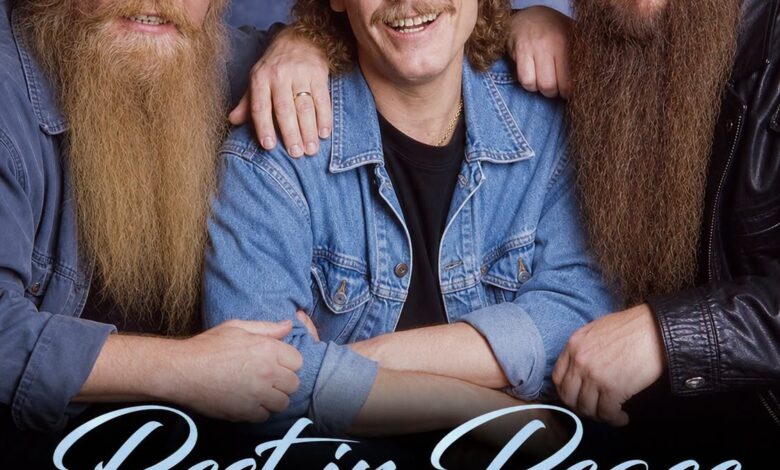
Frank Beard never needed to stand at the front of ZZ Top.
He didn’t need the longest solo.
He didn’t need to dominate interviews.
He didn’t even have the enormous beard that became one of rock music’s most recognizable visual trademarks.
He had the drums.
And once Frank settled behind them, Billy Gibbons and Dusty Hill had something far more important than another spectacle.
They had an engine.
For decades, that engine powered one of the most distinctive sounds ever to come out of Texas: blues dragged through distortion, swagger, humor, boogie, and a rhythm section so steady that ZZ Top could make three musicians sound enormous.
Frank’s job often appeared simple from the audience.
Keep time.
Hold the groove.
Let Billy’s guitar snarl over the top.
But great drumming is rarely about simply keeping time.
It is about making time feel inevitable.
Listen to the classic ZZ Top records and the drums don’t beg for attention.
They create the ground everything else walks across.
That was Frank’s territory.
He understood something many musicians spend entire careers trying to learn:
You don’t have to play the most notes to become indispensable.
Sometimes restraint is the difficult part.
A drummer can fill every available space.
Frank knew when to leave space open.
That gave Billy’s guitar somewhere to breathe.
It gave Dusty’s bass somewhere to settle.
And it gave ZZ Top its unmistakable strut.
The story began long before MTV turned the band into international icons.
Texas was already filled with blues, country, rock and honky-tonk traditions colliding with one another.
Young musicians learned by playing.
Bars.
Clubs.
Rooms where nobody cared about mythology yet.
You either made people move or you didn’t.
Frank learned rhythm in that world.
Then, in 1969, the lineup that would define ZZ Top came together.
Billy Gibbons.
Dusty Hill.
Frank Beard.
Three musicians who discovered that something happened when they played together that couldn’t easily be manufactured with anyone else.
Bands are strange relationships.
They aren’t quite families.
They aren’t ordinary businesses.
They aren’t friendships in the conventional sense.
They are all three at once, usually under terrible conditions.
Long drives.
Small rooms.
Financial uncertainty.
Creative disagreements.
Exhaustion.
Success.
Ego.
Failure.
Then, if you’re extraordinarily lucky, decades.
Most bands don’t survive that.
ZZ Top did.
Part of the reason was musical compatibility.
Billy could push.
Dusty could anchor.
Frank could lock everything into place.
The result sounded loose without actually being loose.
That’s one of the secrets of great blues-based rock.
It should feel dangerous.
But underneath the danger, somebody has to know exactly where the beat lives.
Frank always seemed to know.
Then came “La Grange.”
That rhythm doesn’t politely introduce itself.
It creeps in.
The guitar establishes the attitude, but the drums help turn that attitude into movement.
Suddenly you’re not merely hearing a song.
You’re inside the machinery.
That groove became part of rock history because it feels simultaneously primitive and precise.
Simple enough to understand instantly.
Difficult enough to reproduce with the same personality.
That was the thing about Frank.
A transcription could show you what he played.
It couldn’t necessarily show you how it felt when he played it.
Groove lives in tiny decisions.
Where the beat sits.
How hard the snare lands.
How much space exists between one hit and the next.
Whether the rhythm pushes forward or settles backward.
Those differences can be measured in fractions of seconds.
Yet human bodies recognize them immediately.
You don’t need musical training.
Your foot starts moving.
That’s the verdict.
As ZZ Top evolved, Frank evolved with it.
This mattered enormously.
The band that emerged from Texas blues clubs did not remain frozen there.
By the 1980s, rock music was changing.
Production was changing.
Technology was changing.
Music television was changing how bands were marketed and understood.
A group built around blues, denim, guitars and Texas mythology could easily have become a relic.
Instead, ZZ Top became even bigger.
“Sharp Dressed Man.”
“Legs.”
“Gimme All Your Lovin’.”
Suddenly the band wasn’t simply playing rock radio.
It was everywhere.
The videos became iconic.
The Eliminator car.
The spinning guitars.
The sunglasses.
Billy and Dusty’s enormous beards.
The mysterious women who seemed to materialize whenever some ordinary guy needed his life transformed.
It was ridiculous.
Stylish.
Funny.
Completely unforgettable.
And behind the visual spectacle, Frank kept playing.
That contrast suited him.
The band grew increasingly theatrical while the drummer remained the stabilizing force.
He didn’t need to become the visual punchline.
The famous joke was already built into the lineup.
The only member of ZZ Top without the giant beard was named Beard.
It was almost too perfect.
But beneath the joke was a musician whose contribution was foundational.
Take away the rhythm and the image becomes decoration.
ZZ Top worked because the music underneath the mythology was real.
Frank also lived through the darker side of the rock-and-roll life.
Success can amplify whatever already exists inside a person.
Money removes certain limits.
Touring destroys routine.
Substances become easy to find.
The mythology of rock once treated self-destruction almost as a professional requirement.
Frank knew what that world could cost.
His life was not one uninterrupted victory lap.
There were struggles.
There were consequences.
There were years in which survival required more than playing another show.
That matters because longevity in music is often discussed as though it happens automatically.
It doesn’t.
A band surviving five decades requires its members to survive five decades.
Bodies change.
Relationships change.
Priorities change.
People make mistakes.
People have to decide whether they’re going to keep making them.
Frank kept going.
So did ZZ Top.
Then came the loss that changed everything.
Dusty Hill died in 2021.
For a band whose identity had been built around the same three men for more than half a century, the absence was almost impossible to comprehend.
This wasn’t merely replacing a musician.
It was losing part of the architecture.
Dusty had been there through the clubs.
The records.
The buses.
The arenas.
The videos.
The failures nobody remembers.
The victories everybody remembers.
Thousands upon thousands of nights.
How does a band continue after that?
Apparently, by remembering what the person who died wanted.
Keep going.
That became part of ZZ Top’s philosophy.
The lineup changed.
The spirit continued.
Frank remained behind the kit, still holding down the rhythm that had carried the band across decades.
There is something poignant about musicians aging together.
At twenty, the goal is usually success.
At seventy, simply walking onto the same stage becomes its own victory.
The songs acquire new meanings.
Lyrics remain young while the hands playing them carry fifty years of memory.
An opening riff can contain an entire lifetime.
Audiences change too.
The teenagers who first bought the records bring their children.
Then their grandchildren.
A song that once played from a cheap car stereo now shakes an arena filled with people who weren’t alive when it was recorded.
That’s legacy while you’re still alive to witness it.
Frank witnessed plenty.
Millions of records sold.
Tours across the world.
Generations of musicians influenced.
And eventually, recognition from the Rock & Roll Hall of Fame.
Awards matter.
But for musicians like Frank, the more meaningful recognition may have happened every night before anyone announced his name.
Billy hit the opening riff.
Frank entered.
The crowd moved.
There it was.
Proof.
No trophy required.
Then his health began interfering with the one thing that had remained remarkably constant.
Playing.
For a lifelong musician, being forced away from the instrument can carry a particular cruelty.
The body stops cooperating before the desire does.
Someone else sits behind the drums.
Someone else plays the parts.
The songs continue without the person whose hands helped define them.
Yet bands built for longevity learn a painful truth:
The music eventually becomes larger than the individuals who created it.
Frank had already experienced that after Dusty’s death.
Now his own absence would test the same principle.
Could ZZ Top still be ZZ Top?
Musically, another drummer can learn the songs.
Technically, the beat can continue.
But nobody replaces decades.
Nobody can reproduce the memories attached to a particular person’s timing.
A substitute musician can occupy the stool.
He cannot occupy Frank Beard’s history.
That belongs permanently to the recordings.
To Billy.
To the people who toured with them.
To the audiences who watched him play.
And to countless drummers who learned something from listening.
Frank’s greatness was never about making every song a demonstration of drumming.
It was about serving the song so completely that imagining it without him becomes difficult.
That is musicianship at its most mature.
Ego asks:
Did they notice me?
Craft asks:
Did the song work?
Frank made the songs work.
For decades.
Night after night.
Album after album.
That kind of consistency is easy to undervalue because consistency becomes invisible.
When someone does their job perfectly for long enough, people begin assuming the job is easy.
It isn’t.
Holding a band together while allowing it to breathe requires judgment.
The drummer controls enormous amounts of energy.
Push too hard and the song becomes frantic.
Hold back too much and it collapses.
The groove lives between those extremes.
Frank lived there.
Perhaps that is why the idea of ZZ Top continuing after him feels both painful and appropriate.
The band has always carried forward.
From clubs to arenas.
From blues records to MTV.
Through addiction.
Through changing fashions.
Through Dusty’s death.
Through illness.
Through an industry that reinvented itself repeatedly while three Texans kept showing up with guitars and drums.
“Keep on keeping on” isn’t complicated philosophy.
That’s why it fits.
Musicians understand it.
You play the next measure.
Then the next.
If you make a mistake, you don’t stop the song.
You find the beat again.
Life rarely offers a better instruction.
Frank spent more than half a century finding that beat.
And now, whatever comes next for ZZ Top, his rhythm remains inside the band’s DNA.
Every time “La Grange” begins, he’s there.
Every time someone turns up “Sharp Dressed Man” too loudly in a car, he’s there.
Every time “Legs” brings an old MTV memory rushing back, he’s there.
Recordings create a strange form of immortality.
The musician leaves.
The performance doesn’t.
A drum hit recorded decades ago can remain perfectly alive.
The stick falls.
The snare cracks.
Again.
Again.
Again.
The listener knows intellectually that the moment happened long ago.
The ear experiences it now.
That is the gift Frank leaves behind.
Not simply songs.
Motion.
His rhythms still move bodies.
A teenager discovering ZZ Top decades later won’t need to know every detail of the band’s history before understanding.
The groove will explain itself.
Perhaps somewhere that teenager will find an old drum kit.
They’ll put on headphones.
Try to follow Frank.
At first they’ll overplay.
Most young drummers do.
Then they’ll listen more carefully.
They’ll notice the spaces.
The restraint.
The pocket.
They’ll realize that simple and easy are not the same thing.
And without ever meeting him, Frank Beard will teach another musician how to play.
That’s how influence survives.
Quietly.
Appropriately, in his case.
Because Frank never needed to be the loudest personality in a band famous for being larger than life.
He needed to be dependable.
Billy and Dusty could lean into the spectacle because somebody behind them was holding the floor steady.
For more than fifty years, that somebody was Frank.
Three men found one another in Texas and somehow kept the conversation going across generations.
Now two are gone.
Billy carries memories no audience can fully understand.
Every familiar song must contain ghosts.
A glance toward where Dusty once stood.
A rhythm Frank once played.
A stage crowded with absence.
Yet the music continues.
Maybe that is sad.
Maybe it is beautiful.
Probably both.
Because continuing does not mean forgetting.
Sometimes continuing is how musicians remember.
You pick up the guitar.
You count the song in.
You trust the rhythm you’ve known most of your life.
And somewhere inside that rhythm are the people who taught you what the band was supposed to feel like.
Frank Beard spent decades making ZZ Top feel like ZZ Top.
He didn’t need the longest beard.
He didn’t need to stand beneath the brightest spotlight.
He simply sat behind the drums and gave the whole thing a heartbeat.
Now the stool may belong to somebody else.
The heartbeat doesn’t.
That belongs to the records.
To Texas.
To rock and roll.
And to every room, car, bar, arena, garage, and pair of headphones where that unmistakable backbeat starts again.
Frank once found the people he was meant to play with.
Together, they made something strong enough to keep playing after them.
And perhaps that is the ending every musician secretly wants.
The final count comes.
You leave the stage.
But somehow, impossibly, the groove keeps going.