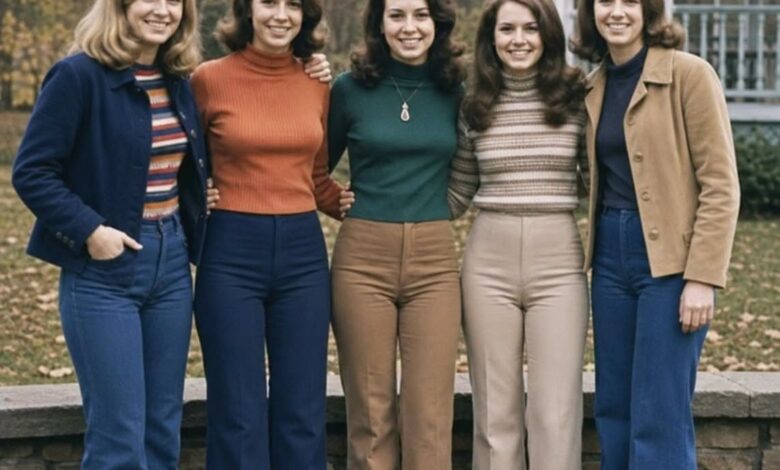
There was a time when taking a photograph required a decision.
You didn’t pull a camera from your pocket every few minutes. You didn’t take twenty nearly identical pictures, inspect them instantly, delete nineteen, adjust the angle, and try again. Film was limited. Developing it cost money. Sometimes weeks passed before you even discovered whether the picture had turned out.
That made the click of a shutter matter.
And perhaps that is why old photographs can feel so different.
Look at an ordinary image from the 1970s and there may be nothing historically important happening at all. No celebrity. No major event. No carefully arranged spectacle.
Just people.
Someone leaning against a wall.
Friends gathered around a table.
A family standing beside a car.
A young couple smiling awkwardly toward whoever happened to be holding the camera.
Yet decades later, those seemingly insignificant frames become extraordinarily valuable.
The clothes immediately announce another era.
Slim trousers.
Simple polo shirts.
Wide collars.
Leather shoes.
A coat with a cut nobody seems to wear anymore.
Hair shaped according to rules that vanished years ago.
But fashion is only the surface.
Look longer and something subtler begins to emerge.
People often seem less aware of themselves as images.
Of course, posing for photographs existed long before social media. People wanted flattering pictures then too. They fixed their hair, stood straighter, smiled, and sometimes dressed specifically for the occasion.
But the photograph usually wasn’t being created for an invisible audience of hundreds or thousands.
There was no immediate upload.
No stream of comments.
No public count of approval.
For many families, the eventual destination was an album, a frame on the mantel, or an envelope mailed to relatives.
The audience was small.
The memory was the point.
That changes the way we experience these images now.
A young man might be leaning back in his chair without wondering how the posture will look online.
Someone caught mid-laugh doesn’t immediately demand another photograph.
A child staring away from the camera doesn’t ruin the picture.
Nobody knows yet that this imperfect frame may someday become precious precisely because it wasn’t perfect.
Then there is the attention.
That’s perhaps the detail modern eyes notice most.
There are no smartphones glowing on the table.
No one is looking down because a notification arrived.
No earbuds create private worlds inside a shared room.
When people are together, their attention appears to have fewer places to escape.
That doesn’t mean everyone in the 1970s was deeply connected.
People became bored.
They ignored each other.
Families argued.
Teenagers disappeared into bedrooms.
Adults buried themselves in newspapers, television, work, and their own thoughts.
Human distraction wasn’t invented by the smartphone.
And nostalgia becomes misleading when it edits out everything unpleasant about the past.
The 1970s were not some universal golden age of happiness.
They contained economic uncertainty, political turmoil, discrimination, war, family struggles, illness, loneliness, and countless hardships that an old photograph cannot reveal.
A smiling person in a faded print may have been carrying worries nobody around them understood.
Photographs preserve appearances far better than they preserve truth.
Still, something genuinely was different.
Technology had not yet turned every idle second into an opportunity for digital consumption.
Waiting meant waiting.
If someone was late, you couldn’t necessarily text them.
A long car journey wasn’t accompanied by endless scrolling.
A quiet moment at a restaurant might remain quiet.
And when friends met, much of their entertainment had to come from one another.
Conversation had room to wander.
Stories could take too long.
Silences didn’t always need filling.
Boredom sometimes became creativity simply because there was nothing else immediately available.
That difference is easy to romanticize, but it is also worth considering.
Modern technology has given us remarkable things.
Families separated by oceans can see each other’s faces instantly.
Parents can photograph thousands of moments from a child’s life rather than preserving only a handful.
Friends can remain connected across decades and continents.
Knowledge that once required a library can be accessed in seconds.
A photograph can be taken, preserved, duplicated, and shared without consuming a single frame of film.
We gained enormously.
But every technological gain changes something else.
When photographs became unlimited, individual photographs became easier to forget.
Thousands accumulate inside phones.
A birthday produces 150 images.
A vacation produces 900.
We document meals before tasting them, concerts while watching through screens, and sunsets while thinking about how they’ll appear after editing.
Sometimes the effort to preserve the moment interrupts the experience of having it.
An old photograph can remind us of that without demanding that we return to the past.
Imagine the person who originally took that 1970s picture.
Perhaps there were twenty-four exposures on the roll.
Maybe thirty-six.
The photographer raised the camera because something about that particular moment seemed worth spending one.
Click.
Then the camera came down.
Life resumed.
Nobody gathered around a screen to review the result.
They couldn’t.
The moment had already passed.
Days or weeks later, the developed photographs returned.
Some were blurry.
Someone blinked.
The lighting was terrible.
A thumb might have appeared near the edge.
Still, those pictures went into albums.
Years passed.
People moved.
Children grew.
Relationships changed.
Parents became grandparents.
Some of the people smiling in those photographs eventually died.
Suddenly, the imperfect picture became irreplaceable.
That ordinary shirt mattered because someone remembered him wearing it.
That ridiculous haircut became beloved.
The wallpaper in the background unlocked memories of a house that no longer existed.
A car parked behind the family reminded someone of summer journeys taken fifty years earlier.
The photograph’s value wasn’t its quality.
It was everything that happened after it was taken.
Perhaps that’s why looking at old pictures creates such a peculiar ache.
Everyone inside them is standing in a present that has become our past.
They don’t know what is coming.
They don’t know which friendships will last.
They don’t know which ordinary afternoon will someday make someone cry.
They certainly don’t know that decades later a stranger might study their clothes, expressions, and posture and wonder what life felt like when that shutter clicked.
And maybe that’s the lesson worth carrying forward.
Not that the 1970s were better.
Not that smartphones ruined human connection.
Not that we should abandon modern technology and recreate a world that never existed as perfectly as nostalgia remembers it.
Something simpler.
Attention is valuable because time is limited.
The people sitting across from us will change.
Rooms will be renovated.
Favorite restaurants will close.
Children will grow.
Faces will age.
Ordinary afternoons will quietly become history.
Take the photograph.
Absolutely.
But afterward, put the camera down.
Look at the people who are actually there.
Listen to the story you’ve heard fifteen times.
Stay through the silence.
Let an imperfect moment remain imperfect.
Because fifty years from now, nobody looking at the photograph will care whether the lighting was ideal.
They’ll be looking at the faces.
The coat.
The strange haircut.
The easy smile.
And they’ll wish, more than anything, that they could step inside that frozen second for just a little while.
The photograph preserves the image.
Being present preserves everything the photograph cannot.