Eyebrows have survived almost every beauty trend imaginable.
They have been shaved off, penciled back in, plucked into impossibly thin arches, brushed upward, darkened, bleached, laminated, feathered, split, extended, and reshaped according to whatever the internet decided looked interesting that month.
Then someone connected them into a circle.
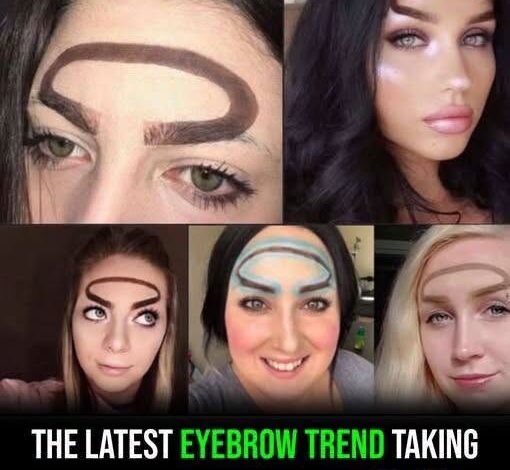
The result became known as the halo brow.
It looked exactly as strange as the name suggests.
Instead of treating the eyebrows as two separate features, beauty influencer Hannah Lyne extended them upward and inward until they formed a continuous loop across the forehead.
The shape curved above the bridge of the nose and connected the brows into one rounded frame.
It was part eyebrow experiment, part optical illusion, and part joke nobody could decide whether to take seriously.
Which is probably why the internet loved arguing about it.
Lyne was already known for approaching makeup less like a daily grooming routine and more like visual art.
Her face was not simply something to make conventionally prettier.
It was a canvas.
That distinction matters because halo brows were never designed to solve a beauty problem.
Nobody looked in the mirror one morning and thought:
My eyebrows would be much more flattering if they completed a circle around my forehead.
The point was experimentation.
And the idea reportedly began almost casually.
Lyne had been discussing another unusual online trend known as fishtail brows.
Fishtail brows alter the outer end of the eyebrow by splitting it into separate points, creating a shape somewhat reminiscent of a fish’s tail.
Like many viral makeup experiments, it was more about creating an image than establishing a practical everyday style.
During a conversation about those brows, someone suggested taking the idea even further.
Why not connect the brows?
The suggestion was absurd.
That was exactly why it was interesting.
Lyne couldn’t stop thinking about it.
So she tried it.
Using makeup rather than permanently altering her natural brows, she extended the existing shapes upward and connected them into a curved line.
The result was surreal.
From a distance, the brows looked almost like a halo had dropped from above and settled onto her forehead.
Except instead of glowing gold, it was made from eyebrow pigment.
She photographed the finished look.
Then posted it.
And the internet did what the internet does whenever somebody produces something impossible to ignore.
It stared.
Then argued.
Some people thought it was brilliant.
Others thought it was ridiculous.
A large number appeared genuinely uncertain whether Lyne was serious.
That uncertainty became part of the entertainment.
Was this a new trend?
A parody of beauty trends?
A piece of makeup art?
A joke?
The answer could comfortably be all four.
That is one of the reasons experimental makeup performs so well online.
Traditional beauty advice usually tries to create certainty.
Here’s how to make your brows look fuller.
Here’s where the arch should sit.
Here’s how to match the color.
Here’s how to make them symmetrical.
Halo brows did the opposite.
They broke the rules so dramatically that viewers were forced to reconsider whether the rules mattered at all.
And technically, the effect was more achievable than it looked.
Nobody needed to shave half their face.
The natural brows could remain largely untouched.
A makeup artist might begin by brushing and filling the existing brow hairs.
Then, using brow pomade, pencil, liner, or another suitable cosmetic product, the artist could extend the ends into the desired loop.
Concealer could help clean the surrounding edges.
Careful blending could make the artificial line appear more intentional.
Precision mattered.
A badly drawn loop would simply look messy.
A carefully constructed one could look strangely graphic, almost like an illustration.
That’s what separated the trend from random scribbling.
The idea was silly.
The execution didn’t have to be.
And that distinction is where much of the online debate became interesting.
People often assume makeup has only one legitimate purpose:
To make someone conventionally attractive.
Under that definition, halo brows were obviously a failure.
Very few people would argue that drawing a complete eyebrow circle across the forehead is the most flattering choice for an ordinary Tuesday.
But makeup has never been limited to correction or enhancement.
It can create characters.
Moods.
Illusions.
Fashion statements.
Performance.
Fantasy.
Artists working in theater, drag, runway fashion, editorial photography, film, music, and special effects regularly use makeup to produce appearances nobody would consider “natural.”
Nobody looks at theatrical stage makeup and asks whether it would work at the supermarket.
That’s not the purpose.
Halo brows belonged much closer to that world than to a tutorial called “Five-Minute Office Makeup.”
Still, practicality became one of the first criticisms.
Commenters joked about people showing up to work with circles drawn above their eyes.
Others declared that beauty culture had officially lost its mind.
Some treated Lyne’s photograph as evidence that influencers were inventing increasingly ridiculous trends simply to generate attention.
There was probably some truth in the broader observation.
Social platforms reward novelty.
If ten thousand people upload perfectly shaped conventional eyebrows, the eleventh thousandth pair is unlikely to stop anyone from scrolling.
Then someone draws a circle across their forehead.
Now people pause.
They comment.
They tag friends.
They repost the photograph with captions like:
“Would you try this?”
“What is happening?”
“Beauty trend or disaster?”
And suddenly one experimental makeup look reaches audiences far beyond the artist’s ordinary followers.
Algorithms don’t care whether viewers love something.
They care whether viewers react.
Disgust can generate engagement.
Confusion generates engagement.
Admiration generates engagement.
Arguments are especially useful.
Halo brows offered all of them.
That doesn’t mean the idea was merely cynical.
Artists have always used shock and novelty.
Long before Instagram or TikTok existed, fashion designers sent deliberately extreme looks down runways because the purpose was to provoke, inspire, or establish an idea.
Editorial makeup routinely exaggerates shapes and colors that will never become everyday trends.
The internet simply removed many of the old gatekeepers.
A young makeup artist no longer needs a magazine editor, fashion house, or advertising agency to decide whether an experiment deserves an audience.
She can create it in her bedroom.
Photograph it.
Post it.
By afternoon, people on another continent can be arguing about it.
That shift has transformed beauty culture.
It has made the field noisier.
Yes.
It has produced endless gimmicks.
Absolutely.
But it has also democratized experimentation.
People who once would have needed industry access can now build audiences entirely through their own creativity.
Halo brows were a perfect example.
The look didn’t need to become commercially successful.
It didn’t need millions of people wearing it.
Its success was measured differently.
People noticed.
Beauty publications noticed too.
Some described the design with genuine admiration, emphasizing the technical control and imagination required to make such an unconventional concept look deliberate.
Others covered it primarily because of the outrage and confusion surrounding it.
Either way, Lyne had accomplished something difficult.
She made eyebrows newsworthy.
Again.
That may sound trivial.
But fashion often operates by transforming tiny details into cultural conversation.
Hemlines move a few inches.
Suddenly people talk about modesty.
Hair gets cut differently.
Suddenly everyone discusses rebellion.
Brows become thick after years of thinness.
Suddenly old photographs look dramatically dated.
Beauty standards reveal themselves most clearly when somebody violates them.
We understand what we expect eyebrows to look like precisely because halo brows looked so wrong to many people.
Two separate shapes.
Horizontal.
Placed above each eye.
That’s the invisible rule.
Lyne broke it.
The reaction exposed the rule.
That is one reason experimental art matters even when most people dislike the result.
It shows us the boundaries we normally don’t notice.
And some of those boundaries eventually move.
Consider how many beauty trends now considered normal initially looked extreme.
Heavily filled brows were mocked after years of pencil-thin fashion.
Unusual lipstick colors once belonged mainly to alternative subcultures before becoming mainstream cosmetic options.
Graphic eyeliner became more adventurous.
Bleached brows repeatedly moved between editorial oddity and high-fashion trend.
Facial gems, exaggerated blush, unconventional contouring, and numerous other ideas traveled from niche artistry into wider culture.
Most experiments never make that transition.
Halo brows probably weren’t destined to become a permanent grooming standard.
But they didn’t have to.
Sometimes an idea exists simply to expand the range of what someone else imagines doing next.
Maybe another artist sees the loop and doesn’t copy it.
Instead, they experiment with curved brow extensions.
Or shapes around the temples.
Or graphic lines connecting eye makeup to brows.
Creative influence rarely travels in straight lines.
An outrageous idea can produce a subtle one.
That is how trends evolve.
There is also something refreshing about a beauty trend that openly admits it is strange.
Much of the modern beauty industry is built around insecurity.
Fix this.
Hide that.
Lift this.
Reduce that.
Correct asymmetry.
Erase texture.
Make your face look younger.
Narrower.
Fuller.
Smoother.
More acceptable.
Halo brows didn’t pretend to fix anything.
They added something unnecessary purely because somebody thought it would be interesting.
That makes the trend almost playful.
There was no suggestion that women needed brow circles to become attractive.
No problem was being invented so a product could solve it.
The whole thing was closer to drawing in the margins of a notebook.
Which may explain why some viewers enjoyed it even while admitting they would never wear it.
You can appreciate an outrageous dress without wanting it in your closet.
You can admire a painting without hanging it in your living room.
You can respect the skill behind makeup without wanting that makeup on your face.
The internet often struggles with that distinction.
Everything becomes:
Would you wear it?
Would you buy it?
Is it beautiful?
Is it ugly?
But art allows another response.
Interesting.
Halo brows were interesting.
They were bizarre enough to stop people.
Precise enough to look intentional.
Familiar enough that the violation was immediately obvious.
And absurd enough to make people smile.
That’s a pretty effective piece of visual communication.
Of course, there is another reason strange beauty trends keep appearing.
Once something becomes familiar, it stops generating attention.
Think about the progression.
Natural brows become normal.
Then thick brows become fashionable.
Then brushed-up brows.
Then feathered brows.
Then carved brows.
Then fishtail brows.
Eventually, someone has to connect them across the forehead if they want to produce genuine surprise.
The attention economy encourages escalation.
That’s the less romantic explanation.
But creativity and attention-seeking aren’t mutually exclusive.
Artists have always wanted audiences.
Painters wanted patrons.
Designers wanted coverage.
Musicians wanted listeners.
Today’s creators want engagement.
The technology changes.
The desire to be seen doesn’t.
The healthiest way to approach trends like halo brows is therefore probably somewhere between worship and outrage.
You don’t have to call them beautiful.
You don’t have to pretend they’re practical.
You certainly don’t have to draw one on your forehead.
But dismissing them as meaningless because they wouldn’t work during an ordinary workday misses what experimental makeup is designed to accomplish.
It asks:
What happens if we do this?
Sometimes the answer is:
It looks terrible.
Sometimes:
It looks strangely beautiful.
Sometimes:
Everyone argues for three days.
Then the internet moves on.
All three outcomes can be useful.
Halo brows eventually became one of those memorable beauty moments people reference when discussing the wildest trends created by social media.
They did not replace traditional eyebrow grooming.
Salons were not suddenly filled with clients requesting full forehead loops.
Office workers weren’t drawing circles before Monday meetings.
The world survived.
But for a brief period, a simple experiment transformed two ordinary eyebrows into a global conversation.
And perhaps that is why the look deserves more credit than its practicality would suggest.
Beauty does not always need to whisper.
It does not always need to flatter.
It does not always need to make someone look younger, smoother, thinner, or more conventionally attractive.
Sometimes beauty can be weird.
Funny.
Surreal.
Almost intentionally wrong.
It can exist simply because somebody had an idea and was curious enough to try it.
Hannah Lyne took one of the most familiar features on the human face and asked what would happen if she ignored its traditional boundary.
The result was a loop.
People laughed.
People complained.
People admired it.
People stared twice.
And that last reaction may have been the entire point.
Because in an online world where thousands of perfectly polished faces pass beneath our thumbs every day, the hardest thing for any artist to create is not beauty.
It’s interruption.
Halo brows interrupted.
They made people stop.
Look again.
And argue about whether eyebrows had any business becoming a circle.
Most people never wore them.
They didn’t need to.
The experiment had already succeeded.
It made the face feel unfamiliar for a moment.
And sometimes that is exactly what art is supposed to do.