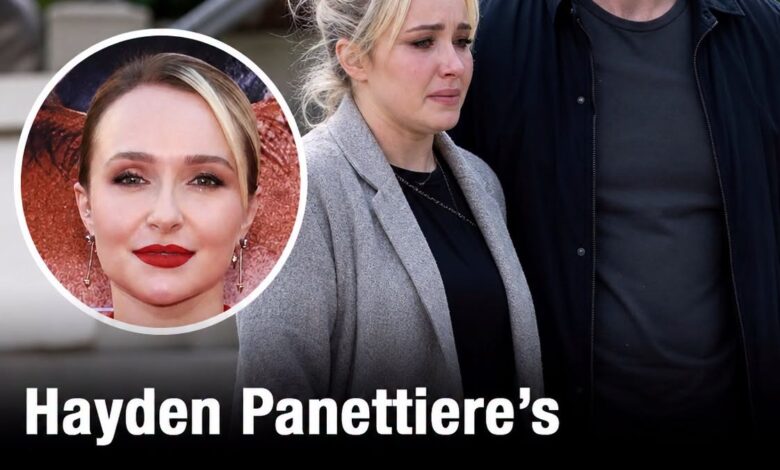
The silence after Hayden Panettiere’s death felt almost impossible to reconcile with the life people remembered.
For decades, she had existed in motion.
On television screens.
On movie sets.
At premieres.
In interviews.
In photographs documenting a career that began when she was still a child.
Audiences had watched her grow up in public, from early roles to the explosive popularity of Heroes, the emotional intensity of Nashville, and her return to the Scream franchise. Even people who knew nothing about her private life recognized the face, the voice, the unmistakable energy she carried onto a screen.
Then came the news that seemed to stop everything.
Hayden had been found unresponsive in an apartment in Greenville.
She was only 36.
Suddenly, a woman whose life had been documented for years became the center of a mystery defined largely by what had not yet been explained.
What happened during those final hours?
Why did a life that had survived so much end so abruptly?
Investigators began the careful process of reconstructing the circumstances surrounding her death. Early information indicated there were no obvious signs of violence, and authorities had not publicly described the case as a homicide.
But absence of obvious violence is not the same thing as having an answer.
And that distinction left an enormous space for grief, uncertainty, and speculation.
The involvement of the Drug Enforcement Administration added another layer of public interest, though the presence of a federal agency does not, by itself, establish what caused someone’s death. Investigations can involve multiple agencies for many reasons, and until toxicology findings, medical conclusions, and official investigative results are available, assumptions remain exactly that.
Assumptions.
For Hayden, that caution matters.
Because her life had already been subjected to enough public interpretation.
She had spent years trying to explain, in her own words, what existed behind the polished photographs.
Addiction.
Trauma.
Postpartum depression.
The pressures of becoming famous before she was old enough to understand what fame would demand from her.
And relationships that became painful in ways the public could not always see.
Among the names inevitably resurfacing after her death was Brian Hickerson.
Their history had been turbulent and intensely public.
What began as a romantic relationship eventually became associated with allegations of domestic violence, arrests, court proceedings, and painful revelations about what Hayden had endured.
At one point, Hayden publicly addressed the abuse and her decision to speak about it.
That mattered.
Speaking publicly about abuse is not a simple act, especially when the person speaking knows every sentence may become a headline.
There can be fear.
Shame.
Confusion.
Love that has not disappeared simply because harm occurred.
Concern about being believed.
Concern about being blamed.
And for a celebrity, there is the additional knowledge that strangers will dissect the most painful experiences of your life as entertainment.
Hayden spoke anyway.
That choice became an important part of how many fans understood her later years.
Not as a woman whose life could be reduced to what happened to her, but as someone trying to regain ownership of the story.
Now Hickerson’s name had returned to the conversation under very different circumstances.
Through his attorney, he was not offering a public account.
And importantly, authorities had not identified him as a suspect.
That fact deserves to remain clear.
A painful history can explain why the public has questions.
It cannot substitute for evidence about a separate event.
Past wrongdoing does not automatically establish responsibility for a later tragedy.
The distinction may feel emotionally unsatisfying, especially to people who remember the details of Hayden’s earlier relationship, but investigations cannot be built on emotional association.
They have to be built on facts.
Timelines.
Physical evidence.
Witness accounts.
Medical findings.
Toxicology.
Digital records.
Verified movements.
The ordinary, painstaking pieces that can turn uncertainty into an answer.
Until those pieces are assembled, the most responsible response is patience.
For the people who loved Hayden, however, patience offers little comfort.
Investigators can wait for laboratory results.
Grief does not operate according to laboratory schedules.
A family confronted with sudden death wants answers immediately because the mind rejects an unfinished story.
What happened?
Was she frightened?
Was anyone with her?
Could something have been done?
Did she suffer?
Was there some warning everyone missed?
Those questions can circle endlessly when death arrives without explanation.
The public asks them too, but there is an important difference.
For fans, the mystery is compelling.
For family and friends, it is permanent.
Whatever investigators eventually determine will not simply close a case.
It will become part of the final memory of someone they knew as more than Hayden Panettiere, the actress.
She was a daughter.
A sister.
A mother.
A friend.
A person whose ordinary private existence continued after cameras stopped recording.
That private person had already endured extraordinary turbulence.
Hayden had spoken openly about addiction and recovery, refusing to package the experience into an easy story of downfall followed by miraculous redemption.
Recovery rarely behaves that neatly.
It can involve progress followed by setbacks.
Confidence followed by fear.
Periods of stability interrupted by moments that remind everyone how fragile stability can be.
She also spoke about postpartum depression, giving language to an experience that many mothers still struggle to discuss without shame.
For someone whose career had depended partly on appearing confident and composed, acknowledging that kind of vulnerability required a different form of strength.
The public had watched Hayden perform toughness before.
Claire Bennet, her character on Heroes, could heal from almost anything.
That fictional immortality became one of the great ironies attached to Hayden’s image.
Audiences watched her character survive injuries that should have been impossible to survive.
Real life offered no such protection.
Offscreen, Hayden was human.
She could hurt.
She could struggle.
She could become overwhelmed.
She could need help.
Perhaps that is why news of her death struck longtime fans with such force.
They remembered the indestructible cheerleader.
They remembered Juliette Barnes on Nashville, a character whose own emotional volatility sometimes seemed to blur painfully with the struggles Hayden later described outside the show.
They remembered Kirby Reed in Scream, fighting to survive a world built around violence.
Again and again, audiences had watched Hayden portray women who endured.
Eventually, endurance became part of the public story surrounding Hayden herself.
She survived difficult years.
She talked about them.
She returned to work.
She appeared to be rebuilding.
That creates a dangerous expectation around people who have suffered publicly.
We want recovery to become permanent.
We want the person to cross some invisible finish line and never struggle again.
We want suffering to produce a clean inspirational arc.
But human beings are not stories written for our satisfaction.
Healing can remain unfinished.
A person can be strong and vulnerable simultaneously.
They can have survived yesterday without being guaranteed tomorrow.
That uncertainty is difficult to accept because it removes the comforting belief that enough courage makes someone safe.
Hayden had courage.
She spoke about experiences many people would have hidden forever.
She confronted addiction.
She addressed abuse.
She acknowledged psychological pain.
She tried to move forward.
None of that made her invincible.
It made her human.
And now the circumstances of her death threaten to overshadow everything that came before.
That is another danger of sudden celebrity deaths.
The final hours become more famous than the preceding decades.
People search for clues in old interviews.
Photographs are reexamined.
Former partners are contacted.
Every troubled period becomes potential foreshadowing.
The person gradually disappears behind the investigation.
Hayden deserves more than that.
The unanswered questions matter.
If wrongdoing occurred, it matters.
If substances were involved, the facts matter.
If her death resulted from a medical event or some other cause, that matters too.
Her family deserves the truth.
So does the official record.
But a cause of death will explain only how Hayden died.
It will not explain who Hayden was.
That story is much larger.
It begins with a little girl working in an industry notorious for asking children to behave like adults.
It continues through years of television and film, through enormous professional success and the strange psychological burden of becoming recognizable before developing an adult identity outside that recognition.
It includes motherhood.
Relationships.
Career pressures.
Mistakes.
Illness.
Recovery.
Pain.
Humor.
Friendships.
Comebacks.
And the difficult work of learning how to speak publicly about experiences once kept private.
When Hayden eventually talked about abuse, she gave other survivors something important.
Recognition.
Not because celebrity suffering is inherently more meaningful than anyone else’s.
Because visibility can break isolation.
Someone watching from a bedroom or kitchen may hear a famous woman describe something frighteningly familiar and realize:
This happens to other people too.
People who seem confident.
Successful people.
Beautiful people.
People with money.
People everyone assumes have complete control over their lives.
Abuse does not disappear because someone is famous.
Neither does addiction.
Neither does depression.
Neither does fear.
Hayden’s willingness to speak made those realities harder to hide behind Hollywood glamour.
That should remain part of her legacy regardless of what investigators eventually determine about her final hours.
So should the distinction between discussing a person’s history and exploiting it.
Brian Hickerson’s past relationship with Hayden is relevant to understanding part of her life.
His documented history with her explains why his name attracts attention now.
But without evidence connecting him to her death, history cannot be transformed into accusation.
Grief wants certainty.
Justice requires proof.
Those principles must coexist.
For now, the investigation continues.
Experts will examine evidence that the public cannot see.
Medical professionals will work toward conclusions based on science rather than rumor.
Authorities may clarify why particular agencies became involved.
Perhaps additional witnesses will be interviewed.
Perhaps records will establish a clearer timeline.
Eventually, there may be answers.
Or at least enough answers to explain the physical cause of what happened.
But even then, something will remain unresolved.
Because death does not neatly finish a complicated life.
It freezes it.
There are conversations that will never happen.
Relationships that will never have another chance to heal.
Projects that will remain unmade.
Plans that existed only as possibilities.
And there is a daughter who must live with a loss no headline can adequately describe.
That is where the story becomes most painful.
Celebrity coverage encourages us to think in public terms.
Career.
Scandal.
Investigation.
Legacy.
But death is experienced privately.
An empty chair.
A phone number nobody can call anymore.
A familiar voice that now exists only in recordings.
Clothes left somewhere.
Messages saved.
Photographs that suddenly mean something different.
For the people closest to Hayden, those details will matter more than whatever strangers argue about online.
Fans have their own smaller version of that absence.
They return to old scenes.
Interviews.
Songs from Nashville.
Moments from Heroes.
Films they hadn’t watched in years.
A performance becomes a time capsule after the performer dies.
Something once consumed casually becomes difficult to watch without remembering what came later.
That is how public mourning works.
We revisit what remains because we cannot accept how suddenly the person stopped creating more.
Yet perhaps the fairest way to remember Hayden is not to pretend her life was uncomplicated.
She herself refused that version.
She talked about the darkness.
She acknowledged the damage.
She described herself as unfinished rather than magically healed.
There is dignity in remembering her with the same complexity.
She was not simply a tragic former child star.
Not simply an addiction story.
Not simply a survivor of abuse.
Not simply a famous actress whose death became an investigation.
She was all of those things and more.
A human being whose strongest and weakest moments existed in the same life.
Someone who could struggle terribly and still create.
Someone who could be harmed and still speak.
Someone who could lose control and still try to reclaim it.
That is not contradiction.
That is humanity.
Right now, people want the mystery solved.
They want investigators to fill the silence with facts.
They want to know what happened inside that Greenville apartment and why a woman of 36 did not walk back out into the rest of her life.
Those answers matter.
But while everyone waits, there is another responsibility.
Do not let speculation become the final author of Hayden Panettiere’s story.
Do not convict people without evidence.
Do not reduce her to the worst experiences she survived.
Do not turn the unknown into entertainment simply because uncertainty is uncomfortable.
Let investigators investigate.
Let evidence speak when it is ready.
And remember the woman who spent years trying to do exactly that herself:
Speak.
Hayden’s life had been narrated by other people almost from the beginning.
Directors.
Producers.
Reporters.
Photographers.
Fans.
Critics.
Partners.
Eventually, she began insisting on her own voice.
She talked about addiction.
About motherhood.
About trauma.
About abuse.
About recovery.
She made herself more complicated than the image people had been given.
That courage should not disappear beneath the circumstances of her death.
Perhaps the hardest thing now is to tolerate the unanswered questions without filling them ourselves.
There may be a temptation to turn every silence into suspicion and every troubled relationship into evidence.
But truth deserves more discipline than that.
For now, there is grief.
There is an investigation.
There is a history that cannot be ignored but must not be misused.
And there is the terrible finality of a young life ending while so much still seemed unfinished.
The woman audiences once watched play someone virtually impossible to kill turned out, like all of us, to be painfully mortal.
But mortality does not erase what came before it.
Hayden fought to survive chapters of her life that could easily have silenced her.
She spoke when silence would have been easier.
She returned when disappearing might have felt safer.
And whatever the investigation ultimately reveals, that remains hers.
Not the rumors.
Not the speculation.
Not the men associated with her story.
Hers.
Until the facts arrive, perhaps that is where remembrance should remain:
With the woman who kept trying to reclaim her own voice.
And with the people who loved her, now facing the one silence she can no longer break.