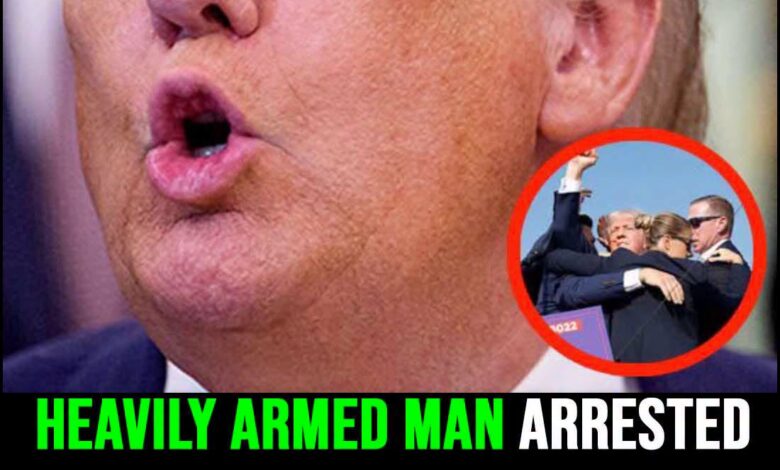
What began as a routine security operation at Donald Trump’s golf course in Rancho Palos Verdes quickly evolved into a far more serious criminal investigation. According to authorities, deputies detained 38-year-old Jeanine John Taele after discovering he was allegedly carrying a loaded magazine containing hollow-point ammunition. A subsequent search reportedly uncovered a handgun and additional ammunition inside his vehicle, prompting investigators to broaden their inquiry.
The investigation intensified the following day when law enforcement officers executed a search at Taele’s residence. Prosecutors allege they recovered an illegally modified AR-style rifle, body armor, multiple high-capacity magazines, and handwritten notebooks containing statements investigators considered troubling. Officials have also linked Taele to an unrelated robbery investigation, adding another layer to an already complex case.
Taele has since been charged with multiple weapons-related offenses, along with charges connected to the separate robbery investigation. He has pleaded not guilty, and the allegations against him remain subject to the judicial process. As the case moves through the courts, prosecutors will be required to present evidence supporting each charge, while the defense will have the opportunity to challenge the government’s claims.
Although investigators have not publicly concluded that an attack was imminent, the circumstances have drawn significant attention because they unfolded near a former president receiving Secret Service protection. Security professionals routinely investigate incidents involving firearms found near protected individuals with exceptional scrutiny, regardless of whether a direct threat can ultimately be established.
The arrest also comes against the backdrop of heightened concern over the safety of public officials and political figures. Recent years have seen multiple high-profile security incidents involving elected leaders and candidates from across the political spectrum, prompting renewed discussions about political extremism, firearms enforcement, and protective security measures.
For law enforcement, cases like this highlight the importance of early intervention. Careful investigation, coordinated intelligence sharing, and thorough searches can uncover evidence that might otherwise remain hidden, allowing authorities to assess potential risks before they escalate. At the same time, investigators must distinguish verified evidence from speculation, ensuring that conclusions are based on facts established through the legal process.
As the proceedings continue, many questions remain unanswered. Prosecutors and investigators will continue examining the evidence, while the courts determine the outcome according to the law. Whatever the final verdict, the case serves as another reminder of the increasingly complex security environment surrounding prominent political figures—and of the ongoing challenge of balancing public safety, constitutional rights, and the rule of law in a deeply polarized era.