There was a time when her face seemed to represent everything Hollywood wanted to celebrate.
She had the kind of beauty that did not need explanation. Cameras loved her instantly. Red carpets seemed brighter when she stepped onto them. Her eyes, her smile, and her effortless elegance made her one of those rare screen presences people remembered long after a film ended. Directors wanted her in their projects, photographers knew exactly how to capture her, and fans admired her not only for her talent but for the natural charm that made her feel unforgettable.
To many, she looked like someone untouched by time.
But time touches everyone.
That simple truth is one of the hardest realities for people whose careers are built in front of cameras. In Hollywood, aging is rarely treated as a natural part of life. It is often treated like a problem to solve, a flaw to conceal, or a threat to a career. For actresses especially, the pressure can be relentless. Every wrinkle is analyzed. Every public appearance is compared to old photographs. Every change becomes a headline.
For someone once praised as an icon of beauty, that pressure can become unbearable.
So, like many public figures before her, she turned to cosmetic surgery in the hope of preserving the image people had loved for so long. At first, the goal may have been simple: soften the signs of aging, refresh tired features, and hold onto the face the world still expected to see.
In moderation, cosmetic procedures can help people feel more confident. There is nothing wrong with wanting to look rested, polished, or comfortable in one’s own skin. Subtle treatments, when done carefully and thoughtfully, can support someone’s self-esteem without changing who they are.
The problem begins when enhancement becomes pursuit.
And pursuit becomes dependence.
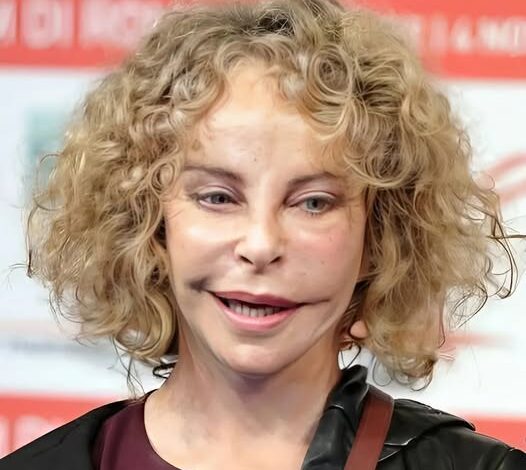
Over time, small changes can lead to more dramatic ones. A lift here, an injection there, a correction to fix the last correction. What begins as an attempt to preserve beauty can slowly erase individuality. The very features that once made someone distinctive can disappear beneath tight skin, exaggerated lips, frozen expressions, and sculpted contours that no longer resemble the person people remember.
That is what makes these transformations so sad.
The goal is often to remain recognizable, but the result can be the opposite.
Fans who once admired a beloved actress for her warmth and expressive face may suddenly struggle to see the person they knew. The softness disappears. The natural lines that once told a story are smoothed away. The ability to show emotion becomes limited. A face that once carried character begins to look artificial, not because aging happened, but because aging was fought too aggressively.
Hollywood has seen this story unfold many times.
Some celebrities become cautionary examples, their appearances discussed more than their achievements. Names like Donatella Versace and Mickey Rourke are often mentioned in conversations about cosmetic procedures taken too far. Once admired for their distinct looks and charisma, they later became symbols of how dangerous the chase for perfection can become when restraint is lost.
But they are not alone.
Many stars from past decades began their careers with striking, natural beauty. Their imperfections made them interesting. Their expressions made them powerful. Their faces could tell stories because they were alive with movement, emotion, and experience. Yet after years under public scrutiny, some altered themselves so dramatically that their original charm became difficult to find.
This is not simply a story about vanity.
It is also a story about fear.
Fear of becoming invisible.
Fear of losing work.
Fear of being compared to younger actresses.
Fear of reading cruel comments online.
Fear of watching an industry that once adored you slowly turn away.
For celebrities, aging happens in public. Most people grow older privately, surrounded by family, friends, and familiar mirrors. Stars age beneath bright lights, high-resolution cameras, and the judgment of millions of strangers. Their faces are not just faces; they become part of a brand, a career, and a public memory.
That kind of pressure can distort anyone’s sense of self.
It is easy for audiences to criticize from a distance, but the deeper issue is a culture that demands impossible things. We praise natural beauty, then punish people when they age naturally. We claim to value authenticity, then mock wrinkles, weight changes, and signs of time. We celebrate youth so loudly that growing older can feel like failure.
In that environment, cosmetic surgery can seem less like a choice and more like survival.
Still, the most painful irony remains: the attempt to hold onto beauty often destroys what made it beautiful in the first place.
True beauty is rarely about flawlessness. It is about presence. Expression. Confidence. The way a face moves when someone laughs. The lines that form from years of emotion. The softness that comes with experience. The quiet dignity of someone who has lived, changed, struggled, and continued forward.
A face untouched by life may look smooth, but it does not always look alive.
That is why more people today are beginning to question old standards of beauty. Audiences are increasingly drawn to stars who age openly, gracefully, and honestly. There is growing admiration for women and men who allow time to show, who choose subtlety over extremes, and who understand that maturity can be just as captivating as youth.
Aging does not erase beauty.
It changes it.
And sometimes, it deepens it.
The conversation around plastic surgery should not be about shaming people who make personal choices about their appearance. Everyone deserves the freedom to feel comfortable in their body. But it is also important to recognize when society pressures people into chasing an impossible ideal.
There is a difference between self-care and self-erasure.
There is a difference between enhancement and transformation so extreme that identity becomes blurred.
The lesson reaches far beyond Hollywood. Ordinary people feel these pressures too. Social media filters, beauty trends, edited photos, and constant comparison have made many people feel as though natural aging is something to hide. But no procedure can replace genuine confidence. No injection can create peace. No surgery can give someone lasting self-worth if they believe their value depends entirely on looking young.
The most powerful kind of beauty is rooted in self-acceptance.
It comes from knowing that change is not failure. Lines, softness, age, and imperfection are not enemies. They are evidence of a life being lived.
The actress who once captured hearts reminds us of something important: beauty is most powerful when it remains connected to authenticity. Features may change, trends may shift, and time may leave its mark, but the face that tells the truth will always carry a deeper kind of grace.
In the end, the goal should never be to look untouched by life.
It should be to look like someone who has lived fully, aged honestly, and learned to see worth beyond the mirror.