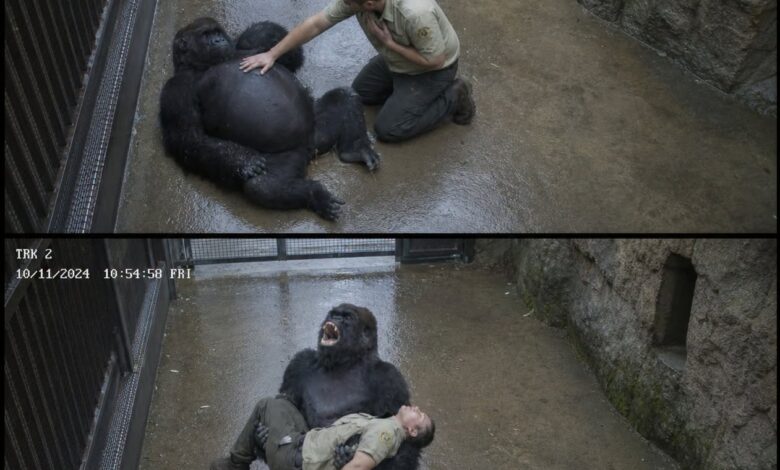
For years, Julius believed he was the one doing the caring.
He brought the food.
He checked the enclosure.
He spoke in the same calm voice, moved with the same familiar patience and returned day after day until his presence became part of the gorilla’s understanding of the world.
There were no grand gestures.
That was precisely why the bond mattered.
Trust had been built from repetition.
The sound of Julius approaching.
The familiar footsteps.
The arrival of food.
A few quiet words.
A hand resting gently against a powerful shoulder.
A slow belly rub through the bars.
Then another day.
And another.
Animals do not need human language to recognize patterns. Consistency becomes its own vocabulary. Someone who repeatedly arrives without causing fear becomes familiar. Someone associated with food, calmness and gentle interaction becomes significant.
Julius had spent years creating that pattern.
Then, one day, the pattern broke.
He collapsed.
There was no warning the gorilla could understand.
One moment, Julius was the familiar human who moved, spoke and responded.
The next, he was frighteningly still.
For the gorilla, there was no concept of a heart attack.
No understanding of blocked arteries, oxygen deprivation or emergency medicine.
No knowledge that somewhere beyond the enclosure were people capable of calling an ambulance.
There was only the sudden disappearance of something expected.
Julius was there.
But Julius was not responding.
The gorilla moved toward him.
At first, the response might have looked almost like curiosity.
A nudge.
Then another.
When Julius did not react, the animal became more insistent.
He repositioned him.
Touched him.
Called out.
The behavior was not the cinematic rescue people like to imagine when telling animal stories. The gorilla did not suddenly understand human anatomy or perform some miraculous medical procedure.
What happened was simpler.
And perhaps more moving because of it.
He noticed.
He knew something was wrong.
And he refused to ignore it.
The calls eventually drew attention.
People came.
The quiet enclosure became an emergency scene.
Julius needed medical help, and quickly.
Doctors would later explain that the timing mattered enormously. Minutes can separate survival from tragedy during a cardiac emergency, and the rapid discovery of Julius after his collapse gave people the opportunity to intervene.
For the sanctuary staff, however, the medical outcome was only part of what stayed with them.
They had watched Julius care for the gorilla for years.
They knew the routines.
They had seen the patience.
From the human perspective, the relationship could easily be described in one direction.
Caretaker and animal.
Provider and dependent.
Human giving.
Gorilla receiving.
Then Julius fell.
And suddenly that description no longer seemed complete.
The animal who had spent years receiving Julius’s attention became the one insisting that Julius receive attention.
That does not mean the gorilla understood the situation exactly as a person would.
It is tempting to romanticize animal behavior, especially when the outcome is extraordinary. We naturally translate what animals do into familiar human emotions and motives.
But we do not need to turn the gorilla into a furry emergency physician to recognize what was remarkable.
He detected a dramatic change in someone familiar.
He responded to it.
And he persisted.
That persistence mattered.
Imagine the scene from the animal’s perspective.
Julius had always moved.
Julius had always answered.
Julius had always participated in the ritual.
Now there was silence where response should have been.
Something in that violation of routine demanded action.
Nudge.
Nothing.
Move him.
Nothing.
Call.
Again.
Do something.
That is where years of seemingly insignificant interactions suddenly become important.
Relationships are often built in moments too ordinary to photograph.
One meal does not create trust.
One gentle touch does not establish security.
One calm afternoon does not create familiarity.
But hundreds of them can.
Thousands can.
Day after day, Julius had taught the gorilla something without ever sitting down to teach it:
I come back.
I am safe.
I pay attention to you.
The day Julius collapsed, the gorilla answered in the only language available to him.
I am paying attention to you, too.
Perhaps that was the revelation that affected the staff most deeply.
Care had not disappeared into the enclosure without leaving anything behind.
It had been registered.
Remembered.
Returned.
Not in a sentimental, perfectly human way.
In an animal’s way.
The story also challenges one of our easiest assumptions about caregiving.
We tend to imagine the caregiver as the strong one.
The keeper feeds.
The nurse tends.
The parent protects.
The sanctuary worker observes.
The person with responsibility gives, while the one being cared for receives.
Real relationships rarely remain that simple.
Even where dependence is unequal, attention can move both directions.
The person doing the feeding can also become familiar.
The voice offering reassurance can become comforting.
The hand providing gentle contact can become something whose absence is noticed.
Julius may have thought he was creating a routine for the gorilla.
He was also becoming part of that routine himself.
That distinction became visible only when he suddenly stopped participating in it.
Years later, people could tell the story as though one dramatic day defined their bond.
It didn’t.
That day revealed the bond.
The important part had happened beforehand.
In the boring days.
The ordinary meals.
The repeated footsteps.
The familiar voice.
The quiet patience.
The countless interactions nobody considered extraordinary at the time.
That is how trust usually works.
Its construction is almost invisible.
Its existence becomes obvious when something threatens it.
Julius’s collapse turned years of accumulated familiarity into one urgent moment.
The gorilla could have moved away.
He could have ignored the still figure.
Instead, he remained engaged.
Nudging.
Repositioning.
Calling.
Insisting, in effect, that the broken pattern be noticed.
Then humans arrived and did what the gorilla could not.
They recognized a medical emergency.
They summoned professional help.
Doctors treated Julius.
And the difference between discovering him quickly and discovering him later may have been the difference between a frightening story and a devastating one.
But perhaps the most enduring image is not the ambulance.
It is what happened before anyone knew an ambulance was needed.
A powerful animal beside a motionless human.
Confused by something he could not possibly understand.
Knowing only that this person was supposed to move.
Supposed to respond.
Supposed to be Julius.
And wasn’t.
So he kept trying.
There is a temptation to describe that as repayment, as though kindness operates like an account and the gorilla finally returned what Julius had deposited over the years.
But relationships are rarely so transactional.
Julius had not fed him in anticipation of being rescued someday.
He had not offered patience as an investment.
He cared because caring was the work in front of him.
The remarkable part is discovering that attention had been traveling both ways all along.
Julius noticed the gorilla every day.
Then came the day when Julius desperately needed someone to notice him.
The gorilla did.
He did not know the words heart attack.
He did not understand ambulances.
He could not know that minutes mattered.
He understood something far simpler:
His person had gone still.
And after years of Julius refusing to overlook him, the gorilla refused to overlook Julius.
Sometimes that is what love—or whatever word we choose for profound animal attachment—looks like.
Not heroics.
Not language.
Not understanding everything that is wrong.
Just noticing the silence where someone familiar should be.
And refusing to let that silence remain unnoticed.