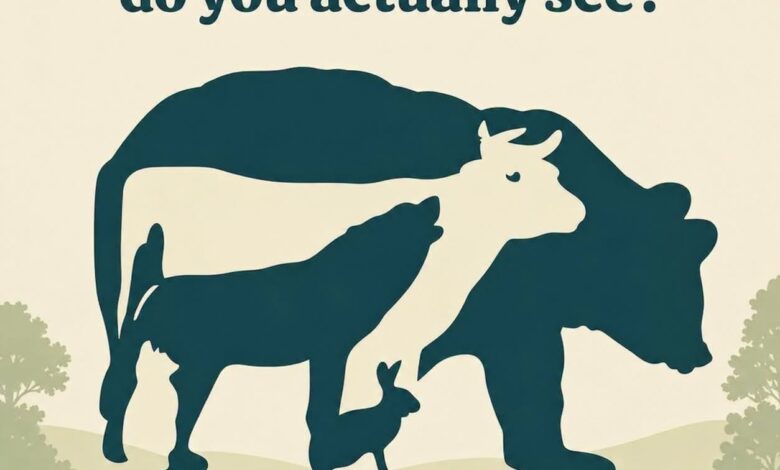
The most unsettling thing about this optical illusion isn’t how many animals are hidden inside it.
It’s how certain you can be that you’ve already found them all.
At first glance, the image seems easy enough. Your eyes immediately lock onto the largest and most recognizable figures. Perhaps you notice the cow first. Then the bear becomes obvious. Within seconds, your brain announces that it understands the picture.
And that’s exactly when the illusion wins.
Because while you’re confidently looking at the animals that demand your attention, smaller shapes may be sitting directly in front of you unnoticed.
A mouse.
A cat.
Perhaps another creature formed by a curve you assumed belonged to something else.
The fascinating part is that these animals don’t suddenly appear. They were visible from the beginning.
Your brain simply decided they weren’t important.
That’s one of the reasons optical illusions like this can be so frustrating. We like to imagine that seeing is a straightforward process: our eyes collect everything in front of us, and our brain faithfully reports what is there.
Reality is much more complicated.
The visual world contains an enormous amount of information. Your brain cannot give equal attention to every line, shadow, color, edge, and empty space at the same time.
So it takes shortcuts.
It searches for recognizable patterns.
Once it identifies something familiar, it begins organizing everything else around that interpretation.
See the outline of a cow, and suddenly nearby curves become parts of the cow.
Recognize a bear, and shapes around it become background.
Your brain isn’t necessarily asking, “What else could this line represent?”
It’s saying, “Solved.”
That’s incredibly useful in everyday life.
Imagine having to consciously analyze every object every time you entered a room. You’d spend minutes determining whether a chair was actually a chair.
Instead, your brain recognizes familiar objects almost instantly and allows you to move on.
But the same efficiency that helps you navigate the world can make you surprisingly easy to fool.
This animal puzzle takes advantage of that tendency.
The largest creatures become visual anchors. Once you’ve identified them, your attention keeps returning to those dominant forms.
Smaller animals can then hide inside outlines, between larger figures, or even in spaces you initially dismiss as empty.
That’s why simply staring harder often doesn’t work.
You need to change how you’re looking.
Start at one corner of the image and move slowly across it.
Ignore the obvious animals for a moment.
Follow individual lines rather than complete figures.
Where does one curve begin?
Where does it end?
Could what appears to be part of one animal actually form the back, face, or tail of another?
Then examine the empty spaces.
Those areas can be particularly deceptive because we tend to treat background as meaningless once we’ve identified the foreground.
But in carefully constructed illusions, negative space may be doing just as much work as the visible shapes.
Turn your attention to small details too.
An innocent-looking bump might become an ear.
Two tiny shapes might suddenly resemble eyes.
A curve you’ve already interpreted as one animal’s body may simultaneously create the outline of another creature.
And then comes the strange moment.
You see it.
An animal that was completely invisible to you seconds earlier suddenly becomes impossible not to see.
You may even wonder how you missed something so obvious.
Nothing in the image changed.
No line moved.
No new shape appeared.
The only thing that changed was your interpretation.
That’s what makes these puzzles more interesting than a simple counting challenge.
Sure, there’s satisfaction in saying, “I found seven,” while someone else found only five.
But the deeper trick isn’t really about numbers.
It’s about attention.
The puzzle exposes how quickly we stop searching once we believe we understand something.
That tendency doesn’t disappear when we stop looking at optical illusions.
It happens constantly.
We skim a familiar room and fail to notice that something has moved.
We search for an object that’s sitting directly in front of us because we’re expecting it to look or appear somewhere else.
We read a sentence and overlook an obvious error because our brain automatically fills in what it expects to see.
Expectation influences perception.
Once the brain creates a convincing interpretation, contradictory details can become surprisingly easy to ignore.
That doesn’t mean your eyes are failing.
It means your brain is doing what it evolved to do: reduce overwhelming information into something manageable.
Optical illusions simply turn that efficiency against us.
So before deciding how many animals are hidden in the picture, try one more scan.
Forget the cow.
Forget the bear.
Look between them.
Look underneath them.
Look at the shapes you dismissed as meaningless.
Search for the mouse.
Search for the cat.
Then question every line that still seems to belong to only one thing.
You might discover another creature almost immediately.
Or you might find nothing—until someone points at a shape you’ve stared at repeatedly and suddenly your brain reorganizes the entire image.
That’s the moment the puzzle becomes memorable.
Not because an animal was hidden particularly well.
Because it wasn’t really hidden at all.
It was visible the entire time.
You simply hadn’t given your brain a reason to recognize it.
And perhaps that’s the quiet lesson behind illusions like this.
We often assume that paying attention means looking directly at something.
Sometimes it doesn’t.
Sometimes real attention means resisting the first explanation, slowing down, and examining what your mind has already decided isn’t worth noticing.
The obvious things will always demand your eyes first.
The interesting question is what remains after you think you’ve seen everything.
So take another look before giving your final answer.
Trace the edges.
Study the empty spaces.
Question the familiar shapes.
Because the creature you’re still searching for may not be concealed behind anything.
It may be sitting directly in front of you, waiting for you to finally notice.